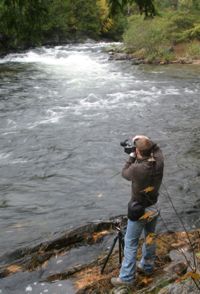
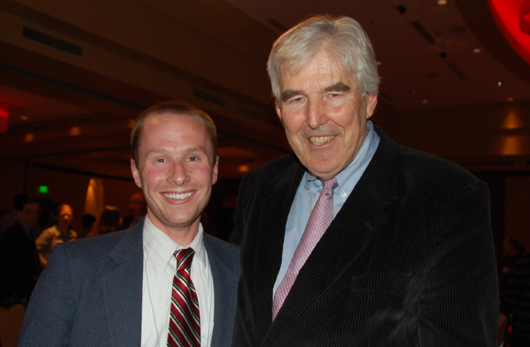
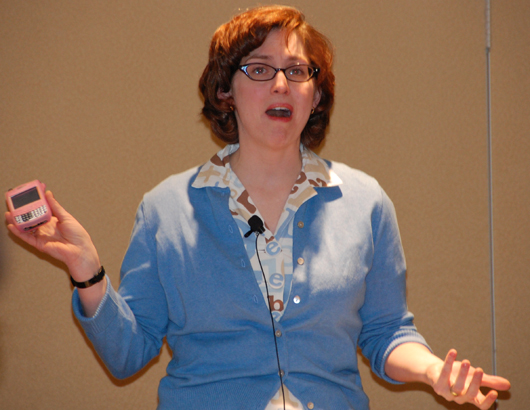
More journalism educators should blog. Professionals, professors and students could learn a lot from blogs by j-school insiders. Two of the foremost blogging professors are Doug Fisher of the University of South Carolina and Andy Bechtel, left, of the University of North Carolina in Chapel Hill.
I'm especially eager to see what Bechtel writes about his upcoming summer as an intern at the Los Angeles Times. That's right: a 40-year-old intern. (It's nice to have connections.) Go here for more.
Yesterday, Bechtel became the second of the aforementioned j-profs to mention The Offlede's work at the American Copy Editors Society conference in Denver. For the sake of gratitude and cross-promotion, here's a link to that post, which links to my Smokin' ACES home page. He gave me "The Last Word from Denver."
Thanks, professor.
Tuesday, May 6, 2008
Academic blogging should be an epidemic


Sunday, May 4, 2008
Video: Smokin' ACES: An overview of my time in Denver
I shot this video using my Canon point-and-shoot digital camera, so again, the quality of sound and picture just isn't there. At least I finally mastered video exporting in Final Cut. My videos can only get better after this.
I used Viddler for this one because it allows larger files than YouTube. But if you want to see the YouTube version, go here.
Oh, and if I knew how to change that stupid look on the preview frame, I would.
Tuesday, April 29, 2008
So you think you know everything about copy editing?
in review
Smokin' ACES
Denver national conference
a blog series by Andrew C. Knapp
 Copy editing honcho rails against 'wacko' ideas and the people who think them out loud
 Newspapers must get dumb to make us smart
Our eyes float toward the visual. Alternative story forms aid comprehension.
 Know-it-all copy editors ask, 'What's RSS?'
Copy editors are supposed to know a lot. We are the masters of all. But many at a session I attended were clueless as to how programs such as iGoogle gather headlines through RSS.
 Life after journalism would be the death of me
Being a low-level celebrity and meeting high-level celebrities such as Dan Rather are cool parts about being a journalist. These moments make journalism a difficult career to abandon. But there are ways in which copy editors should diversify their skills and knowledge.
 Copy editors are stuck in middle of new media
It's difficult to say what role copy editors will play in this new-mingled-media landscape. Will we be editing more? Will we be sitting on the sidelines? Or will we be stuck somewhere in the middle?
 Ex-Freep editor is fond of the weird and short
Alex Cruden, longtime editor at another Gannett publication, the Detroit Free Press, reflected on his 40 years in daily journalism. He talked about how it's important to accentuate what makes news, news, and to use short sentences. He provided a step-by-step guide to copy editing.
 Words will be words, unless your dictionary says otherwise (but it probably doesn't)
Dictionaries offer some fuel for debate and are often the main weapons of copy editors when attempting to shoot holes in a reporter's deranged word usage. But copy editors should remember: Just because a word is in the dictionary, we don't necessarily have the right to use it.

This post is pretty straightforward. Copy editors often are charged with trimming large stories into smaller ones, sometimes considerably smaller ones. Here are a few tips.
 Florida Today, small papers stand among giants of online editing
Surprisingly, many smaller newspapers do just as good at editing online stories as the larger papers. I talked about online editing at FLORIDA TODAY.
 Premier editing professor Ed Trayes gets it
Temple University professor Ed Trayes has spent decades training young journalists. He knows that it is the flexibility of copy editors in adapting to new media that will determine our future. His keynote address offers several points for us to ponder about the changes in the industry.
 Rocky Mountain News-Denver Post tour
On the final day of the conference, a few nice guys from the Rocky Mountain News and The Denver Post took a large group of editors on a tour of their not-so-humble abodes. Our two guides each tried to convince us that their half of the building was better than the other.
The following are some of my personal experiences at ACES. These posts are directed at anyone who cares.
 Offlede visits real city, can't escape tropical 'plants'
Living in Florida makes me miss real cities with culture. Denver was nice, but I couldn't escape tropical trees.
 I'm from Florida; what's all this white stuff?
It snowed in Denver. Co-worker Beth, who has been stuck in Florida her whole life, has never experienced snow to such a large scale: 1 inch.
 What food is Denver known for? Mac 'n' chicken, apparently
I was looking for something different on the menu, and I found the mac 'n' chicken, pasta shells smothered in a few types of cheese and mixed with chunks of white and dark chicken meat. It was weird, but at least the carrot cake was good.
 Not cool: Hot shower burns at Marriott in Denver
The stream of hot water it spits at me each morning at the Marriott Denver City Center is quite enjoyable, until things go south. About twice during each shower, I have been burned by a burst of extremely hot water.
 Copy editing = great; copy editing with a view = even better
I just wanted to pass on a few photos of the view from atop the building.
 Denver food disappoints; Burger King has its number
I didn't see any Rocky Mountain oysters (bull testicles) on the Rialto menu, but I still wanted beef for my lunch. It would have been a shame to leave Denver without having beef. So I went with the "Rialto Burger." It was burned and dry.
 So long to Denver's mediocre food, time difference, cold air
My blood obviously has thinned during my seven months in Florida. Denver's cold, dry air didn't go over so well.
Sunday, April 27, 2008
Smokin' ACES: Premier editing professor Ed Trayes gets it
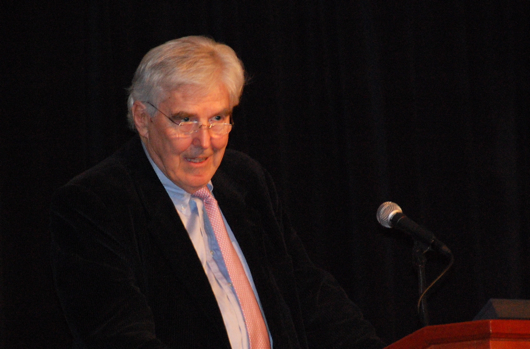
If it weren't for a single person, I wouldn't be where I am today. I might be reporting at some tiny community newspaper in North Dakota.
But because of Temple University professor Ed Trayes, I'm a copy editor. And I'm proud of it.
I had the privilege of being taught by Trayes for two weeks as part of my training for The Dow Jones Newspaper Fund editing program. As a fund co-founder, he has led more than 50 such residencies.
After that boot camp last spring, I spent the summer at Newsday as probably its last Dow Jones intern.
It's because of Trayes that I value my role as a copy editor more than I would as a reporter. Copy editors are the quality controllers. We know a lot so that nothing will slip by us, whether it's about Brad Pitt or George Bush.
It was appropriate that Trayes was the keynote speaker for my first American Copy Editors Society national convention. And for a guy who has spent decades training young journalists, he knows that it is our flexibility in adapting to new media that will determine our future.
"No journalist's job has changed more than the copy editor's," he said. "And no group has handled change better, been more nimble, ever going forward, ever adapting, succeeding."
Trayes said that some publications have shot themselves in the foot by trying to attract all audiences through the "slicing and dicing" of content. A focus on a broader readership results in a poorer diet of news.
"So often the competition is we - ourselves," he said.
Today's world is one of shorter attention spans. Instead of actively seeking it, readers want the news to come to them. Commuters at metropolitan train stations will check a box of free newspapers, find it empty, then walk away disappointed - all as a box of 50-cent papers sits full, forlorn, almost untouched.
Trayes said publishers should give away newspapers. Maybe then, we could make those commuters happy.
But the greatest challenge to newspapers, to journalism, is not price; it is time. Technology has trimmed the news cycle from 24 hours to 24 minutes, "probably less," he said. But copy editors will not, must not, get lost in this frenzy.
"Technology ... will not kill us," Trayes said. "As long as there are words to be written, there will be copy editors with whatever at the time is the technological equivalent of a sharp pencil. ... With this in mind, technology and the lifestyles of today - how people choose to get news and information, how they choose to spend their time - will change us."
Technology certainly has changed me.
In the past several months, I have gone from a copy editor of words to a copy editor of media. The new tools that make the news richer - tools such as video, photos, blogs and the general wide world of the Web - must be viewed with the unique and critical eye of a copy editor. We know the genuine from the contrived, the worthy from the weak. When I trained in video editing, I said it is a job that is natural for a copy editor because video is also about details.
After Newsday, I took a job at a company with forethought, with a vision for the future's journalism that is dominated by new media. Copy editors' jobs have changed from the strict editing of words to pagination and design. Now, we must adapt to the online world. And we can't sit back. We must speak up to ensure quality.
"It is up to each of you to meet the challenges as they come while taking an active role in determining what copy editors can and must do in the years ahead," Trayes said.
Some people have criticized my views that traditional copy editors have fallen behind because they have not met the challenges of today's technology. They do not understand how to use it. They do not even understand its uses.
"For at least some of you, if not most of you, the next great battle is online editing," Trayes said. "Editing for Web sites and other venues must have the same standards as print. There is no doubt about copy editing being under attack in this area."
Trayes arrived the morning of his keynote address at the convention's host, the Marriott in Denver. He attended the panel discussion about online editing at which I spoke. I thought his presence would make me nervous, but it put me at ease: I knew he would support, if not agree with, what I said.
In my closing words, I said, "Because of the scrutiny that our Web sites are subjected to, it’s absolute that the next generation of online news producers should be us – traditional, well-grounded, smart and unreasonably critical copy editors. Our reputations are at stake."
In his closing words, Trayes said, "Readers, online and otherwise, count on, depend on, what copy editors pass along as true, accurate and fair."
We may be ignored, but we are not insignificant. We are not powerless.
We are copy editors. We balance the scales of journalism justice. That will never change.
Friday, April 25, 2008
Smokin' ACES: Florida Today, small papers stand among giants of online editing
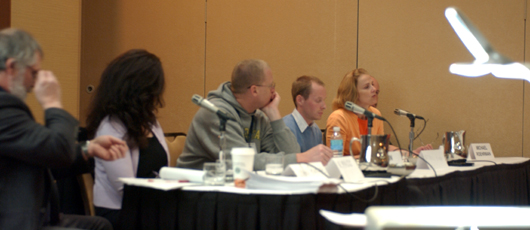
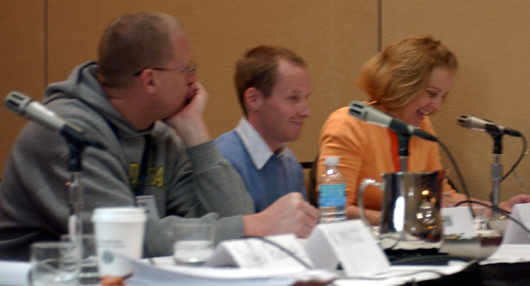
Several weeks ago, after being in my first full-time job for six months, I was preparing for the American Copy Editors Society national conference. It would be my first.
So when University of Oregon professor John Russial asked me to participate in a panel about online editing, I was hesitant to accept. I told him that I was inexperienced and relatively immature, but he still thought I would be "a good addition." So I accepted. And I'm glad.
I presented my opening statement alongside Amy Hubbard, the copy desk chief for Travel, Real Estate and Books at the Los Angeles Times, and John Boogert, Internet news editor at the Rocky Mountain News. Even Hubbard was nervous when she gave her speech, so that put me at ease.
Russial first presented his study about the editing of online products at newspapers. He surveyed 210 publications and divided them into three size categories. I don't have many details, but these are a few things I jotted down.
Twenty percent of the largest newspapers said they don't edit online stories.
Of all papers that do edit online, there's a 2-1 ratio of editors who have editing experience to those who don't. But copy editors would say "editing" experience doesn't mean "copy editing" experience.
Of the newspapers that don't edit online stories, 59 percent said they don't because it delays posting, and 42 percent said they don't have enough employees.
But the most striking result in Russial's study is that smaller newspapers are, for the most part, doing just as well as the larger ones when it comes to online editing.
For example, Michael Roehrman of The Wichita Eagle, which is about the size of FLORIDA TODAY, said that all stories are given to the day or night copy desk to be edited, then sent to the Web site. The Eagle was surveyed in Russial's study. FLORIDA TODAY was, too, and that's why Russial asked me to join the panel.
Represent!
At FLORIDA TODAY, online producers are responsible for editing and for the technical maintenance of the site's function and aesthetics.
My opening statement about how editing is done in Brevard County was well-received. People came up to me several times for the rest of the conference to talk about FLORIDA TODAY. I was a proud ambassador.
To look at my speech, click on either the Word version or the PDF version.
Editing blogs
In Russial's sample, one of three newspapers did not edit blogs. Of the sites that didn't edit blogs, 70 percent said blogs were solely the writer's responsibility.
Hubbard said the Times assigns blogs to copy editors to edit whenever they have time. It's not a regular part of their duties. This seems like a good way to handle blog editing.
Some people argue against blog editors because they risk taking away the writer's voice. But what about accuracy? What about embarrassing errors? Andy Bechtel of the University of North Carolina talks more about blog editing here.
Copy editors don't edit FLORIDA TODAY blogs. Instead, an assigning editor oversees them, so there is some quality control.
It isn't always practical to have a copy editor for a blog, such as in the case of FLORIDA TODAY's space team. Some blogs are 24-hour features that are updated from home or from the field. For example, our NASA reporters blog from Mission Control in Houston at 3 a.m. when no one is on duty in Florida.
The only thing that I ask, however, is that bloggers learn to write headlines.
Session information
- Title: "Online Copy Editing: What’s Being Done, What Could Be Done"
- Time: 10:45 a.m. to 12:15 p.m. Friday
- Panelists: John Russial, University of Oregon; John Boogert, Rocky Mountain News; Amy Hubbard, Los Angeles Times; Michael Roehrman, Wichita Eagle; Valerie Mass, Denver Post; Andrew Knapp, Florida Today
- Description: "A look at who’s editing what online, and how little copy actually is being edited before being posted. The problem runs from small to large publications. But some newsrooms have created online copy editing positions, and others are experimenting with schedules, desk structures and other things as a way to get online copy read."
Smokin' ACES: Trimming fat is a big part of copy desk's job
This post is pretty straightforward. Copy editors often are charged with trimming large stories into smaller ones, sometimes considerably smaller ones. It's increasingly becoming a reality as our readers' attention spans shorten. I'll just present my notes in bullet points for any editor who wants to pick up a few tips.
Types of trims
- An inch or two
- Slash and burn: cutting a story by several inches
- From a story to a brief
- From a story to a sentence or two (FLORIDA TODAY has a page of summaries for the big articles of the day. It's called the 5-Minute Read. Each item is a sentence or two.)
Obstacles
- Deadlines, especially online
- Shrinking news hole and staff size
- Pressure for shorter stories and fewer jumps
- Alternate story forms (design-heavy stories)
Options
- Make use of cutlines: Don't repeat the same information from the story.
- Let graphics and text boxes share the load: Again, this text shouldn't regurgitate the story.
- Use the Web.
- Cut carefully with the reader in mind.
An inch or two
- When a story is close to fitting, edit it thoroughly before trimming: Find words and phrases to cut.
- Trim excess details and quotes.
- Summarize and condense.
- Pull back lines if your publishing system allows it: Watch out for widows.
Slash and burn
- When you have a lot to trim, remember the inverted pyramid.
- Read, but don't edit, the entire story.
- Pick an ending point. Deal no more with what's below that point. (Turn a major trim into a minor trim.)
- Look for optional trims in wire copy.
- Keep the "new news."
- Keep the explainer (why you should care about the story).
- Keep the "talker" (something you would tell a co-worker tomorrow at the water cooler).
- Keep the methods and disclaimers on scientific and poll stories.
- Keep the he said/she said (both sides of the story).
- Cut the excess, and summarize the essential.
Caution
- Make sure you keep the first reference of names.
- Don't end on a transition.
- Make sure the story ends somehow, not necessarily with a quote.
Briefs
- Use just the facts: Leave out quotes.
- Craft a focused lede.
- Use quotes only if they're effective at getting the story across.
Web streamlining tasks
- Breaking news
- News updates
- Night-before stories (big teasers to print edition)
- Summaries for multimedia projects
- All of these elements require a short style, which often is achieved through trimming.
Breaking news
- When a car accident happens around 4:30 p.m., put the traffic information at top. Do this especially if people are injured. Later on, the lede might change to stress injuries or fatalities.
Session information
- Title: "Tighten Up! Trimming the Fat, Trimming to Fit"
- Time: 9 a.m. to 10:30 a.m. Saturday
- Panelists: Andy Bechtel, University of North Carolina; Lisa McLendon, Wichita Eagle
- Description: One of the underrates skills that a copy editor must have is the ability to trim: Cutting huge swaths, excising an unnecessary paragraph of two, posting parts of stories online first, even if the whole story is in. But trimming isn't just about fitting the story to the page. Just because there's unlimited space on the Web doesn't mean readers wants 1,600 words. This session will cover trimming for both situations: fitting stories into a print publication and streamlining for the Web.
Thursday, April 24, 2008
Smokin' ACES: Words will be words, unless your dictionary says otherwise (but it probably doesn't)
Not necessarily. As I will explain later, there's danger of death when you do that.
But dictionaries do offer some fuel for debate and are often the main weapons of copy editors when attempting to shoot holes in a reporter's deranged word usage.
But copy editors should remember: Just because a word is in the dictionary, we don't necessarily have the right to use it.
Erin McKean, the dictionary evangelist and chief consulting editor at Oxford University Press, asked copy editors at their 2008 geek fest in Denver what they want in a dictionary.
For me, all I ask for is a sound compilation of words with definitions that are easy enough for a reporter to understand.
But copy editors often use the dictionary as ammunition against readers, too.
My boss has mentioned on a few occasions that readers have complained about using the word "tank" to describe a team or business that founders.
Yes, dear reader, the noun "tank" is a sort of military vehicle, but it also is a verb meaning to decline, to sink or to otherwise fail miserably. It's in the dictionary. Look it up.
But the dictionary doesn't have your back 100 percent of the time. You can't always interpret it literally. McKean's example was "hackles," which a dictionary might say are the hair on a dog's neck. But the entry might not say that it means temper or anger that becomes visible when you see the neck hair stand up. The sentence "The boy pets the dog's hackles" would just be wrong.
Even though the definition of a word is technically correct, it's use as such in a sentence just may not fit. But the dictionary doesn't tell us that. In this case, a copy editor can't point to a dictionary when saying, "I told you so," to a reporter who insists on using "hackles" in that manner.
A case for online dictionaries
So, copy editors need something to explain why a sentence is "just wrong."
That's where extensive etymologies and usage dictionaries could come in handy. But the space needed to print them would be mind-boggling.
"The paper book is just too limiting," McKean said. "They can't show the supporting evidence."
Newspapers have found the print product limiting, and dictionaries should follow their lead by migrating online. Cyberspace offers forums for comments on words and their various usages, sometimes depending on regional dialect. They also offer efficient searchability, a time saver that would help the copy desk.
Probably the best online dictionary is Merriam-Webster. Some of my fellow copy editors are known to look up more words on m-w.com than in the proper, Associated Press-sanctioned Webster's New World College Dictionary, Fourth Edition.
This is too bad, of course. Though Merriam-Webster bills itself as the direct descendant of legendary lexicographer Noah Webster, many circles see it only as the "slut" dictionary: It allows almost everything between its binders.
Ironically, Merriam-Webster seems rather bitter on its Web site. Under the frequently asked question "Are all Webster's dictionaries alike?" (which is answered "no"), it says: "In the late 1800s and early 1900s, legal difficulties concerning the copyright and trademark of the name Webster arose, and eventually many different publishers — some rather unscrupulous — began putting dictionaries on the market under the Webster's name."
I don't care. You're still a slut.
Words are fun when they're hopped up on caffeine
Where McKean really shined was in her humor and insight. Dictionaries can be fun.
She mentioned two words that irk her: "slacks" and "moist." I don't see their irksome nature. Of course, in Florida, if you dress up in a suit during the humid summer months, what do you get? Yup, moist slacks, and I guess they are a bit irksome.
McKean exposed a little-known fact about lexicographers. Because they guard their work closely, they make up words to see if other lexicographers will steal them. A good example is "esquivalience." Go to this New Yorker article for more.
Also, the Dictionary of American Regional English, or DARE, contains definitions from all the great sections of the United States. McKean mentioned the long-debated words for a soft drink.
These are my theories behind the soft drink variations:
- pop (Upper Midwest)
- coke (Lower Midwest and South,
specificallyespecially Atlanta) - soda (Northeast)
- tonic (Canadian border regions, such as my hometown)
Safe and deadly ways of improving vocabulary
This was the only session I attended with co-worker Beth. As we listened to McKean, I asked Beth, "What do you think she scored on her SAT?"
So, to get smart like her, McKean suggested two methods. One is safe. The other is fast and dangerous, possibly deadly.
- Safe: Up your reading. Buy a bunch of magazines you wouldn't normally buy, ones that are out of your comfort zone. If you're the Vanity Fair type, buy Forbes. If you're the Forbes type, buy Vanity Fair.
- Fast and dangerous: Buy a word-a-day calendar (or look at The Offlede's "Word of the Day" feed on the right sidebar). The danger is that you won't have the context to the use the word in a proper sentence. McKean said a child once told his librarian, "My family erodes a lot," because he learned that the definition of "erode" is "to eat away" or "to eat out." The boy meant to say, "My family eats out a lot." Also, high-security inmates with access only to dictionaries, not real books, are guilty of memorizing words without context. "You don't want to sound like someone writing from death row," McKean said.
- Title: "Tell Me What You Really Want From Your Dictionary"
- Time: 4 p.m. to 5:30 p.m. Friday
- Presenter: Erin McKean
- Description: Once you really get some traction as a copy editor or journalist, you start to see the holes that all dictionaries—even great dictionaries—have. Words you can’t find. Unclear usage information. Ambiguity abounds, and trying to get a definitive (no pun intended) answer can be tricky, especially on deadline. But dictionaries can’t fix what they don’t know is broken. Come to this session and vent to a real-live lexicographer ... and learn about some new and exciting (and more importantly, more helpful) dictionary features that are just around the corner!
Wednesday, April 23, 2008
Smokin' ACES: Ex-Freep editor is fond of the weird and short

Alex Cruden, longtime editor at another Gannett publication, the Detroit Free Press, reflected on his 40 years in daily journalism. He just took a buyout in March.
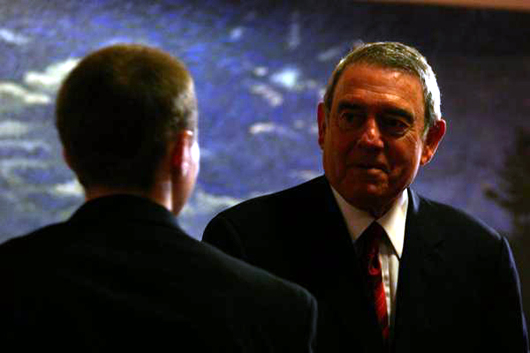
 This was actually the last session I attended at ACES, but it was one of the best. Oddly enough, however, I didn't take many notes. I must have been too engrossed in his wisdom. (Cruden is at left. Photo by Daniel Hunt, Flickr.)
This is the one thing I wrote down, and it's a quote from Cruden: "Be willing to not only tolerate the unusual; try to enhance it." He was talking about the editing process and how it's paramount to accentuate what makes news, news.
Cruden distributed a handout about how to edit on a tight deadline. He offers a 14-step process. For the Word version of the guide, go here. For the PDF version, go here. Click it. Print it. Learn from it.
The closing two sentences of his biography in the ACES conference program were: "As an editor, he has a fondness for short sentences. And irony."
I know a few flowery-writing reporters who could benefit from his insight.
Session information
- Title: "40 Years in 90 Minutes"
- Time: 2:15 to 3:45 p.m. Saturday
- Presenter: Alex Cruden, Detroit Free Press (retired)
- Description: "Cruden will offer a one-page handout and lead a discussion based on distillation of four decades of daily journalism. What’s most valuable amid the tread of deadlines and the blare of online? What skills should an editor cherish, and expect to be rewarded for?"
Monday, April 21, 2008
Smokin' ACES: Copy editors are stuck in middle of new media

Doug Fisher, a journalism professor at the University of South Carolina and blogger at Common Sense Journalism, blogged a few of my posts about the American Copy Editors Society conference in Denver.
It's interesting to see how someone from an older generation with knowledge of the new tools of the trade reacts to the sometimes naive thoughts of yours truly, a self-proclaimed "next-gen" journalist. I like to be snarky and blunt, a tactic that runs the risk of seeming less intellectual at times, especially when I use words such as "stupid" and "dumb."
But it's difficult to avoid those terms when today's journalism, Dumb, still learns from yesterday's journalism, Dumber. Times are changing, and words and attitudes are changing with them.
So that's why I found it a bit humorous how some people reacted to the tools and concepts Fisher presented at ACES. If you look at his handout, which I posted earlier, there are many of them - too many to divulge to any great extent in the 90 minutes he had.
By listening to the questions asked of Fisher, I thought there were some misperceptions among the audience members about why copy editors need to know about Web 2.0. They also had a very basic knowledge of social media and its positive and negative influences on journalism. That's why I said copy editors' collective pencil is a bit dull when it comes to new media.
The overarching of these misunderstandings is that copy editors think they are going to edit Twitter entries, "citizen" blogs and online reader comments as though they are newspaper articles. After all, that's what copy editors do: They edit. Unfortunately, I don't think people were thinking about my "masters of all" theory of copy editing, which states that we must know it "all," whether it's by reading books or by monitoring Joe Schmoe's Twitter page.
Despite the urge to edit Schmoe's ungrammatical and libelous Tweets, as Fisher mentioned during another session ("Moderating Online Communities: A Potential New Job for the Desk"), it's better to take a hands-off approach. I've even heard FLORIDA TODAY's lawyer say it: If you touch something a reader writes, it's yours, and you're liable for it. But if you leave it alone, you're simply an innocent host.
On Floridatoday.com, people who register with the site can published their own blogs through the Pluck platform. It's in its infancy here in Brevard County, but the service should stimulate a robust community conversation. It already has shown promise toward this end in the humorous, critical and sometimes good blogs started by FLORIDA TODAY readers.
Copy editors - no matter how strong their editing urge is - won't be able to touch this conversation unless it's to contribute, as I have done, or to wholly prevent comments on a news story.
Fisher mentioned the comments last year of The Ithaca Journal publisher: Once I give you a voice, I have to accept that voice. Journalists are no longer the only people with a voice. We must get that into our heads.
But he said online communities create so many legal conundrums that cannot easily be answered outside court. "Someone's going to get sued and lose," he said. "I just hope it's not me."
I hope he's wrong (about the first part).
No, seriously, 'What's RSS?'
Misperception No. 2 (though it's more of a misconception) in the first Fisher session was more technical than theoretical. It's about how RSS works, hence the "What's RSS?" question I portrayed copy editors as posing (my headline for that session post was "Know-it-all copy editors ask, 'What's RSS?'").
It seemed that many editors in attendance thought that an online story must be perfectly edited with a perfect headline before it goes live because, as it's posted, an RSS headline goes out, and it cannot be changed later. False. If you rewrite the headline and recache the story, the new headline will overwrite the old.
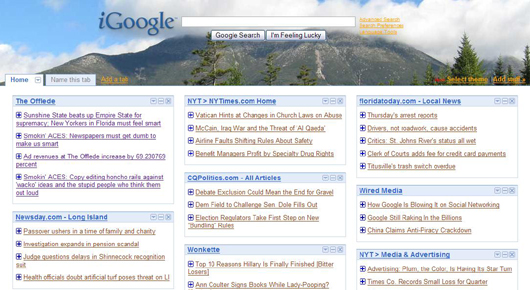
I know this is the case with The Offlede headlines, but I wanted to see if it were true for a real news site, too. So I experimented with Floridatoday.com. Here are the results:
 Headline No. 2 in this list - which is a screenshot of my RSS reader, iGoogle - "Students scurry to shine for their last dance" was too long. "Dance" bumped over to the second line. So I decided to take out "their" to shorten it. I went into our online content manager and took it out. Then I waited.
 Sure enough, about 30 minutes later, a new headline showed up on my iGoogle desktop via RSS. It was "Students scurry to shine for last dance." So don't worry, newbie online editors, you can change a headline, and RSS readers everywhere will know about it.
Of course, if you have subscribers who get automatically generated e-mails containing RSS headlines (through a service such as Feedblitz), you'll want to make sure the headlines are all right before that e-mail goes out. But really, how many people do this; how many people want more e-mail in their inbox?
It's difficult to say what role copy editors will play in this new-mingled-media landscape. Will we be editing more? Will we be sitting on the sidelines waiting for something big to happen before we step in? Or will we take our usual, humble position as we have in the newsroom for years: Will we be stuck, somewhere in the middle?
Some terms for online conversation communities:
- Flamer: person who posts just to make people mad
- Sock puppet: person who creates multiple identities or monikers and starts conversations with themselves
- Troll: someone who posts off-topic or off-the-wall remarks to make others become emotionally charged or to kill the forum discussion
- Troll whisperer: moderator, not editor, who deals with difficult posters without depressing the conversation
- Title: "Moderating Online Communities: A Potential New Job for the Desk"
- Time: 2:15 to 3:45 p.m. Friday
- Panelists: Doug Fisher, University of South Carolina; Travis Henry, Examiner.com
- Description: "Social networks and comments on stories are all the rage - and rage sometimes is the operative word as conversations get out of hand. As news organizations open their sites to comments, blogs and other community-generated content, this might be a new opportunity for savvy copy editors, or just something else the desk will have to handle. So you want to be a troll whisperer? Find out what has been learned from sites like YourHub and Hartsville Today."
Sunday, April 20, 2008
Smokin' ACES: Life after journalism would be the death of me
On Feb. 23, editors at a Pulitzer Prize-winning newspaper in Albuquerque, N.M., put the paper to bed for the last time. After 86 years of great, hearty journalism, The Albuquerque Tribune was dead.
"That's when my life after journalism began," former Tribune writer and editor J.A. Montalbano said during a panel discussion last week at the American Copy Editors Society convention in Denver.
Montalbano and a few other former editors at the defunct paper talked about ways in which journalists should prepare themselves for making a living outside of journalism. Montalbano now teaches at the University of New Mexico and at Central New Mexico Community College.
The state of newspapers has forced me into thinking about the territory outside the Fourth Estate. But it's not the first time. There have been several junctures when I questioned the direction in which my career was heading.
In high school, I was all about math and science. I thought engineering would surely be my fate because the University of Maine, the school I was bound for, was known for it; it wasn't where all the wannabe journalists were going. And when I graduated as the valedictorian, I got science awards, not writing accolades.
But it was my interest in and my flair for writing about sports that got me into journalism. I decided on a whim to declare it as my major. And I tell people that I never changed it because I was just too lazy.
I strayed from sports and started to write exclusively about hard news. Then, when I graduated with a journalism degree, I wanted to further my education, either by going to law school or to graduate j-school. I had even started to study for the LSAT when I decided I couldn't stand being away from journalism. So I went to American University to study it yet again.
And then, when it came time to get a real job, I looked into government editing, public relations work and even military service. I started to apply for a few of them when - just as it did during my LSAT studies - that feeling of withdrawal came over me: I could not live without the news and without being a part of the news. (By the way, the federal job application is enough to change your mind about working for the government.)
But while I was in Denver, my vigor was tested again. I was courted to become under the employ of a non-newspaper employer. It would've been an editorial job, but not one that I would consider journalism, or at least, the type of journalism that I would appreciate.
Though the salary would've been more than twice what I get now, I'm not about to abandon the six years that I invested in journalism education for a non-journalism job - especially after I've been a full-time journalist for only seven months. This industry still offers too much for me to ignore.
Besides, I wouldn't enjoy my job as much. I'm sure of that. I thrive under the gun of deadline. I live for breaking news. I love shaping the information readers get.
Some fellow editors at the conference said they revel in the sort of low-level celebrity they enjoy by working at a newspaper. That's manifest in the supermarket-type conversations when someone notices your newspaper ID badge:
Cashier (at World Market): "Oh, you work at FLORIDA TODAY. That's cool."
Me: "Yeah, it's OK."
Me: "You're cute. You wanna go on a date?"
Cashier: "Tee hee. Sure."
Well, the last two lines of that exchange are contrived. But that's beside the point.
The former journalists who talked about life after journalism at the ACES conference said it is important to diversify your job skills.
For one, copy editors - many of whom work nights - are able to devote daylight hours to teaching at a local college or university. Once I get more professional experience, I plan to do that. I already have some teaching experience.
They said the skills of reporters and editors are especially conducive to careers in law, academia and public policy, all of which happen to be areas of interest to me.
"I thought journalism was all I ever wanted to do," said Kelly Brewer, a former executive editor at The Albuquerque Tribune who now blogs and consults from Redding, Calif. "But I discovered there's more out there."
That may be true. And there's nothing stopping me from sampling the outside world. I write. I blog. I take photos. I talk Democrats, Republicans and health care. I do research. I could brief a legal case in five minutes. I even argue like a lawyer.
But it's not my time. Not yet. I'm not ready.
Session information
- Title: "Is There Life After Newspapers?"
- Time: 10:45 a.m. to 12:15 p.m. Saturday
- Panelists: J.A. Montalbano, Kelly Brewer, Zachary Shank
- Description: Refugees from the Albuquerque Tribune talk about options beyond the newsroom, including law, academia and public policy.
Saturday, April 19, 2008
Smokin' ACES: Know-it-all copy editors ask, 'What's RSS?'
Copy editors are supposed to know a lot. We are the masters of all. We know politics, news, sports, business, literature. You name it.
But with the Web, we're not exactly the sharpest pencils in the basket. That's cause for concern.
One of the sessions I attended at the American Copy Editors Society conference was called "Web 2.0." I was expecting presenter Doug Fisher of the University of South Carolina to go deep into the world of social media.
Fisher certainly has the capacity to do that, but he was held back by many of the old people in the audience who couldn't grasp concepts such as Twitter, RSS feeds and the YouTube.
These are some of the points I gathered from what Fisher said:
- Two-thirds of all traffic to Web sites doesn't originate at the home page. Instead, the Web hits are through sharing services such as Digg, Facebook and del.i.cious. "Share," Fisher said, "is not a four-letter word." (It's nice to know copy editors still know math.)
- Each news story should come with a 150-word summary attached. This gives Web surfers a teaser that could persuade them to read the story. At FLORIDA TODAY, this summary is called a "digest." Editors who know what it does actually care about what it says. For those who don't, they wonder why it's there.
- “If the news is that important, it will find me," Fisher said, quoting a New York Times article. RSS syndicates news from multiple sources by bringing headlines onto a single Web page. When a common reader logs onto his RSS aggregating program - such as Bloglines, Netvibes or Google Reader - he is getting news on a single page instead of visiting external news sites.
- By the questions copy editors were asking, most traditional journalists don't know what RSS is. More on that in another post.
Fisher mentioned how reporters and editors can monitor residents' pages on Twitter, a microblogging service, to find out what's happening in the community. He did not
And hey! I use Twitter and RSS together on Offlede.com. On the right sidebar, under "Offlede Tweets," you'll see my latest Twitter postings brought to the Offlede home page via RSS. How about that?
But because Web 2.0 doesn't have anything to do with that pile of inky newsprint that shows up on their doorsteps each morning, most attendees just didn't get it. Allison, a friend of mine from my Newsday days, and I jokingly toyed with asking questions such as "What is the blog? What is the Google? What is the YouTube?"
We probably would have been taken seriously, so we settled with simply laughing at everyone else. But ignorance, in this case, isn't really funny: It's a nefarious mark on journalism.
Here is the PDF handout that Fisher distributed during the session.
Session information
- Title: "Web 2.0"
- Time: 2:15 to 3:45 p.m. Thursday
- Panelists: Doug Fisher, University of South Carolina; Chuck Moozakis, Newspapers & Technology
- Description: How do you navigate the brave new(-media) world? And when it comes to technology, where are newsrooms now and what's ahead? Get a rundown of some of the top Web 2.0 tools that can make your life easier and help you navigate social media. Blogs, wikis, RSS, tags, Technorati, Furl, Newsvibes and more. Bring some of your favorite sites, too, to share.
Friday, April 18, 2008
Smokin' ACES: Newspapers must get dumb to make us smart
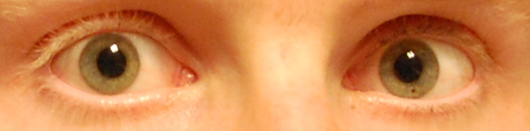
When you viewed this Web page just now, what did you see first? Headlines? Photos? Googly eyes? The links to take you away from here?
That’s what the folks at the Poynter Institute think they’ve figured out.
Chances are that your eyes were drawn to the “nav” bar to the right that allows you navigate elsewhere. The bar combines a little text with several visual aids, such as photos, to make for a more appealing, readable presentation. And apparently, this significantly "dumbed-down" approach to the news is the key to the future.
Poynter, a media research organization based in St. Petersburg, Fla., last year completed an intensive study called EyeTrack. Researchers retrofitted subjects with high-tech goggles that record where their eyes are looking when they view a newspaper or Web page. It also records how long they look at it.
 I first learned of the results during last spring’s American Society of Newspaper Editors convention, left, in Washington. Sara Quinn, who directed the study for Poynter, presented preliminary results.
She said large photos attract newspaper and Web readers more than small ones. No surprise there.
She said people read farther into a story on the Web, but stop reading sooner in newspapers. Now wait a second. I thought people who read newspapers were methodical and deliberate. Maybe not.
But Quinn is still at it, further spreading the gospel of EyeTrack at the American Copy Editors Society national conference last week in Denver. She talked about how the study pertains to alternative story forms – such as fact boxes, graphics and numbers – in newspapers.
She said alternative forms aid comprehension of information in print and online. Quinn and the Poynter researchers gave people three pages: one with a traditional story, one with a shorter story and a few fact boxes, and one without a story and just boxes, numbers and photos. Researchers then quizzed the readers.
“People who read the page without the traditional narrative were able to answer most questions correctly,” Quinn said.
Here are three points she made clear about the benefit of these broken-down story formats:
- They help readers understand and remember facts. (Hey, dumbing down information makes people smarter. Who would've thunk it?)
- They attract a lot of attention.
- Newspapers don’t do them very often. Only 4 percent of newspapers studied in EyeTrack used them.
No one really knows how to fix this readability issue yet. But “bitesizing” information into digestible pieces is at least part of the equation. Yes, it may be dumbing down the information, but honestly, we just don’t have time to be smart these days.
So as the Black Eyed Peas would say, let’s get retarded.
Not rules, but guidelines for getting stupid
Josh Crutchmer, the deputy presentation editor at the Omaha World-Herald, says newspapers' ability to find the most effective way to communicate information is how they're going to compete with blogs.
If that were true, the industry wouldn't be having the problems it is right now.
Nevertheless, Crutchmer offered a few points to keep in mind when bitesizing traditional journalistic pot roasts.
- Do it for the readers. (Cliche.)
- Don't design just to design. It's not about what looks cool; you need content to back it up.
- Words make an alternative form work.
- Don't say something in two paragraphs that you can say in one.
- Criticize before, not after, something goes to print.
- Title: "Working Together: Alternative Story Forms, Designers and the Desk"
- Time: 10:45 a.m. to 12:15 p.m. Thursday
- Panelists: Andy Bechtel, University of North Carolina; Josh Crutchmer, Omaha World-Herald; Sara Quinn, Poynter Institue; Katie Schwing, (Colorado Springs) Gazette
- Description: How is the rise of timelines, Q&A material and other nontraditional storytelling affecting the copy and design desks? This panel discussion will examine what ASFs mean for collaboration and work flow, and how readers notice and learn from these forms. Come ready to talk about what works at your publication and what needs help.
Thursday, April 17, 2008
Smokin' ACES: Copy editing honcho rails against 'wacko' ideas and the people who think them out loud
I attended the 12th national conference of the American Copy Editors Society. It was a three-day "learning time" in which hundreds of editors nationwide gathered to commiserate about their obscure and thankless jobs at newspapers big and small, at magazines and at governmental agencies such as the CIA and Department of Defense. Yes, copy editors are defending America ... from the scourge of bad writing and information gathering.
On a side note, I heard one story about a CIA copy editor. A newspaper counterpart asked him, Who is your target audience? "The president," he said. (Must not be too much pressure to get his grammar right with the current commander in chief!)
The opening session was a pity party put on by a few ACES higher-ups and the audience, which included one journalism educator who came all the way from Australia to ask me a question during the panel I paneled for (more about that later).
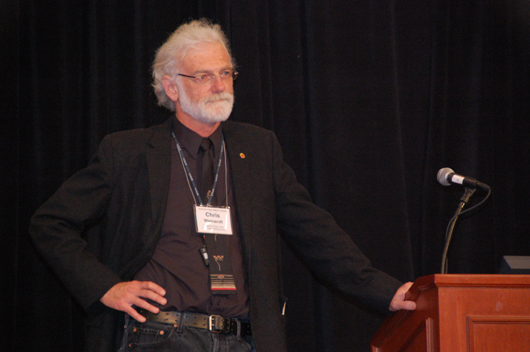
ACES President Chris Weinandt of the Dallas Morning News kicked it off on a real down note: Society membership has dipped into the 600s from a higher number (I don't know what), and national conference attendance this year was only 300, down from 400 at last year's meeting in Miami. Much of that, I suspect, had to do with belt-tightening newspapers not willing to pony up the funds for a great training opportunity. Luckily, I work at a newspaper that values training.
But Weinandt said copy editors are "as essential to newspapers' success as their stockholders are." Yet, we are too often ignored. Of 200 letters about the value of copy editing that he sent this year to upper-level newspaper editors, he received one response. He usually gets five (all at once now: OOOOOOOOOOO).
Some of Weinandt's meandering thoughts and trepidations are better summed up and commented on in bullet form:
- One newspaper's idea to outsource copy editing to India was totally "wacko." Editors need local knowledge to edit. New Dehli isn't exactly a suburb of Orlando. Any upper-level manager who disagrees is clueless, stupid and should go home to Neverland ... or move to India.
- We're expected to do more with less. There's a reason we're working more overtime: We don't have enough workers to do the needed work.
- Copy editors are "criminally overlooked" by management and the rest of journalism. The scope of our job isn't realized in the outside world, probably because we work nights or that we're just quiet and too good for bickering.
- We need to raise our profile, speak out against "wacko" ideas in trade journals, on Web sites and in major media, and partner with other organizations such as the Online News Association to blaze a trail into a future that has so far skipped over us. (I'm all for partnering with the ONA.)
But today (and yesterday and the day before that and the day before that), the fear is (and was and will be) the Web. Journalism hasn't quite figured out how to use it profitably. And old, traditional journalists haven't quite figured out how to use it. I have, and I'm not scared.
But with the proliferation of diffuse, unadulterated and unedited voices on the Internet, will copy editors become even more insignificant and forgotten?
Temple said, "I'm optimistic as long as we stick to journalism."
The best journalists I know are copy editors.
Blogger's note on the headline: The Offlede Stylebook says "copy editing" is not hyphenated as an adjective because it is easily recognized as a two-word word and that adding a hyphen would not add any meaning or ease of readability.
Session information
- Title: "Opening General Session"
- Time: 9-10:30 a.m. Thursday
- Speakers: Chris Wienandt, president of American Copy Editors Society; John Temple, editor of the Rocky Mountain News
Monday, April 14, 2008
Live blogging the food court at Orlando International Airport
Live blogs from most major media outlets (FLORIDA TODAY isn't major) are pointless and wrought with unnecessary punctuation. I decided to join the cacophony. This is my foray into live blogging (the over-usage of exclamation points)!
8:37 p.m. Co-worker (and friend) Beth needs a ride home from the airport. She's flying in from Kansas City, Mo., via Charlotte, N.C., on US Airways flight 1719 after the national conference of ACES. Before she went airborne, she didn't call and let me know when her flight was due in Orlando, so I, of course, got to the airport two hours early. At the start of this live blog, though, we're less than an hour away from arrival. Her flight gets here at 9:30. So I'm trying to pass the time on The Offlede as my car racks up a charge in the Terminal B parking garage, Level 1, Row A. Don't let me forget that! When I got back from my trip to Denver, I went to the wrong garage. That won't happen this time!
8:49 p.m. I'm a bit slow doing this live blog because of the lack of technology. I brought all of my cameras, but I forgot the cables to get photos off them. So instead, I'm using my poor Motorola Razr phone to take photos and post them to my blog. I'll be back when I figure this out!
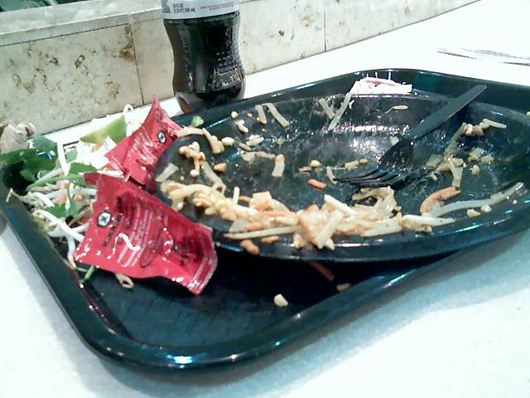
8:54 p.m. I bet you were able to figure out from the above photo that I figured it out (how to send picture messages on my phone). I had to change the entry method on the message. Instead of entering a number address, I had to enter a letter address in order to send it to my e-mail. The photo is of my almost-finished mound of pad thai purchased, with a Diet Coke, from the Zyng Asian Grill in the food court for a hefty $12.12. Maybe if they made the portion size a little more reasonable, the price would be more reasonable, too. $12.12 is a nice number, though, so my budget and I will let it slide. But I've made better pad thai myself. They didn't even cook the carrots and bean sprouts (I removed many of them, as you can see in the upper left of my food tray). Fortunately, they did cook the chicken, but it was $2 extra. I hadn't eaten all day, so I ate the entire mound. I feel sick!
9:02 p.m. A few airport workers are speaking Spanish as they clean around the bar-style eating area where I'm sitting. They're looking at me like I'm weird, probably because I was taking photos of my lackluster food. I whispered, "I know what they're saying," to myself in hopes they would hear me and stop. I don't think they did because they're not stopping!
9:05 p.m. Another technical glitch. I'm trying to figure out why the line spacing in this post is abnormally generous. I don't like it. It's not compact enough. It makes the post look longer than it is. Anyone know Blogger better than I do?!
9:06 p.m. Here's the breakdown of that ripoff of a pad thai plate:
- Server: James
- Time: 7:48 p.m.
- 1 PAD THAI BWL - 6.99
- w/CHIX - 2.00
- 1 COKE BTL 20oz - 2.39
- SUBTOTAL - 11.38
- TAX - 0.74
- VISA - 12.12!
9:11 p.m. I just felt like posting at 9:11 ... because I'm at an airport!
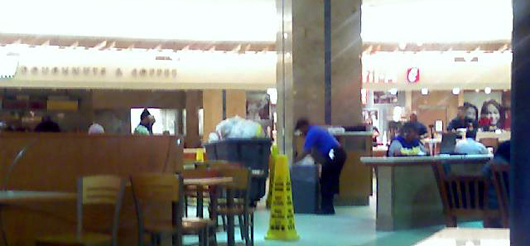
9:18 p.m. One janitor takes out the trash in the above photo. Another tries to get a few peeks at my screen. I must look super creepy right now. The good thing about a camera phone is that it's a bit more discreet than a regular one. The bad thing is that it sucks!
9:28 p.m. Plane is almost here. I guess. I haven't checked the arrival time or gate. There are three janitors surrounding me now. Should I move? I'm beginning to fear for my life!
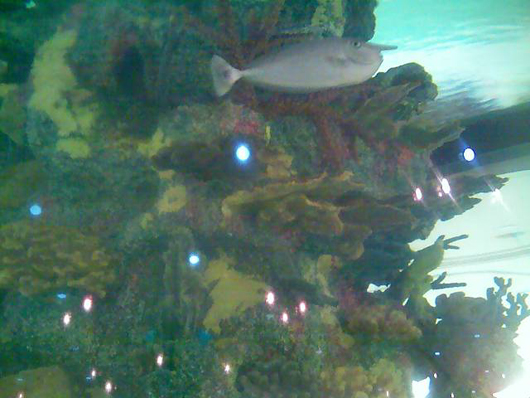
9:29 p.m. The food court has a fish tank. With fish! It's a big cylinder of water in the middle of the action (janitors cleaning and a few people eating). This place is actually quite quiet at 9:29 at night. That's sleepy Florida for ya!
9:32 p.m. An annoying masculine voice keeps booming over the intercom system: Your attention, please. The Department of Homeland Security would like to remind you of the elevated threat level. It is currently at orange. ... Don't leave your baggage unattended. ... Report unattended baggage. ... Blah blah blah. .... The carriage of liquid gels and aerosols is prohibited through the security gate except for 3-ounce bottles in one clear quart-size plastic bag. (The limit is actually 3.4 ounces, according to the TSA agent who confiscated The Offlede's 3.5-ounce bottle of cologne Sunday in Denver. Interestingly, it made it through security in Orlando before the flight to Denver.)!
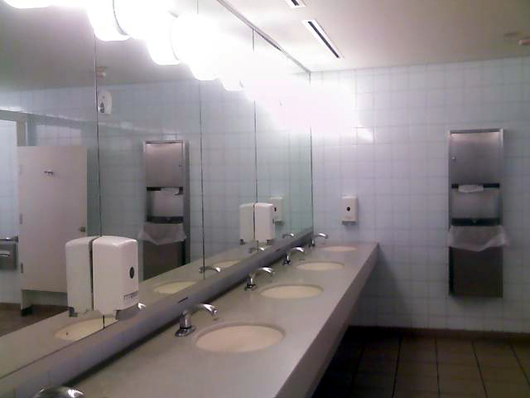
9:47 p.m. The Offlede has used his expert journalistic skills to expose airport pad thai as a sure trip to the airport bathroom. In an attempt to reduce the graphic nature of such a disgraceful abuse of the public's trust in food, the above photo is just of the sinks the men's room, rather than the business end of it!
9:51 p.m. The janitor is mopping around my feet and over my laptop power cord. Where is Beth? Get me out of here! I cannot get my feet wet! I'm in an airport!
9:54 p.m. It should be noted that this is the first blog post on The Offlede that has gone unedited for such a long time. I apologize for all the errors. All entries were written without a single edit. If I had more time, I would have looked up style questions such as, "Should the 'thai' in 'pad thai' be capitalized when it refers to a food that has no obvious connection in looks or taste to the country of Thailand?"!
9:57 p.m. I'm too lazy to get off my butt and check the arrival-departure status boards. Instead, I checked the airport's Web site for Beth's flight. Here's the line: USAirways - 1719 - Charlotte - Mon 21:31 - Mon 21:40 - Arrived - 20 - 57. Beth has to claim her checked baggage before texting me. But the plane is nine minutes late. What's the deal? This is yet another airport disgrace! US Airways will be the next to go bankrupt!
10:02 p.m. McDonald's, Sbarro and Chick-Fil-A are the only restaurants still open. Nice to know you can't eat great, even late. Where's Dave Thomas when you need him?!
10:04 p.m. I'm beginning to wonder what Beth will think when she reads this post!
10:04:30 p.m. I'm beginning to wonder why the line spacing has gone back to normal generosity. It looks better, though. Life is good!
10:06 p.m. The team at Facebook just informed me via e-mail that I have been tagged in a photo of the ACES national conference in Denver. 'Tis great to feel a sense of belonging when all the janitors at Orlando International Airport hate my guts!
10:09 p.m. I just realized that it is my brother's birthday. I should have called. He must not have that same sense of belonging I just achieved!
10:10 p.m. Hey, 10:10! It's almost like my pad thai bill ($12.12). But this time, it's time, and it's tens!
10:11 p.m. OK. Seriously. Where's Beth. Growing impatient!
10:12 p.m. It seems that they have turned down the heat in here for the night. It's a chilly 70 degrees outside! I'm going to freeze my butt off in here if they don't turn the heat back on! Yet another disgrace!
10:16 p.m. Beth sent me a ton of text messages. I didn't hear my phone buzz. Oops!
- 9:53: Going to baggage
- 10:02: Bag soon, at 20 (gate)
- 10:15 p.m. Where are you?
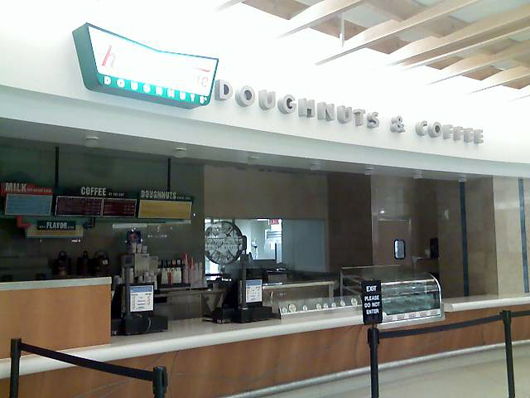
10:23 p.m. During my waning hours in the food court, I feel like eating a nice and hot glazed doughnut. Oh, but wait! Krispy Kreme is closed! Yet another disgrace!
10:24 p.m. I found out why I didn't hear Beth's text messages. I had turned my phone ringer to "All Off." Yet another oops!
10:25 p.m. "Ladies and gentleman, may I have your attention please." I'm getting fed up with that stupid security warning every 30 seconds. I hate this food court! I hate this airport! Beth, WHERE ARE YOU? Perhaps I should go look for her.?!
10:28 p.m. I see Beth over near Sbarro. Should I say something? She looks like she's looking for someone!
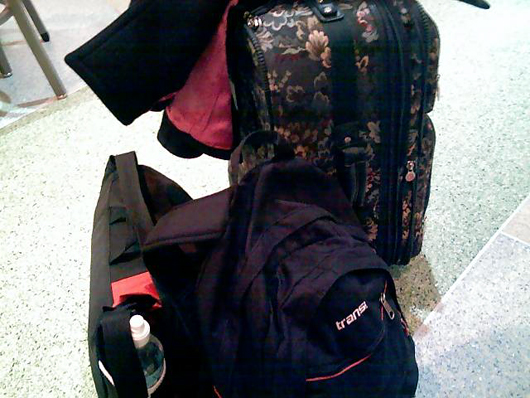
10:29 p.m. I snap my fingers to get her attention. How rude, me thinks. Beth doesn't seem happy. She won't let me take her picture, so I photograph her baggage. Yay!
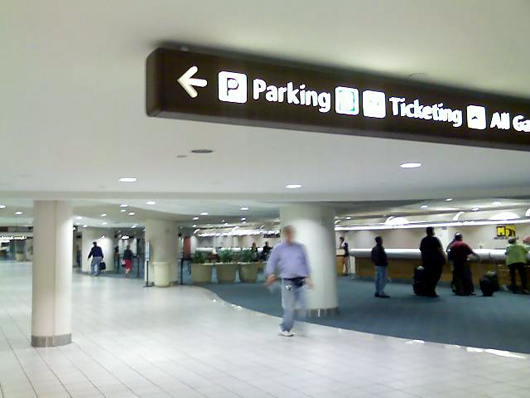
10:35 p.m. We take the elevator to "Ground Transportation," but it's not the "ground transportation" we're looking for: It's the rentals, not the parking garage. We backtrack and find the sign that says, "Parking." Who would have thought this was the correct way to the parking?!
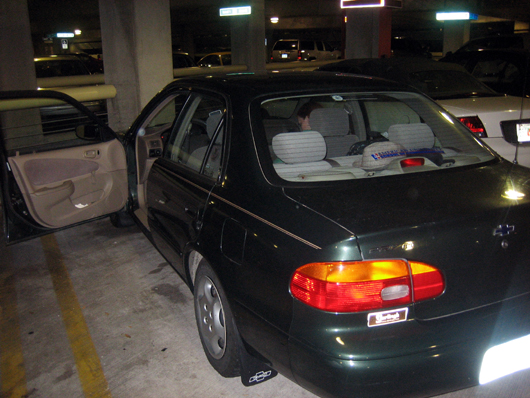
10:44 p.m. Found my car with relative ease. In the spirit of full disclosure, this was taken with my Canon point-and-shoot digital and taken off the camera after getting home!
10:46 p.m. $11 is the damage for parking in the garage for just more than three hours. Got gouged at the food court and again in the airport toll lane!
10:47 p.m. The eastbound on-ramp onto the Beachline to Brevard County (home) is closed by the Florida Highway Patrol because of construction by the Florida Department of Transportation. Glad to see our state agencies collaborating to cost the general public even more money. I had to go west, pay $1.25 toll, take the next exit, go back east and pay another $1.25 at the same toll booth. I'm sending the FHP and FDOT the bill for $2.50. They will take years to figure out how to split it. Joke's on them!
10:56 p.m. Beth tells me during the trip home that I was lame at the Denver conference. I wasn't lame: I was SICK. I don't have much fat on my bones, so the cold tends to get to me. But with that pad thai tonight, I'm working on upping my fat content!
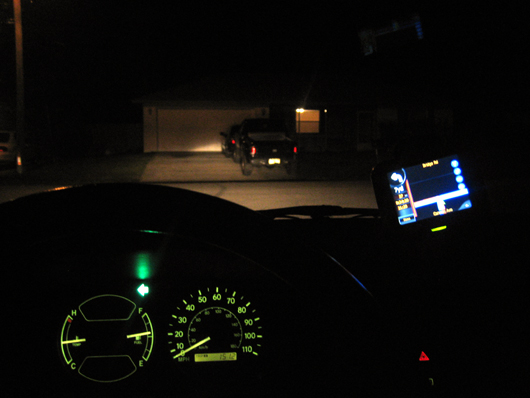
10:22 p.m. I'm relying on the GPS unit to get to Beth's friend's house in the sticks of Port St. John, where her car has been sitting since last Monday!
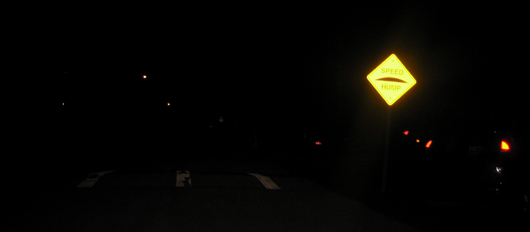
10:23 p.m. Among the circuitous back roads of PSJ, a Brevard County gah-hetto (ghetto), are dozens of speed humps. As opposed to bumps, which are shorter and steeper, humps are longer and not as steep (go figure). They are both equally as annoying. I think humps are easier on the car, though!
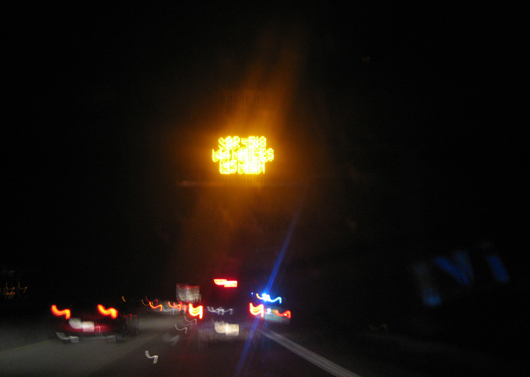
10:54 p.m. I ran into a backlog on Interstate 95. A cop has an ess yoo vee pulled over near a traffic sign. The sign says that it's 15 miles and 15 minutes to the next exit. A minute per mile is the usual, free-flowing traffic rate. Brevard County must have these signs just for show because they definitely don't help commuters while they're stuck in traffic. Farther down the road, a cop has a bulldozer pulled over. I'm not kidding!
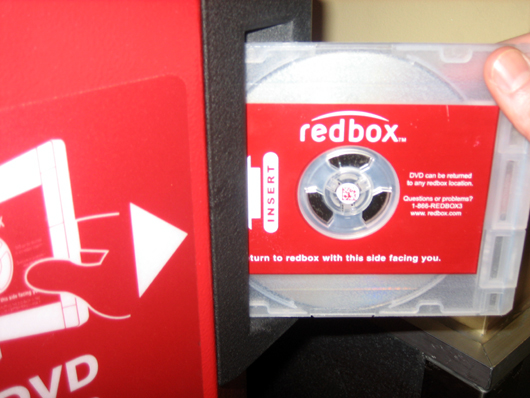
11:25 p.m. I took my time, but I finally get to Wal-Mart. It was the plan to go to the airport, pick up Beth, get to Wally World before 9 and return a movie rental to avoid a late fee. Thanks to an inaccurate traffic sign, a nine-minute flight delay, a blocked highway on-ramp and indigestion from pad thai, I'm stuck with the $1 fine. What a disgrace!