Showing posts with label florida today. Show all posts

Monday, April 21, 2008

Earnings are up at Offlede (again), down at Gannett (again)

forsalesigns
I took my camera on a jog through the neighborhood, and it didn't take me long to shoot enough for sale signs for a Photoshop collage. The bottom sign has been out in a yard so long that it's rusted and faded to the point of near illegibility. If real estate brokers can't make money on real estate, it's no wonder that newspaper also can't.


As ad revenue at The Offlede continues to soar (another Lincoln collected this week, up from 22 cents to 23 cents total), it continues to fall at Gannett, the parent company of FLORIDA TODAY.

Gannett earnings dropped 9 percent in the first three months of the year. You could say the earnings were "nearly decimated." (Click that link, please. You might learn something.) The weak economy likely attributed to fewer ads being sold. According to The Associated Press:
Gannett chairman and chief executive Craig Dubow (who made $7.5 million last year) said the difficulties are particularly acute at Gannett's 11 newspapers in Arizona, California, Florida and Nevada, where the real estate downturn has been sharper. Full story.
Heck, it's so bad here in Florida that my roommate, who owns the house I live in, left his place off the market after his Realtor said she didn't want it anymore. It isn't worth the hassle of listing it because it's not going to sell anytime soon.

The economic doldrum really hit home a few months ago when FLORIDA TODAY "awarded" buyouts to six newsroom employees. The announcement by our executive editor wasn't a shock to me. At the moment the staff meeting was announced via e-mail, I knew it would be about layoffs.

Real estate in Florida is continuing to founder. This state lives for homes. It's a retirement community, after all. And the declining revenues for newspapers exacerbate the economic climate for journalism.

This is the first time I've been at a publication as it laid off people.

Not long after I left the Bangor Daily News in Maine, 11 employees and the internship program were dropped.

The Pew Research Center, where I worked as a reporter, has been cost-cutting, though not necessarily laying off people.

My intrepid and beloved former co-workers at Newsday told me that the internship program had been cut in addition to the 40 buyouts that were distributed throughout the more-than-decimated newsroom.

But I can't do much more right now than just complain and continue to do my job. Copy editors are good at both of those things. Especially the former.

Thursday, April 17, 2008

Smokin' ACES: Copy editing honcho rails against 'wacko' ideas and the people who think them out loud

president0079
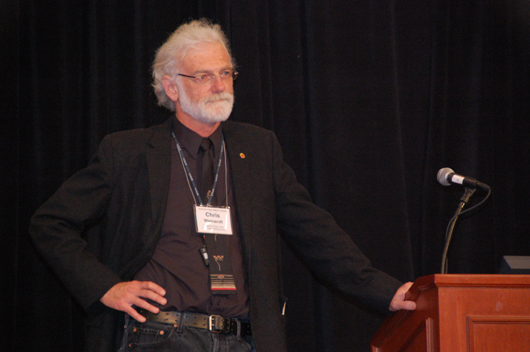
ACES President Chris Weinandt of the Dallas Morning News kicked off the ACES conference with a little rabble-rousing - well, as much "rabble-rousing" that is possible for copy editors. He's from Texas: Doesn't he look like Walker, Texas Ranger? He even wears cowboy boots.


This is the first post in a series that explains what my employer was paying me to do in Denver last week.

I attended the 12th national conference of the American Copy Editors Society. It was a three-day "learning time" in which hundreds of editors nationwide gathered to commiserate about their obscure and thankless jobs at newspapers big and small, at magazines and at governmental agencies such as the CIA and Department of Defense. Yes, copy editors are defending America ... from the scourge of bad writing and information gathering.

On a side note, I heard one story about a CIA copy editor. A newspaper counterpart asked him, Who is your target audience? "The president," he said. (Must not be too much pressure to get his grammar right with the current commander in chief!)

The opening session was a pity party put on by a few ACES higher-ups and the audience, which included one journalism educator who came all the way from Australia to ask me a question during the panel I paneled for (more about that later).

ACES President Chris Weinandt of the Dallas Morning News kicked it off on a real down note: Society membership has dipped into the 600s from a higher number (I don't know what), and national conference attendance this year was only 300, down from 400 at last year's meeting in Miami. Much of that, I suspect, had to do with belt-tightening newspapers not willing to pony up the funds for a great training opportunity. Luckily, I work at a newspaper that values training.

But Weinandt said copy editors are "as essential to newspapers' success as their stockholders are." Yet, we are too often ignored. Of 200 letters about the value of copy editing that he sent this year to upper-level newspaper editors, he received one response. He usually gets five (all at once now: OOOOOOOOOOO).

Some of Weinandt's meandering thoughts and trepidations are better summed up and commented on in bullet form:
  • One newspaper's idea to outsource copy editing to India was totally "wacko." Editors need local knowledge to edit. New Dehli isn't exactly a suburb of Orlando. Any upper-level manager who disagrees is clueless, stupid and should go home to Neverland ... or move to India.
  • We're expected to do more with less. There's a reason we're working more overtime: We don't have enough workers to do the needed work.
  • Copy editors are "criminally overlooked" by management and the rest of journalism. The scope of our job isn't realized in the outside world, probably because we work nights or that we're just quiet and too good for bickering.
  • We need to raise our profile, speak out against "wacko" ideas in trade journals, on Web sites and in major media, and partner with other organizations such as the Online News Association to blaze a trail into a future that has so far skipped over us. (I'm all for partnering with the ONA.)
It's better to end a post on a high note, so for that, I'll resort to the comments of John Temple, editor, president and publisher of ACES co-host Rocky Mountain News. He said that at the first ACES conference, the fear was pagination in which traditional editors of words were forced to design and polish newspaper pages. I do that, and I'm not scared.

But today (and yesterday and the day before that and the day before that), the fear is (and was and will be) the Web. Journalism hasn't quite figured out how to use it profitably. And old, traditional journalists haven't quite figured out how to use it. I have, and I'm not scared.

But with the proliferation of diffuse, unadulterated and unedited voices on the Internet, will copy editors become even more insignificant and forgotten?

Temple said, "I'm optimistic as long as we stick to journalism."

The best journalists I know are copy editors.

Blogger's note on the headline: The Offlede Stylebook says "copy editing" is not hyphenated as an adjective because it is easily recognized as a two-word word and that adding a hyphen would not add any meaning or ease of readability.

Session information
  • Title: "Opening General Session"
  • Time: 9-10:30 a.m. Thursday
  • Speakers: Chris Wienandt, president of American Copy Editors Society; John Temple, editor of the Rocky Mountain News
Smokin' ACES home

Monday, April 14, 2008

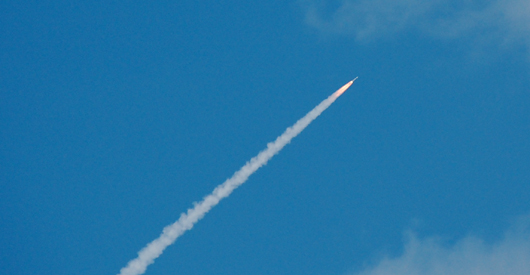
Offlede beats employer to photo of Atlas 5 rocket launch

atlas0004
Taken at 200mm.

closeatlas0004
I blew this one up.

This post mainly is to see if I could beat the FLORIDA TODAY space team to the punch. I posted this photo of the Atlas 5 rocket to my Floridatoday.com blog 10 minutes after the 4:12 p.m. launch from Cape Canaveral Air Force Station. If I hadn't talked to my roommate on the way back into the house near Wickham Park in Melbourne, it would have been earlier. As of 4:30 p.m., The Flame Trench blog hadn't posted a photo (nothing like a little friendly internal competition, right?). Today, The Offlede is the lede.

And considering how easy it was, I should be the lede more often: I grabbed my camera one minute before the launch, ran outside and snapped a few photos without a tripod. I'm actually surprised they turned out all right.

Saturday, April 5, 2008

Convergence at Gannett: Florida Today journalists learn video

trainingbook0015
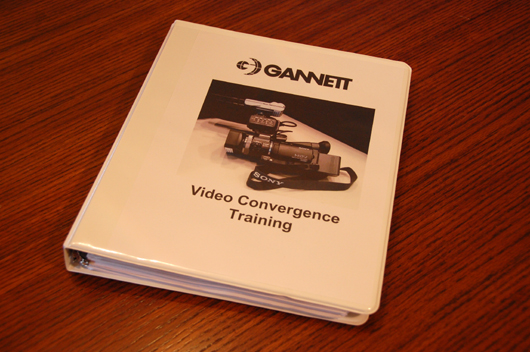
My video training bible.

Convergence is an icky word for traditional print journalists. They don't want to get near it because they don't want to get dirty.

Convergence is defined generally as the movement through nonspecific methods toward a definite value or equilibrium state. This definition represents a battle for and against convergence and an icky "I dunno, I’m scared" attitude in the journalism industry. The object is to find peace, to find a way for newspapers to survive.

In a high-tech world, media consumers look toward new information sources that bring together diverse media such as text, photography, video and audio. In this way, convergence is equal parts (equilibrium) of content that is produced through various (nonspecific) technologies. This entails information gathering and storytelling techniques and using multimedia platforms to deliver the product.

But this is where the most heated debate arises.

Much of the problem with convergence is either the inability or the stubbornness to keep up with it. The (Baltimore) Sun of the particularly embattled Tribune chain of newspapers last year lashed out against the corporate move to compel reporters to take photographs – probably the first step toward convergence.

That is why I could not imagine a better opportunity to train in a new skill set with any other company than Gannett and FLORIDA TODAY. This week, about 20 traditional print journalists – photographers, assigning editors, reporters – subjected themselves to a 42-hour, 3.5-day "Video Convergence Training." As a copy editor – a position focused mostly on words – it is amazing that I got such an opportunity.

Lane Michaelsen and Harvey Mars, vice presidents from Gannett's broadcasting division, were our teachers. They instructed the pilot video group of newspaper trainees two years ago here at FLORIDA TODAY. After visiting dozens of Gannett newspapers nationwide and teaching hundreds of traditional journalists to be proficient in video shooting and editing, they returned to Melbourne, Fla., for an encore.

Participants were divided into eight groups. I was grouped with a beat reporter and a business reporter from FLORIDA TODAY and a TV news producer from Gannett’s KARE in Minneapolis who flew in with the equipment we used for training.

Michaelsen explained the basic anatomy of our expensive Sony video cameras, starting with the on-off switch and moving to functions such as the iris, white balance and various focusing mechanisms.

On our first day, we shot staged news events, including a car accident in which our executive editor, Terry Eberle, was killed by a disgruntled and drunken FLORIDA TODAY employee in the parking lot. My group battled infighting during the editing process, and we eventually produced a piece that was lacking proper natural sounds and B-roll, or shots of objects such as beer bottles and security cameras that were pertinent to the story. I, however, was featured in my group’s video as the culprit, an exclusive that none of the other groups were able to catch.

Our in-house assignment was to create a video of the printing press at FLORIDA TODAY. We followed an operator around the machinery as he explained each step of the process. We shot forklifts positioning heavy rolls of newsprint, recorded the nat sound of the alarm when the press started and edited our sound and video into a coherent and rather good piece. I have experience in Apple's Final Cut editing software, but FLORIDA TODAY uses Avid. Many of the editing functions are similar, however, so I was able to pick it up easily. Mars made it even simpler with his down-to-earth, humorous teaching style.

Finally, in what was probably the least compelling assignment received by any group, my team was charged with a story about gas prices. It's a cliche and rather routine task to tell people that prices are high, as if they don’t already know. But my group made it interesting and managed to get a few of the stereotypical Southern characters saying silly things about oil and the federal government as they filled up their tanks. Other groups produced stories about a NASA attraction, a local thrill park and those annoying saltwater critters called the man-of-war.

When we played our final assignment for the rest of the class to see, Anne Saul, who oversees the training for Gannett, said, "Now wasn’t this 300 percent better than your accident video?"

It was more like 400 percent.

Before this session, I had some instruction in shooting and editing at American University, where USA TODAY video director, Steve Elfers, was my teacher. I already had grasped the basics, and it was easy to pick them up again. But before this training, I lacked the enthusiasm for videography.

Now, I actually respect TV journalists. My first experience with them had soured me. I was a reporter at the Bangor (Maine) Daily News when I was interviewing a man who had capsized his fishing boat in the river and was rescued by firefighters. As I chatted with him and scribbled in my notebook, a videographer from the local CBS affiliate, WABI, walked up to us, started shooting my interviewee and told me, "Do you mind getting out of my shot?"

"Do you mind getting out of my interview?" I said.

But now, I can’t wait to get into the field to be that pain in the butt, too. Just think: I now know how to report, write stories, edit words and sentences, write headlines, design pages, heckle other editors and reporters, blog, produce Web content, take still photos on an SLR camera, edit those photos, shoot video, record audio and edit a video story. Am I missing something?

"Now you can learn how to sell ads," a co-worker told me.

I think I'll skip that part.

Traditionally trained print journalists cannot be stubborn. They cannot ignore new content delivery systems. Twitter, YouTube, Blogger, Flickr, RSS, text messaging, podcasts and Facebook are our friends, not our enemies.

It does not take a long time to earn new skills. The video training was my third journalism boot camp. The first was a two-week crash course in Washington reporting, which was my first class at American University. The second was two weeks of 20-hour days of copy editing at Temple University last summer. They were tiring (I got five hours of sleep each night this week), but they were the most exciting aspects of my early multimedia (not newspaper) journalism career.

The training may take money, but I consider it a great investment. I compare the Gannett training with the Travel Channel's program, which similarly teaches the basics of shooting and editing in four days. But it's $2,500.

The answer to convergence's introduction of new gadgets is training. With any new media technology, we have to change to survive. It's journalistic Darwinism: Those who don’t adapt and don’t learn new skills will fall behind and fail.

Gannett is not falling behind; it is not failing. It is leading; it is surviving.

After our amazingly resurrected editor, Eberle, handed us certificates of completion, instructor Mars said, "You're way out ahead of everyone else."