Showing posts with label twitter. Show all posts

Saturday, June 14, 2008

Mars Phoenix communicates with Earthlings via Twitter

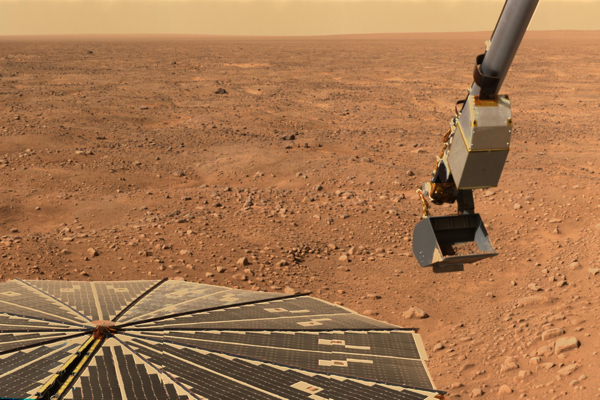
MarsLander3
The Mars Phoenix lander beamed this photo back for the pleasure of Earthlings following its actions on Twitter, the microblogging Web service. High-res version here. (Photo by NASA's Phoenix, a Twitter superstar)


On May 7, the Mars Phoenix lander was weeks away from the red planet when it decided to join the latest blogging craze: Twitter.

Since then, it has sent more than 260 updates and has gained more than 20,000 followers on Twitter, creating an interactive forum for the lander, its engineers and the inquisitive public. Check it out here. Its latest post - however off-topic - says, "Godspeed Tim Russert."

On May 25, Phoenix expressed its anxiety to the world as it plummeted through the Martian atmosphere:

"Atmospheric entry has started. time to get REALLY nervous. Now I'm in the 'seven minutes of terror.'"

"parachute opening is scariest part for the team."

"parachute is open!!!!!"

"come on rocketssssss!!!!!"

"I've landed!!!!!!!!!!!!!"

"Cheers! Tears!! I'm here!"

Since landing, Phoenix has beamed information about the Martian atmosphere and soil back to Earth, but it has continued these Tweets that succinctly (in 140 words or fewer) present its findings without all the scientific mumbo-jumbo. The lander's entries on Twitter include links to high-resolution photos, high-definition videos and animations of its activities on the surface of Mars.


Some posts have bordered on funny/geeky/nerdy. Some have divulged the secrets of its engineers at the Jet Propulsion Laboratory in Pasadena, Calif., where the operation is headquartered: "
Eating peanuts in mission control is a good luck tradition at JPL. Jars are being opened now! Wish I had some, too!"

As of Saturday afternoon, there have been 264 updates since Phoenix started Twittering. Many of them are answers to questions posed by other people on Twitter, so it's a great way to communicate directly with the robot. Its intelligence reminds me of that trailer I saw for the movie "Wall-E," but then - what do ya know? - I saw this Tweet: "A Pixar animation team went to JPL to study the rovers. In fact, a rover is going to the Wall-E premiere in L.A. :-)"

The Phoenix has portended its own demise, however. Now, Phoenix said, the "temperature here is a balmy (ha) -31F (high) and -112F (low). ... Forecast is sunny and dusty." But such weather won't last for long: "I'm sure to freeze up over Martian winter" and die.

Twitter geeks universewide will miss you, Phoenix.

Saturday, April 19, 2008

Smokin' ACES: Know-it-all copy editors ask, 'What's RSS?'

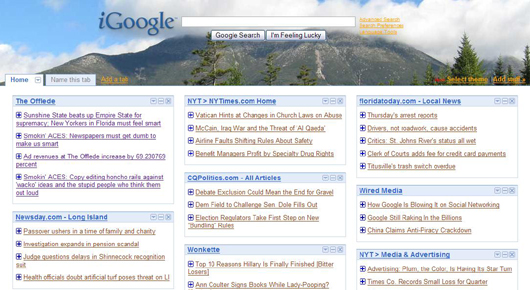
igoogle2
Many copy editors at a session I attended were clueless as to how programs such as iGoogle gather headlines through RSS, or really simple syndication.


Copy editors are supposed to know a lot. We are the masters of all. We know politics, news, sports, business, literature. You name it.

But with the Web, we're not exactly the sharpest pencils in the basket. That's cause for concern.

One of the sessions I attended at the American Copy Editors Society conference was called "Web 2.0." I was expecting presenter Doug Fisher of the University of South Carolina to go deep into the world of social media.

Fisher certainly has the capacity to do that, but he was held back by many of the old people in the audience who couldn't grasp concepts such as Twitter, RSS feeds and the YouTube.

These are some of the points I gathered from what Fisher said:
  • Two-thirds of all traffic to Web sites doesn't originate at the home page. Instead, the Web hits are through sharing services such as Digg, Facebook and del.i.cious. "Share," Fisher said, "is not a four-letter word." (It's nice to know copy editors still know math.)
  • Each news story should come with a 150-word summary attached. This gives Web surfers a teaser that could persuade them to read the story. At FLORIDA TODAY, this summary is called a "digest." Editors who know what it does actually care about what it says. For those who don't, they wonder why it's there.
  • “If the news is that important, it will find me," Fisher said, quoting a New York Times article. RSS syndicates news from multiple sources by bringing headlines onto a single Web page. When a common reader logs onto his RSS aggregating program - such as Bloglines, Netvibes or Google Reader - he is getting news on a single page instead of visiting external news sites.
  • By the questions copy editors were asking, most traditional journalists don't know what RSS is. More on that in another post.
"Why do we need to know about all this?" was the question asked over and over. Besides that "masters of all" thing I mentioned above, Web 2.0 is pretty important for the delivery and receipt of news and information in today's new media world. Not knowing it is dulling our pencils even further.

Fisher mentioned how reporters and editors can monitor residents' pages on Twitter, a microblogging service, to find out what's happening in the community. He did not mentionstress, however, how Twitter - which permits blog posts up to 140 characters - is being used as a news delivery medium by reporters such as John Dickerson, chief political correspondent for Slate.

And hey! I use Twitter and RSS together on Offlede.com. On the right sidebar, under "Offlede Tweets," you'll see my latest Twitter postings brought to the Offlede home page via RSS. How about that?

But because Web 2.0 doesn't have anything to do with that pile of inky newsprint that shows up on their doorsteps each morning, most attendees just didn't get it. Allison, a friend of mine from my Newsday days, and I jokingly toyed with asking questions such as "What is the blog? What is the Google? What is the YouTube?"

We probably would have been taken seriously, so we settled with simply laughing at everyone else. But ignorance, in this case, isn't really funny: It's a nefarious mark on journalism.

Here is the PDF handout that Fisher distributed during the session.

Session information
  • Title: "Web 2.0"
  • Time: 2:15 to 3:45 p.m. Thursday
  • Panelists: Doug Fisher, University of South Carolina; Chuck Moozakis, Newspapers & Technology
  • Description: How do you navigate the brave new(-media) world? And when it comes to technology, where are newsrooms now and what's ahead? Get a rundown of some of the top Web 2.0 tools that can make your life easier and help you navigate social media. Blogs, wikis, RSS, tags, Technorati, Furl, Newsvibes and more. Bring some of your favorite sites, too, to share.
Smokin' ACES home