Showing posts with label copy editing. Show all posts

Monday, August 3, 2009

The importance of being 'responsilbe'

sign_0001
And apparently punctuation is necessary only at the end of the paragraph and not after a sentence that might conclude somewhere in that paragraph.


It has been a while since I pointed out a business' or government's improper use or mutilation of the English language on public signage. I never mentioned on The Offlede the time a local McDonald's announced that its McCafe coffee drinks were "comming" soon. Or the many instances in which a flashing construction sign kept changing the way "periodic" - as in periodic delays - was misspelled ... a different way each time. Pereodic. Perodic. Peridoc. You name it. Never could get it quite right.

As a copy editor, I criticize such things that pop up in everyday life. There's a figurative red pen in my mind that I can't seem to cap. I do it when I watch TV, when I read books, when I order food. Even when I hear people talk. If you say "further" when you mean "farther" when talking about your jog this morning, I will make a mental red scribble on your speech. If your slipup is egregious enough and if I feel priggish enough, I might even correct you with my own speech.

It's a consuming, yet instinctive activity. And one would think that such an uncapped red pen would eventually dry up, that I'd get tired of it. Not yet.

Golf, however, is supposed to be an activity in which I am not exposed to things that need editing: It's just me and nature, and nature needs no editing. (But yes, yes, I admit: I should edit my own profanity when I hit ugly shots.)

That's why my day on the golf course last week was ruined when I walked up on a sign with a disclaimer of sorts. It warned golfers that they are "resonsilbe" - whatever that means - for boinking a car windshield with a sliced drive or pegging a condominium with a shanked approach shot. (Or maybe taking a pitching wedge to a neighborhood cat; it's actually not very specific.)

The sign - typo and all - likely has stood in its position for a good period of time, at least since the last major hurricane, in 2004. A plus side to the next major hurricane would be that signs such as this one would be endangered, possibly ripped up and never found again (unless it somehow makes its way into my personal collection of ridiculous public signs).

In my expert legal opinion - I minored in law at the prestigious University of Maine - the error makes any contract between the erratic golfer and the golf course null and void. Such a misspelling makes it unconscionable.

But it's plausible that the city of Melbourne, which owns Mallards Landing Golf Course off Lake Washington Road, couldn't justify paying for a new sign - especially now that we're in a recession and all the excuses that come with economic hard times. But there are questions that were raised as to why it hasn't been fixed or replaced.

First, if a contractor created the sign, why wasn't the typo pointed out and corrected before it was put into place on the course? This stuff should come with a warranty. Or were its municipal recipients simply too cranially deficient to pick up on such an error?

Secondly, if a jailbird fashioned the sign, why not just scrap the inmate work program completely? It's unarguable that criminals need more education. They wouldn't have gotten caught if they weren't stupid. So why not just keep them locked up and let them read books for their entire sentence? In the long run, 364 days of solid book learnin' might be the best option for society as a whole.

Maybe then, such mistakes won't be made, and they will be prevented from ever polluting brains with misspelled words and nonexistent punctuation. I want to know who is responsible for this sign so that he or she can repair any intellectual damage it may have caused to me and to my fellow athletes. And be brought to justice by my red pen.

Saturday, September 20, 2008

In a changing world of news, a rally cry for copy editors

1newseum_0035
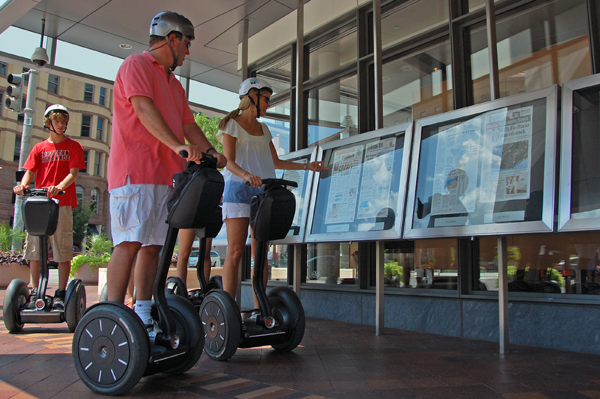
Segway-equipped tourists browse the daily front pages - one from each state - posted in front of the Newseum each morning.


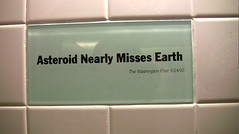
I went to the Newseum's restroom, a place with shiny tiles on the walls that said things like "Asteroid Nearly Misses Earth." It was a newspaper headline likely botched by a copy editor who didn't know that "nearly misses" means it didn't miss. It was a second-day story about the end of the world.

When someone outside the media realm asks me what I do, I say I'm a journalist. If I have time for a conversation, I say I'm an editor. If there are La-Z-Boys and coffee nearby, I sit down, take a gulp and explain what I really do as a copy editor.
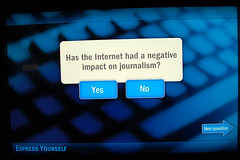
Copy editors are superhuman. They're supposed to catch the asteroid before it hits Earth.

But because many people outside the world of newspapers don't understand what we do, I should ask: If copy editors ever go away, will anyone notice?

Lawrence Downes of The New York Times says no, as manifest in his trip to Washington's Newseum, a museum of news and journalism that lacks - by name, at least - a copy editing exhibit.

2newseum_0115In June, he wrote "In a Changing World of News, an Elegy for Copy Editors," an editorial that stirred ire among "testy" copy editors. They felt slighted that their jobs are becoming less significant in the Internet's get-it-right-first, no-time-for-picky-editing news cycle. "Copy editors are being bought out or forced out; they are dying and not being replaced," he wrote. Because copy editing isn't represented at the Newseum, it's obviously being forgotten.

"I thanked Lawrence for making me feel completely hopeless," Phillip Blanchard, who worked at The Washington Post until he got bought out, said on his Web site, TestyCopyEditors.org.

Downes and I received some of the greatest training possible for copy editors. We both went through the Dow Jones Newspaper Fund's training program and were taught by Ed Trayes, a co-founder of the fund, at Temple University. We both interned at Newsday. We both know the value of copy editing, the phenomenon Downes says is taking its last breath.

"I’m still an editor at heart," he wrote in a post this week on Trayes' blog. "Editors - copy editors in particular - are underappreciated and overabused."

In just a year of full-time work as a copy editor, I could not agree more. We rarely get credit for our work unless we design a sterling newspaper page or write an award-winning headline. We toil when most people are sleeping. And it's the work that doesn't appear in the newspaper that is our best: stories we have spiked, sparing plagiarism from print; misspelled names we have changed, skirting an embarrassing correction; libel we have caught, avoiding millions in legal penalties; headlines we have tweaked, preventing the end of the world.

Like Downes, I went to the Newseum. But I saw something different.

In each display - the 383 memorable front pages, the historic mistakes, the prize-winning stories - I saw something that reminded me of what I do every day. As I browsed, I thought: I could have improved that headline; I would not have made that error; there were copy editors behind that Pulitzer.

But I was especially proud when I went to the restroom. On the wall were headlines - likely written by copy editors - that should have never been published: "Panda Lectures at Zoo" (always knew they were smart); "Woman Found Dead in Trunk Kept to Herself, Neighbors Say" (obviously); "Actor Sent to Jail for Not Finishing Sentence" (should happen to reporters, too); and, as mentioned, "Asteroid Nearly Misses Earth" (a New York Times story that the Daily News is undoubtedly mad that it overlooked). As do our triumphs, our screw-ups show our value.

But the fundamental issue is not whether a museum of news shows copy editors' part in history. It is not whether copy editors will matter in the future. The question all journalists - reporters, photographers, copy editors - should ask themselves is this: Are we all, because of our traditional beliefs, becoming extinct?

This "webby" focus and inability to "generate Google hits" with traditional methods - which Downes says are diminishing the copy editor's role - are doing the same to the reporter, the photographer and the editorial writer.

At most newspapers, copy editors don't have time to sit down and edit a story for an hour. But at all newspapers, most reporters don't have time to sit down and write a story for an hour. The Web has changed copy editors no more than it has changed reporters.

The most interesting exhibit I saw in the Newseum foreshadows all journalists' futures. It was about social media, the ability of everyone - including the people who have never heard of a "copy editor" - to make and produce news and to disseminate their opinions.

So if copy editors were wiped from the Earth, would anyone notice?

People noticed "Dewey Defeats Truman." They noticed Jayson Blair. They noticed New York Times v. Sullivan.

If Downes' death knell rings true for all newspaper journalists, not just copy editors, the Newseum will have to dedicate more than just a restroom to the historic blunders of news.

It will mean the end of the world every day.

__________

1newseum_0211
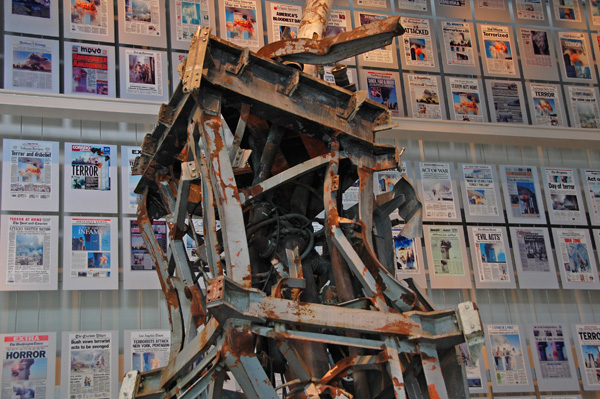
Copy editors touched each one of those pages from Sept. 12, 2001, behind the antenna mast from the North Tower of the World Trade Center.


2newseum_0218

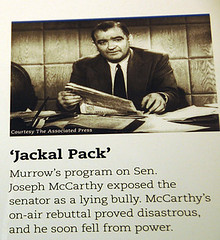
The Newseum could use a copy editor. The Edward R. Murrow exhibit gives the CBS broadcaster credit for exposing Joseph McCarthy as "a lying bully." Murrow wasn't even close to being the first one to attack McCarthy. He simply used newspapers to show the evidence against him. Far from groundbreaking.


1newseum_0112
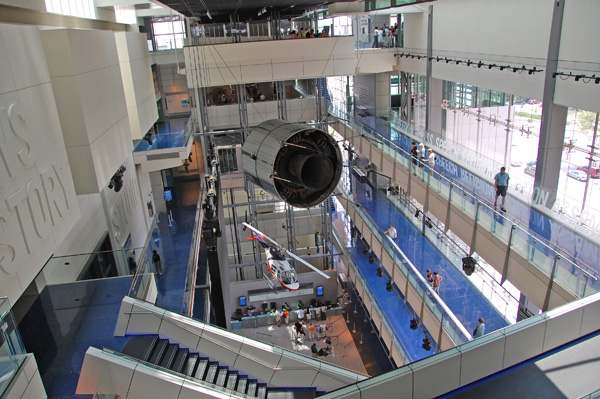
The heart of the Newseum features a replica of a communications satellite.


1newseum_0099
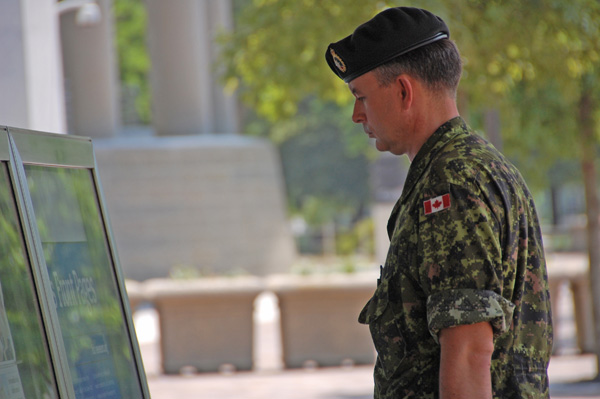
A Canadian soldier looks at the international section of the day's front pages in front of the Newseum. The Canadian Embassy is next door.


sentinel_newseum_0158
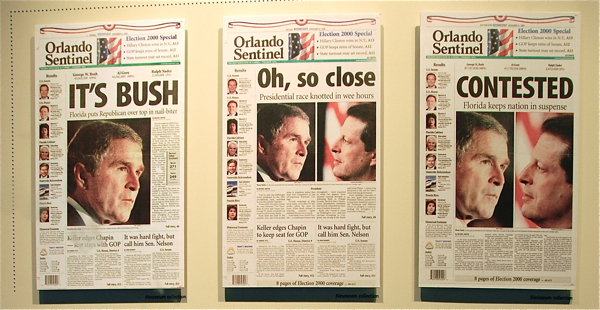
A trilogy of headlines all from the same night in 2000.


1newseum_0109
W. Joseph Campbell, a professor of mine, wrote most of the captions for the 383 historic front pages featured at the Newseum.

Tuesday, May 6, 2008

Academic blogging should be an epidemic

More journalism educators should blog. Professionals, professors and students could learn a lot from blogs by j-school insiders.

Two of the foremost blogging professors are Doug Fisher of the University of South Carolina and Andy Bechtel, left, of the University of North Carolina in Chapel Hill.

I'm especially eager to see what Bechtel writes about his upcoming summer as an intern at the Los Angeles Times. That's right: a 40-year-old intern. (It's nice to have connections.) Go here for more.

Yesterday, Bechtel became the second of the aforementioned j-profs to mention The Offlede's work at the American Copy Editors Society conference in Denver. For the sake of gratitude and cross-promotion, here's a link to that post, which links to my Smokin' ACES home page. He gave me "The Last Word from Denver."

Thanks, professor.

Sunday, May 4, 2008

Video: Smokin' ACES: An overview of my time in Denver


I shot this video using my Canon point-and-shoot digital camera, so again, the quality of sound and picture just isn't there. At least I finally mastered video exporting in Final Cut. My videos can only get better after this.

I used Viddler for this one because it allows larger files than YouTube. But if you want to see the YouTube version, go here.

Oh, and if I knew how to change that stupid look on the preview frame, I would.

Sunday, April 27, 2008

Smokin' ACES: Premier editing professor Ed Trayes gets it

TrayesACES
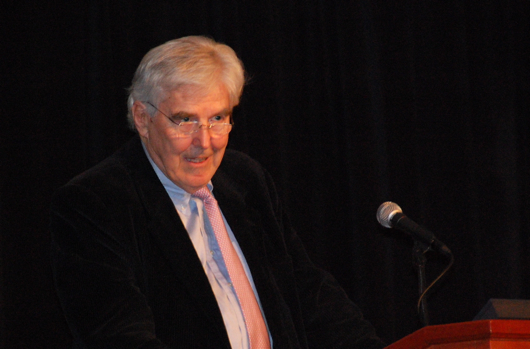
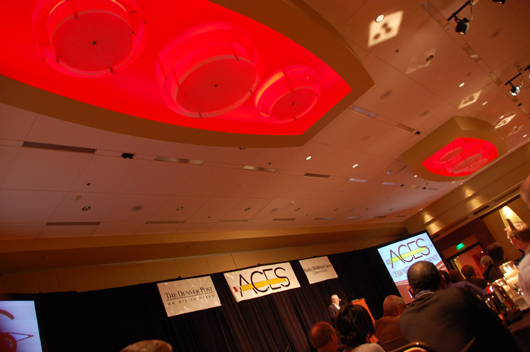
Temple University professor and Offlede mentor Ed Trayes delivers the keynote address at the 2008 American Copy Editors Society national convention in Denver.


If it weren't for a single person, I wouldn't be where I am today. I might be reporting at some tiny community newspaper in North Dakota.

But because of Temple University professor Ed Trayes, I'm a copy editor. And I'm proud of it.

I had the privilege of being taught by Trayes for two weeks as part of my training for The Dow Jones Newspaper Fund editing program. As a fund co-founder, he has led more than 50 such residencies.

After that boot camp last spring, I spent the summer at Newsday as probably its last Dow Jones intern.

It's because of Trayes that I value my role as a copy editor more than I would as a reporter. Copy editors are the quality controllers. We know a lot so that nothing will slip by us, whether it's about Brad Pitt or George Bush.

It was appropriate that Trayes was the keynote speaker for my first American Copy Editors Society national convention. And for a guy who has spent decades training young journalists, he knows that it is our flexibility in adapting to new media that will determine our future.

"No journalist's job has changed more than the copy editor's," he said. "And no group has handled change better, been more nimble, ever going forward, ever adapting, succeeding."

Trayes said that some publications have shot themselves in the foot by trying to attract all audiences through the "slicing and dicing" of content. A focus on a broader readership results in a poorer diet of news.

"So often the competition is we - ourselves," he said.

Today's world is one of shorter attention spans. Instead of actively seeking it, readers want the news to come to them. Commuters at metropolitan train stations will check a box of free newspapers, find it empty, then walk away disappointed - all as a box of 50-cent papers sits full, forlorn, almost untouched.

Trayes said publishers should give away newspapers. Maybe then, we could make those commuters happy.

But the greatest challenge to newspapers, to journalism, is not price; it is time. Technology has trimmed the news cycle from 24 hours to 24 minutes, "probably less," he said. But copy editors will not, must not, get lost in this frenzy.

"Technology ... will not kill us," Trayes said. "As long as there are words to be written, there will be copy editors with whatever at the time is the technological equivalent of a sharp pencil. ... With this in mind, technology and the lifestyles of today - how people choose to get news and information, how they choose to spend their time - will change us."

Technology certainly has changed me.

In the past several months, I have gone from a copy editor of words to a copy editor of media. The new tools that make the news richer - tools such as video, photos, blogs and the general wide world of the Web - must be viewed with the unique and critical eye of a copy editor. We know the genuine from the contrived, the worthy from the weak. When I trained in video editing, I said it is a job that is natural for a copy editor because video is also about details.

After Newsday, I took a job at a company with forethought, with a vision for the future's journalism that is dominated by new media. Copy editors' jobs have changed from the strict editing of words to pagination and design. Now, we must adapt to the online world. And we can't sit back. We must speak up to ensure quality.

"It is up to each of you to meet the challenges as they come while taking an active role in determining what copy editors can and must do in the years ahead," Trayes said.

Some people have criticized my views that traditional copy editors have fallen behind because they have not met the challenges of today's technology. They do not understand how to use it. They do not even understand its uses.

"For at least some of you, if not most of you, the next great battle is online editing," Trayes said. "Editing for Web sites and other venues must have the same standards as print. There is no doubt about copy editing being under attack in this area."

Trayes arrived the morning of his keynote address at the convention's host, the Marriott in Denver. He attended the panel discussion about online editing at which I spoke. I thought his presence would make me nervous, but it put me at ease: I knew he would support, if not agree with, what I said.

In my closing words, I said, "Because of the scrutiny that our Web sites are subjected to, it’s absolute that the next generation of online news producers should be us – traditional, well-grounded, smart and unreasonably critical copy editors. Our reputations are at stake."

In his closing words, Trayes said, "Readers, online and otherwise, count on, depend on, what copy editors pass along as true, accurate and fair."

We may be ignored, but we are not insignificant. We are not powerless.

We are copy editors. We balance the scales of journalism justice. That will never change.

billconnoly0032
Bill Connolly, formerly of The New York Times, spoke after Trayes.

trayesknapp0037
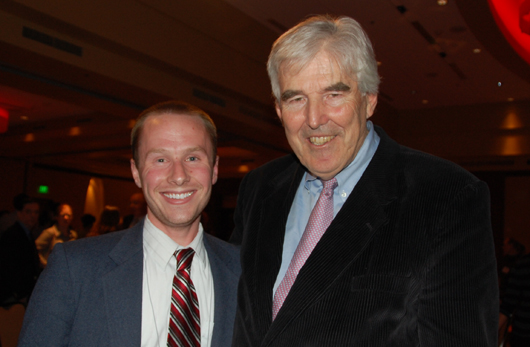
Trayes and I after his keynote.


Friday, April 25, 2008

Smokin' ACES: Florida Today, small papers stand among giants of online editing

wholepanel
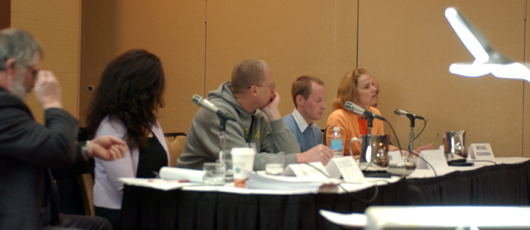
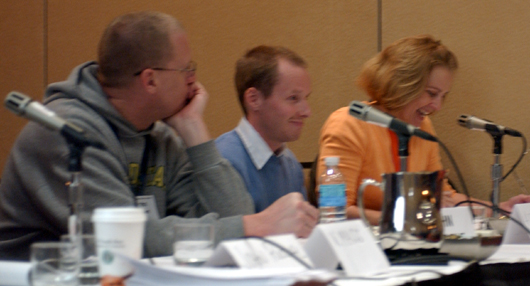
From left to right: John Russial, University of Oregon; Valerie Mass, The Denver Post; John Boogert, Rocky Mountain News; Andrew Knapp, The Offlede (and FLORIDA TODAY); and Amy Hubbard, the Los Angeles Times. Michael Roehrman of The Wichita Eagle is hiding behind Hubbard. Boogert gave Mass a difficult time throughout the session because they're cutthroat, but friendly competitors.

threeofus
Photos by Daniel Hunt, Flickr


Several weeks ago, after being in my first full-time job for six months, I was preparing for the American Copy Editors Society national conference. It would be my first.

So when University of Oregon professor John Russial asked me to participate in a panel about online editing, I was hesitant to accept. I told him that I was inexperienced and relatively immature, but he still thought I would be "a good addition." So I accepted. And I'm glad.

I presented my opening statement alongside Amy Hubbard, the copy desk chief for Travel, Real Estate and Books at the Los Angeles Times, and John Boogert, Internet news editor at the Rocky Mountain News. Even Hubbard was nervous when she gave her speech, so that put me at ease.

Russial first presented his study about the editing of online products at newspapers. He surveyed 210 publications and divided them into three size categories. I don't have many details, but these are a few things I jotted down.

Twenty percent of the largest newspapers said they don't edit online stories.

Of all papers that do edit online, there's a 2-1 ratio of editors who have editing experience to those who don't. But copy editors would say "editing" experience doesn't mean "copy editing" experience.

Of the newspapers that don't edit online stories, 59 percent said they don't because it delays posting, and 42 percent said they don't have enough employees.

But the most striking result in Russial's study is that smaller newspapers are, for the most part, doing just as well as the larger ones when it comes to online editing.

For example, Michael Roehrman of The Wichita Eagle, which is about the size of FLORIDA TODAY, said that all stories are given to the day or night copy desk to be edited, then sent to the Web site. The Eagle was surveyed in Russial's study. FLORIDA TODAY was, too, and that's why Russial asked me to join the panel.


Represent!

At FLORIDA TODAY, online producers are responsible for editing and for the technical maintenance of the site's function and aesthetics.

My opening statement about how editing is done in Brevard County was well-received. People came up to me several times for the rest of the conference to talk about FLORIDA TODAY. I was a proud ambassador.

To look at my speech, click on either the Word version or the PDF version.


Editing blogs

In Russial's sample, one of three newspapers did not edit blogs. Of the sites that didn't edit blogs, 70 percent said blogs were solely the writer's responsibility.

Hubbard said the Times assigns blogs to copy editors to edit whenever they have time. It's not a regular part of their duties. This seems like a good way to handle blog editing.

Some people argue against blog editors because they risk taking away the writer's voice. But what about accuracy? What about embarrassing errors? Andy Bechtel of the University of North Carolina talks more about blog editing here.

Copy editors don't edit FLORIDA TODAY blogs. Instead, an assigning editor oversees them, so there is some quality control.

It isn't always practical to have a copy editor for a blog, such as in the case of FLORIDA TODAY's space team. Some blogs are 24-hour features that are updated from home or from the field. For example, our NASA reporters blog from Mission Control in Houston at 3 a.m. when no one is on duty in Florida.

The only thing that I ask, however, is that bloggers learn to write headlines.

Session information
  • Title: "Online Copy Editing: What’s Being Done, What Could Be Done"
  • Time: 10:45 a.m. to 12:15 p.m. Friday
  • Panelists: John Russial, University of Oregon; John Boogert, Rocky Mountain News; Amy Hubbard, Los Angeles Times; Michael Roehrman, Wichita Eagle; Valerie Mass, Denver Post; Andrew Knapp, Florida Today
  • Description: "A look at who’s editing what online, and how little copy actually is being edited before being posted. The problem runs from small to large publications. But some newsrooms have created online copy editing positions, and others are experimenting with schedules, desk structures and other things as a way to get online copy read."
Smokin' ACES home

Smokin' ACES: Trimming fat is a big part of copy desk's job

trimmingfat


This post is pretty straightforward. Copy editors often are charged with trimming large stories into smaller ones, sometimes considerably smaller ones. It's increasingly becoming a reality as our readers' attention spans shorten. I'll just present my notes in bullet points for any editor who wants to pick up a few tips.


Types of trims

  • An inch or two
  • Slash and burn: cutting a story by several inches
  • From a story to a brief
  • From a story to a sentence or two (FLORIDA TODAY has a page of summaries for the big articles of the day. It's called the 5-Minute Read. Each item is a sentence or two.)

Obstacles
  • Deadlines, especially online
  • Shrinking news hole and staff size
  • Pressure for shorter stories and fewer jumps
  • Alternate story forms (design-heavy stories)

Options
  • Make use of cutlines: Don't repeat the same information from the story.
  • Let graphics and text boxes share the load: Again, this text shouldn't regurgitate the story.
  • Use the Web.
  • Cut carefully with the reader in mind.

An inch or two
  • When a story is close to fitting, edit it thoroughly before trimming: Find words and phrases to cut.
  • Trim excess details and quotes.
  • Summarize and condense.
  • Pull back lines if your publishing system allows it: Watch out for widows.

Slash and burn
  • When you have a lot to trim, remember the inverted pyramid.
  • Read, but don't edit, the entire story.
  • Pick an ending point. Deal no more with what's below that point. (Turn a major trim into a minor trim.)
  • Look for optional trims in wire copy.
  • Keep the "new news."
  • Keep the explainer (why you should care about the story).
  • Keep the "talker" (something you would tell a co-worker tomorrow at the water cooler).
  • Keep the methods and disclaimers on scientific and poll stories.
  • Keep the he said/she said (both sides of the story).
  • Cut the excess, and summarize the essential.

Caution
  • Make sure you keep the first reference of names.
  • Don't end on a transition.
  • Make sure the story ends somehow, not necessarily with a quote.

Briefs
  • Use just the facts: Leave out quotes.
  • Craft a focused lede.
  • Use quotes only if they're effective at getting the story across.

Web streamlining tasks
  • Breaking news
  • News updates
  • Night-before stories (big teasers to print edition)
  • Summaries for multimedia projects
  • All of these elements require a short style, which often is achieved through trimming.

Breaking news
  • When a car accident happens around 4:30 p.m., put the traffic information at top. Do this especially if people are injured. Later on, the lede might change to stress injuries or fatalities.

Session information
  • Title: "Tighten Up! Trimming the Fat, Trimming to Fit"
  • Time: 9 a.m. to 10:30 a.m. Saturday
  • Panelists: Andy Bechtel, University of North Carolina; Lisa McLendon, Wichita Eagle
  • Description: One of the underrates skills that a copy editor must have is the ability to trim: Cutting huge swaths, excising an unnecessary paragraph of two, posting parts of stories online first, even if the whole story is in. But trimming isn't just about fitting the story to the page. Just because there's unlimited space on the Web doesn't mean readers wants 1,600 words. This session will cover trimming for both situations: fitting stories into a print publication and streamlining for the Web.
Smokin' ACES home

Thursday, April 24, 2008

Smokin' ACES: Words will be words, unless your dictionary says otherwise (but it probably doesn't)

erinmckean0013
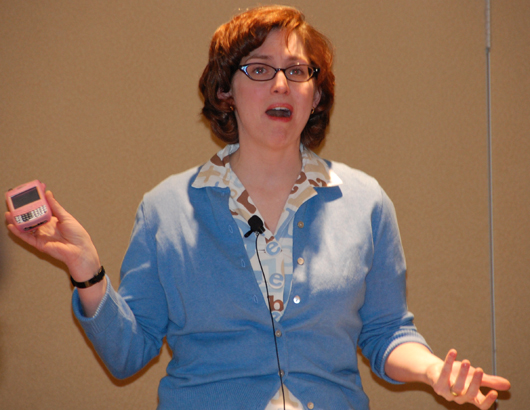
I can't remember, but I think Erin McKean was looking up a word on a BlackBerry as I snapped this. ... Sorry, Erin. But look! She's got letters, which make words, on her dress.


Words are surprisingly entertaining. So that means a book of words, also known as a dictionary, could be a good piece of literature to curl up to on a cold January afternoon.

Not necessarily. As I will explain later, there's danger of death when you do that.

But dictionaries do offer some fuel for debate and are often the main weapons of copy editors when attempting to shoot holes in a reporter's deranged word usage.

But copy editors should remember: Just because a word is in the dictionary, we don't necessarily have the right to use it.

Erin McKean, the dictionary evangelist and chief consulting editor at Oxford University Press, asked copy editors at their 2008 geek fest in Denver what they want in a dictionary.

For me, all I ask for is a sound compilation of words with definitions that are easy enough for a reporter to understand.

But copy editors often use the dictionary as ammunition against readers, too.

My boss has mentioned on a few occasions that readers have complained about using the word "tank" to describe a team or business that founders.

Yes, dear reader, the noun "tank" is a sort of military vehicle, but it also is a verb meaning to decline, to sink or to otherwise fail miserably. It's in the dictionary. Look it up.

But the dictionary doesn't have your back 100 percent of the time. You can't always interpret it literally. McKean's example was "hackles," which a dictionary might say are the hair on a dog's neck. But the entry might not say that it means temper or anger that becomes visible when you see the neck hair stand up. The sentence "The boy pets the dog's hackles" would just be wrong.

Even though the definition of a word is technically correct, it's use as such in a sentence just may not fit. But the dictionary doesn't tell us that. In this case, a copy editor can't point to a dictionary when saying, "I told you so," to a reporter who insists on using "hackles" in that manner.


A case for online dictionaries

So, copy editors need something to explain why a sentence is "just wrong."

That's where extensive etymologies and usage dictionaries could come in handy. But the space needed to print them would be mind-boggling.

"The paper book is just too limiting," McKean said. "They can't show the supporting evidence."

Newspapers have found the print product limiting, and dictionaries should follow their lead by migrating online. Cyberspace offers forums for comments on words and their various usages, sometimes depending on regional dialect. They also offer efficient searchability, a time saver that would help the copy desk.

Probably the best online dictionary is Merriam-Webster. Some of my fellow copy editors are known to look up more words on m-w.com than in the proper, Associated Press-sanctioned Webster's New World College Dictionary, Fourth Edition.

This is too bad, of course. Though Merriam-Webster bills itself as the direct descendant of legendary lexicographer Noah Webster, many circles see it only as the "slut" dictionary: It allows almost everything between its binders.

Ironically, Merriam-Webster seems rather bitter on its Web site. Under the frequently asked question "Are all Webster's dictionaries alike?" (which is answered "no"), it says: "In the late 1800s and early 1900s, legal difficulties concerning the copyright and trademark of the name Webster arose, and eventually many different publishers — some rather unscrupulous — began putting dictionaries on the market under the Webster's name."

I don't care. You're still a slut.


Words are fun when they're hopped up on caffeine

Where McKean really shined was in her humor and insight. Dictionaries can be fun.

She mentioned two words that irk her: "slacks" and "moist." I don't see their irksome nature. Of course, in Florida, if you dress up in a suit during the humid summer months, what do you get? Yup, moist slacks, and I guess they are a bit irksome.

McKean exposed a little-known fact about lexicographers. Because they guard their work closely, they make up words to see if other
lexicographers will steal them. A good example is "esquivalience." Go to this New Yorker article for more.

Also, the Dictionary of American Regional English, or DARE, contains definitions from all the great sections of the United States. McKean mentioned the long-debated words for a soft drink.

These are my theories behind the soft drink variations:
  • pop (Upper Midwest)
  • coke (Lower Midwest and South, specificallyespecially Atlanta)
  • soda (Northeast)
  • tonic (Canadian border regions, such as my hometown)

Safe and deadly ways of improving vocabulary

This was the only session I attended with co-worker Beth. As we listened to McKean, I asked Beth, "What do you think she scored on her SAT?"

So, to get smart like her, McKean suggested two methods. One is safe. The other is fast and dangerous, possibly deadly.
  • Safe: Up your reading. Buy a bunch of magazines you wouldn't normally buy, ones that are out of your comfort zone. If you're the Vanity Fair type, buy Forbes. If you're the Forbes type, buy Vanity Fair.
  • Fast and dangerous: Buy a word-a-day calendar (or look at The Offlede's "Word of the Day" feed on the right sidebar). The danger is that you won't have the context to the use the word in a proper sentence. McKean said a child once told his librarian, "My family erodes a lot," because he learned that the definition of "erode" is "to eat away" or "to eat out." The boy meant to say, "My family eats out a lot." Also, high-security inmates with access only to dictionaries, not real books, are guilty of memorizing words without context. "You don't want to sound like someone writing from death row," McKean said.
Session information
  • Title: "Tell Me What You Really Want From Your Dictionary"
  • Time: 4 p.m. to 5:30 p.m. Friday
  • Presenter: Erin McKean
  • Description: Once you really get some traction as a copy editor or journalist, you start to see the holes that all dictionaries—even great dictionaries—have. Words you can’t find. Unclear usage information. Ambiguity abounds, and trying to get a definitive (no pun intended) answer can be tricky, especially on deadline. But dictionaries can’t fix what they don’t know is broken. Come to this session and vent to a real-live lexicographer ... and learn about some new and exciting (and more importantly, more helpful) dictionary features that are just around the corner!
Smokin' ACES home

Wednesday, April 23, 2008

Smokin' ACES: Ex-Freep editor is fond of the weird and short

freepmast
"On guard for 176 years," and Alex Cruden was there for almost 40 years of it.


Alex Cruden, longtime editor at another Gannett publication, the Detroit Free Press, reflected on his 40 years in daily journalism. He just took a buyout in March.

This was actually the last session I attended at ACES, but it was one of the best. Oddly enough, however, I didn't take many notes. I must have been too engrossed in his wisdom. (Cruden is at left. Photo by Daniel Hunt, Flickr.)

This is the one thing I wrote down, and it's a quote from Cruden: "Be willing to not only tolerate the unusual; try to enhance it." He was talking about the editing process and how it's paramount to accentuate what makes news, news.

Cruden distributed a handout about how to edit on a tight deadline. He offers a 14-step process. For the Word version of the guide, go here. For the PDF version, go here. Click it. Print it. Learn from it.

The closing two sentences of his biography in the ACES conference program were: "As an editor, he has a fondness for short sentences. And irony."

I know a few flowery-writing reporters who could benefit from his insight.

Session information
  • Title: "40 Years in 90 Minutes"
  • Time: 2:15 to 3:45 p.m. Saturday
  • Presenter: Alex Cruden, Detroit Free Press (retired)
  • Description: "Cruden will offer a one-page handout and lead a discussion based on distillation of four decades of daily journalism. What’s most valuable amid the tread of deadlines and the blare of online? What skills should an editor cherish, and expect to be rewarded for?"
Smokin' ACES home

Tuesday, April 22, 2008

Maybe that traitorous interrobang should just be shot

freepfrontinterro

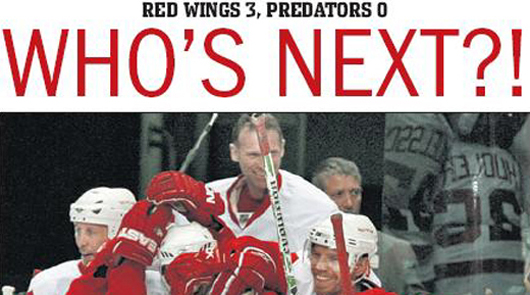
Browsing through the Newseum's front pages yesterday, I noticed the either deft or dimwitted use of the interrobang on the front page of the Detroit Free Press.

Ideally, the interrobang is formed by visually blending a question mark with an exclamation point, as you see to the left. Few pagination and word processing programs allow such blasphemy, so we must settle with side-by-side marks of punctuation whose usages are merged. I'll call it a "severed interrobang." OK?!

There are three common uses for an interrobang:
  • To excitedly pose a question
  • To convey excitement or disbelief through a question
  • To ask a rhetorical question.
And, of course, the word "interrobang" itself is derived from interrogation (asking a question) and "bang!," which is slang for an exclamation point. So, to use an interrobang is to ask a question with a bang.

Its origin has been traced to media advertiser Martin Speckter, who supposedly invented it as a convenient way to express incredulity.

I suspect its frequent usage today in our sacred English language is another casualty from the slaughter that electronic communication has committed. How many times have you seen your instant messaging buddy respond to you like this:

WHAT?!?!?!

My problem always is deciding which order the question mark and the exclamation point should be arranged in. The question is: Which is the most important mark of punctuation? The first? Or the last?

I'm guessing it's the last because that's the one that makes the lasting impression, the punctuating cherry on the top. In the case of this headline, it's an exclamatory cherry.

The question mark says, "Seriously, who's next? I wanna know so we can start watching film."

The exclamation point says, "Grrr, who's next? Who wants a piece of me? Bring it on!"

Of course, the severed interrobang flies in the face of the old rule that a sentence should end in a single piece of punctuation. Sentences that end, say, with a interrogatory title cannot escape that rule's jurisdiction. Example:
  • I used to watch "Where in the World is Carmen Sandiego?"
It's not:
  • I used to watch "Where in the World is Carmen Sandiego?".
The latter would be silly.

But what would happen if the headline had just one of those punctuation marks?

WHO'S NEXT?
  • Borrrrrrring.
WHO'S NEXT!
  • Wrong.
So in the old world, the severed interrobang would be sacrilege. But in the new world, it might work.

After all, the use of punctuation, as opposed to grammar, always has been somewhat interpretative. Even The Associated Press admits this. Its stylebook says: "The punctuation entries in this book refer to guidelines rather than rules. Guidelines should not be treated casually, however."

But let's remember that the person who invented the interrobang worked in advertising. So putting it in a front-page headline is not just melding two marks of punctuation; it's also combining news and advertising.

A simple punctuation mark, the interrobang, could be responsible for the fall of the wall between church (advertising) and state (news).

Saturday, April 12, 2008

Copy editing = great; copy editing with a view = even better

fromatop0016

constructioncranesview0048

John Boogert, news editor at the Rocky Mountain News with whom I joined on a panel about online editing, took a large group of copy editors on a tour of the building that houses the Rocky and The Denver Post. I'll post more about it later and more about the technical side of editing, but I just wanted to pass on a few photos of the view from atop the building. Rocky Mountain High, Colorado!

Smokin' ACES home

Monday, April 7, 2008

Small-town Northern man from south goes west on a jet plane

dadfishing0007
Goin' fishin' with pops is a favorite pastime in a small town that has a lake.


I'm not sure why, but I've been listening to a lot of country music lately. It's likely because I live in the south now (but not the South).

It seems that every country song has something to do with a small town. Some feature "small town" in their titles: Miranda Lambert's "Famous In A Small Town," Kenny Chesney's "In A Small Town," Alan Jackson's "Small Town Southern Man," Kellie Pickler's "Small Town Girl" and Hal Ketchum's "Small Town Saturday Night."

And then it seems that every so-called "good" memoir is about a poor kid from a small town who makes it big, i.e. Al Neuharth.

Please. Stop.

"Small town" these days means 30,000 people. Where I grew up in Princeton, Maine, 30,000 was a big city.

To be exact, Bangor, a city of about that many people, was two hours away. As a child, I would look forward to the once-monthly, two-hour treks to the big city to do some shopping. Bangor had a Wal-Mart and a mall with a Dunkin' Donuts, a treat I couldn't get back my hometown of 892 people (I got mad when they discontinued the strawberry cheesecake doughnut). The nearest city, Calais (about 2,000 people), had shopping meccas such as the salvage-surplus store, Marden's, and the now-defunct Rich's, which was like an expensive but trashy Kmart.

And just tonight, I heard a country song that said "a left will take you to the interstate." There was no interstate where I grew up, only two-lane paved roads and one-and-a-half-lane dirt roads.

People who say they're from a small town here in Florida are partially lying. Most every little town here is located near a big city. Suburbs don't count as small towns. A co-worker is from the rural Lawtey (673 people), but it's only an hour from Jacksonville, Florida's most populous city at more than 800,000 people. Maine's biggest city is Portland, which has about 60,000, but it's five hours away from my hometown.

I'm going to segue this rant against "small town" wannabes into my current predicament: impending air travel. As a small-town sheltered boy, I rarely traveled to another state. Most of my trips were to another country: Canada was only 20 minutes away (but even that was rural).

My first time on an airliner was when my parents took me to Florida as an infant. I don't remember that. The second time was when I flew to Orlando in July for an interview with my current employer. Yup. That's right. I don't get out much.

But this year, I have four air trips planned, and the first is coming Wednesday when I fly to Denver for the American Copy Editors Society conference. I've been checking out Southwest Airlines' Web site for regulations on how much luggage I can lug onto the plane. I think I'll be set with my computer bag also holding my camera and a backpack of clothes. I'll be in Denver until Sunday.

This trip will be the farthest I've ever traveled from Maine, the farthest west I've ever been and tied for the highest in elevation. Maine has a mile-high peak that I've climbed several times, so Denver doesn't quite take the entire cake for that honor.

But this small-town boy is a big fan of big cities now, so I guess Denver is just next on my list (after New York, New Orleans, Philadelphia, Tampa, St. Petersburg, Washington, Baltimore, Hartford, Halifax, to name a few). But the best cities are ones that still have the small-town feel of some of the more rural areas of their host states. New Orleans, for one, is a town I described as a sort of "urban bayou," which means it still has down-home characters amid the excitement that a city has to offer.

So I'm saddling up, expecting a unique Western experience in a big town (call it what it is).


View larger map

Saturday, March 29, 2008

Reminiscing with the future in mind

kites14jefferson
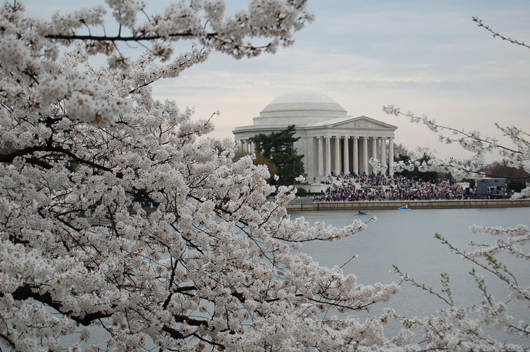
At this time last year, I was in Washington taking photos of the Jefferson Memorial during the National Cherry Blossom Festival. All that reminiscing has got me thinking about how my past has plowed a road into the future (and all that philosophical baloney).


I rarely talk shop on The Offlede, and I doubly rarely get too personal with my posts for fear my boredom could be contagious. But there are a few happenings coming up that excite me personally on a professional level (if only that made sense).

First, next week will present my first chance for in-house training at FLORIDA TODAY. I was promised it when I was hired, and now, it's being delivered - with food.

With about 20 other journalists - including higher-level editors, reporters, you name 'em - I'll be learning to produce publishable video from start to finish. Gannett trainers are coming in with the equipment and the know-how. I'm going to be grouped with two reporters. We'll report, shoot and edit. I'm severely lacking in this skill set, so once I'm proficient (that is the goal), I hope to be an all-around-darn-good journalist. And we're being fed breakfast and lunch each day, so what' not to like about this training?

Second, in order to do some of these tasks for myself and for this blog, I'll soon upgrade my computer to a MacBook Pro. The current Toshiba machine has slowed with age. It trembles during simple tasks such as looking for the definition of "za" on m-w.com (a horrible dictionary, by the way, but sometimes, it's just darn convenient). "Za" is not a word, according to Merriam-Webster online.

My video training will last four days of about 12 hours each. In addition, I'll be working one normal day, so next week won't be a cakewalk. But overtime is good for the personal economic state.

Oh, and in case you don't know what I do, I'm a copy editor, a post that is responsible, among other things, for editing stories, writing headlines, then crunching them to fit onto the printed newspaper page. Copy editors are the last line of defense: If we don't catch a major error committed by a reporter or another editor - and there are many - then the compound is infiltrated and newspapers go down in defeat (but don't for a second blame the news industry's state on me).

Third, I'll be heading to Denver for my second external training mission (the first was a newspaper design conference in Tampa). That will be the three-day national conference of the American Copy Editors Society (but I'll be there for five days). I will meet with other such journalists to commiserate about our jobs and will reconnect with some old friends.

But more importantly, I'll be a panelist during one of the conference sessions called "Online Copy Editing: What’s Being Done, What Could Be Done." University of Oregon journalism professor John Russial requested my presence because FLORIDA TODAY employs Web producers who actually know a bit about editing (as opposed to those with an exclusive technological focus). I'll speak about my experience with Web producing since arriving. I love the Net, so this opportunity is perfect.

All of this has made me think about how far I've come since leaving Maine. I took the nation's capital by storm, graduated with my master's from American University, enjoyed Philadelphia and the ultimate copy editing teacher in professor Ed Trayes, left, at Temple University and loved my internship at Newsday.

I'll be blogging from Denver, so if there are any journalists reading this, you may want to stay tuned. And I guess I should take some video while I'm there, if not just to pretend I learned something.