Showing posts with label facebook. Show all posts

Sunday, March 29, 2009

Senseless in Seattle: Facebook's dream-city quiz is biased

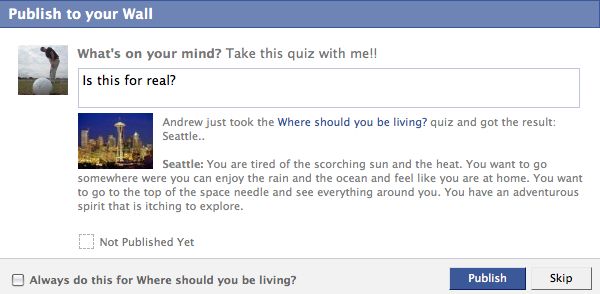
Seattle
I'll skip, please.


Facebook. I created my profile in August 2004, months after it was started at Harvard University and at the beginning of my junior year at the University of Maine. At the time, it was called TheFacebook.com because Facebook.com was occupied. I consider myself an experienced user of today's most popular social network.

My Facebook wisdom allows me to dismiss some parts of the site such as the "Where should you be living?" quiz that many of my friends have been taking. I noticed that an alarming number of them got the same answer: Seattle. Only a few got Paris. Some got "the country."

I snooped around various blogs and discussion forums, and many people have been either delighted or disappointed that they should be coffee-drinking, drizzle-loving Seattleites.

Something's fishy, I thought. And I had a theory: Someone in Seattle might be behind this. So I did some light digging.

The third-party developer of the application is Arwyn Robinson. One would think that the developer would maintain a Facebook profile, and the only Arwyn Robinson on Facebook is a high school student set to graduate in 2011.

A high school kid developed software? Not really. Actually, it's a simple quiz that can be put together in a matter of moments. Even a caveman can do it.

But the particular high school that this Arwyn attends intrigued me. It's Sandpoint High. Where is it? Near Spokane, Wash., across the state from Seattle.

The quiz asks seven questions about living preferences, including entertainment, food and relaxation. I doubt seven questions properly account for all the factors one considers in relocating. And I'm guessing that there aren't many possible answers for the quiz and that it skews toward Seattle.

In a comment section for the application, a quiz-taker says, "The stupid quiz picked almost the furthest place on earth from my current location - I live in Mauritius and it told me that I should live in Seattle (a city I admit that I quite like apart from the absence of decent coffee)."

The Internet activities that people engage in amaze me. Some are productive. Some are pointless. I'm certainly guilty of the latter, as is apparent in this post.

But as for Facebook quizzes, with all their shallowness, they aren't worth your time.

Link: To become my Facebook friend, click here. Let me know that you're a fan of The Offlede.

Saturday, April 19, 2008

Smokin' ACES: Know-it-all copy editors ask, 'What's RSS?'

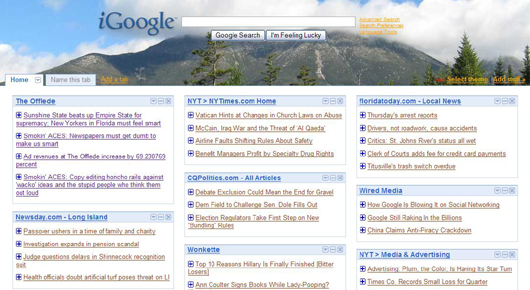
igoogle2
Many copy editors at a session I attended were clueless as to how programs such as iGoogle gather headlines through RSS, or really simple syndication.


Copy editors are supposed to know a lot. We are the masters of all. We know politics, news, sports, business, literature. You name it.

But with the Web, we're not exactly the sharpest pencils in the basket. That's cause for concern.

One of the sessions I attended at the American Copy Editors Society conference was called "Web 2.0." I was expecting presenter Doug Fisher of the University of South Carolina to go deep into the world of social media.

Fisher certainly has the capacity to do that, but he was held back by many of the old people in the audience who couldn't grasp concepts such as Twitter, RSS feeds and the YouTube.

These are some of the points I gathered from what Fisher said:
  • Two-thirds of all traffic to Web sites doesn't originate at the home page. Instead, the Web hits are through sharing services such as Digg, Facebook and del.i.cious. "Share," Fisher said, "is not a four-letter word." (It's nice to know copy editors still know math.)
  • Each news story should come with a 150-word summary attached. This gives Web surfers a teaser that could persuade them to read the story. At FLORIDA TODAY, this summary is called a "digest." Editors who know what it does actually care about what it says. For those who don't, they wonder why it's there.
  • “If the news is that important, it will find me," Fisher said, quoting a New York Times article. RSS syndicates news from multiple sources by bringing headlines onto a single Web page. When a common reader logs onto his RSS aggregating program - such as Bloglines, Netvibes or Google Reader - he is getting news on a single page instead of visiting external news sites.
  • By the questions copy editors were asking, most traditional journalists don't know what RSS is. More on that in another post.
"Why do we need to know about all this?" was the question asked over and over. Besides that "masters of all" thing I mentioned above, Web 2.0 is pretty important for the delivery and receipt of news and information in today's new media world. Not knowing it is dulling our pencils even further.

Fisher mentioned how reporters and editors can monitor residents' pages on Twitter, a microblogging service, to find out what's happening in the community. He did not mentionstress, however, how Twitter - which permits blog posts up to 140 characters - is being used as a news delivery medium by reporters such as John Dickerson, chief political correspondent for Slate.

And hey! I use Twitter and RSS together on Offlede.com. On the right sidebar, under "Offlede Tweets," you'll see my latest Twitter postings brought to the Offlede home page via RSS. How about that?

But because Web 2.0 doesn't have anything to do with that pile of inky newsprint that shows up on their doorsteps each morning, most attendees just didn't get it. Allison, a friend of mine from my Newsday days, and I jokingly toyed with asking questions such as "What is the blog? What is the Google? What is the YouTube?"

We probably would have been taken seriously, so we settled with simply laughing at everyone else. But ignorance, in this case, isn't really funny: It's a nefarious mark on journalism.

Here is the PDF handout that Fisher distributed during the session.

Session information
  • Title: "Web 2.0"
  • Time: 2:15 to 3:45 p.m. Thursday
  • Panelists: Doug Fisher, University of South Carolina; Chuck Moozakis, Newspapers & Technology
  • Description: How do you navigate the brave new(-media) world? And when it comes to technology, where are newsrooms now and what's ahead? Get a rundown of some of the top Web 2.0 tools that can make your life easier and help you navigate social media. Blogs, wikis, RSS, tags, Technorati, Furl, Newsvibes and more. Bring some of your favorite sites, too, to share.
Smokin' ACES home