Showing posts with label dow jones newspaper fund. Show all posts

Saturday, September 20, 2008

In a changing world of news, a rally cry for copy editors

1newseum_0035
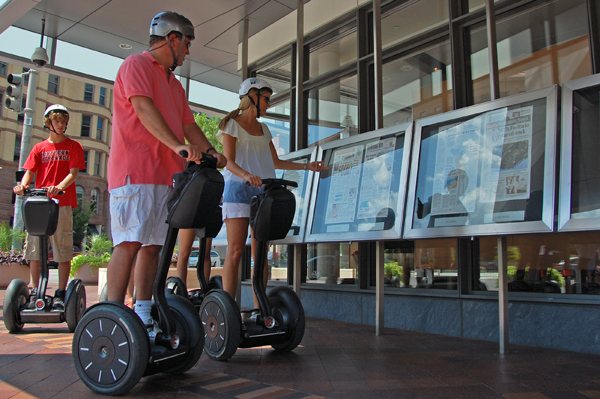
Segway-equipped tourists browse the daily front pages - one from each state - posted in front of the Newseum each morning.


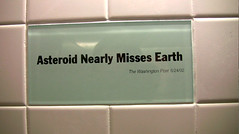
I went to the Newseum's restroom, a place with shiny tiles on the walls that said things like "Asteroid Nearly Misses Earth." It was a newspaper headline likely botched by a copy editor who didn't know that "nearly misses" means it didn't miss. It was a second-day story about the end of the world.
When someone outside the media realm asks me what I do, I say I'm a journalist. If I have time for a conversation, I say I'm an editor. If there are La-Z-Boys and coffee nearby, I sit down, take a gulp and explain what I really do as a copy editor.

Copy editors are superhuman. They're supposed to catch the asteroid before it hits Earth.

But because many people outside the world of newspapers don't understand what we do, I should ask: If copy editors ever go away, will anyone notice?

Lawrence Downes of The New York Times says no, as manifest in his trip to Washington's Newseum, a museum of news and journalism that lacks - by name, at least - a copy editing exhibit.
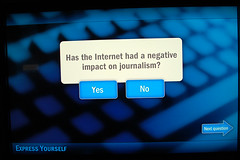
2newseum_0115In June, he wrote "In a Changing World of News, an Elegy for Copy Editors," an editorial that stirred ire among "testy" copy editors. They felt slighted that their jobs are becoming less significant in the Internet's get-it-right-first, no-time-for-picky-editing news cycle. "Copy editors are being bought out or forced out; they are dying and not being replaced," he wrote. Because copy editing isn't represented at the Newseum, it's obviously being forgotten.

"I thanked Lawrence for making me feel completely hopeless," Phillip Blanchard, who worked at The Washington Post until he got bought out, said on his Web site, TestyCopyEditors.org.

Downes and I received some of the greatest training possible for copy editors. We both went through the Dow Jones Newspaper Fund's training program and were taught by Ed Trayes, a co-founder of the fund, at Temple University. We both interned at Newsday. We both know the value of copy editing, the phenomenon Downes says is taking its last breath.

"I’m still an editor at heart," he wrote in a post this week on Trayes' blog. "Editors - copy editors in particular - are underappreciated and overabused."

In just a year of full-time work as a copy editor, I could not agree more. We rarely get credit for our work unless we design a sterling newspaper page or write an award-winning headline. We toil when most people are sleeping. And it's the work that doesn't appear in the newspaper that is our best: stories we have spiked, sparing plagiarism from print; misspelled names we have changed, skirting an embarrassing correction; libel we have caught, avoiding millions in legal penalties; headlines we have tweaked, preventing the end of the world.

Like Downes, I went to the Newseum. But I saw something different.

In each display - the 383 memorable front pages, the historic mistakes, the prize-winning stories - I saw something that reminded me of what I do every day. As I browsed, I thought: I could have improved that headline; I would not have made that error; there were copy editors behind that Pulitzer.

But I was especially proud when I went to the restroom. On the wall were headlines - likely written by copy editors - that should have never been published: "Panda Lectures at Zoo" (always knew they were smart); "Woman Found Dead in Trunk Kept to Herself, Neighbors Say" (obviously); "Actor Sent to Jail for Not Finishing Sentence" (should happen to reporters, too); and, as mentioned, "Asteroid Nearly Misses Earth" (a New York Times story that the Daily News is undoubtedly mad that it overlooked). As do our triumphs, our screw-ups show our value.

But the fundamental issue is not whether a museum of news shows copy editors' part in history. It is not whether copy editors will matter in the future. The question all journalists - reporters, photographers, copy editors - should ask themselves is this: Are we all, because of our traditional beliefs, becoming extinct?

This "webby" focus and inability to "generate Google hits" with traditional methods - which Downes says are diminishing the copy editor's role - are doing the same to the reporter, the photographer and the editorial writer.

At most newspapers, copy editors don't have time to sit down and edit a story for an hour. But at all newspapers, most reporters don't have time to sit down and write a story for an hour. The Web has changed copy editors no more than it has changed reporters.

The most interesting exhibit I saw in the Newseum foreshadows all journalists' futures. It was about social media, the ability of everyone - including the people who have never heard of a "copy editor" - to make and produce news and to disseminate their opinions.

So if copy editors were wiped from the Earth, would anyone notice?

People noticed "Dewey Defeats Truman." They noticed Jayson Blair. They noticed New York Times v. Sullivan.

If Downes' death knell rings true for all newspaper journalists, not just copy editors, the Newseum will have to dedicate more than just a restroom to the historic blunders of news.

It will mean the end of the world every day.

__________
1newseum_0211
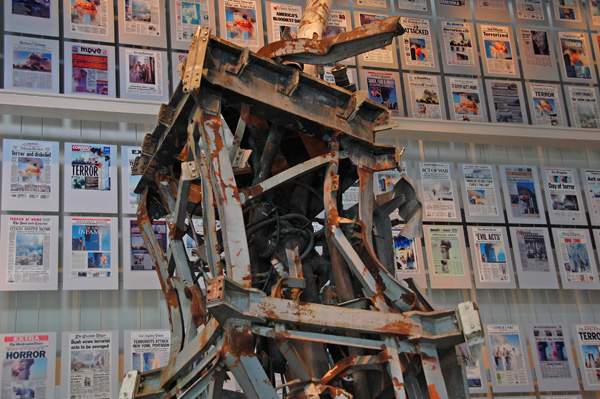
Copy editors touched each one of those pages from Sept. 12, 2001, behind the antenna mast from the North Tower of the World Trade Center.


2newseum_0218

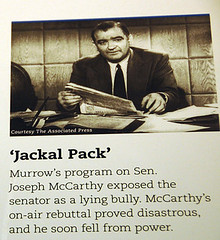
The Newseum could use a copy editor. The Edward R. Murrow exhibit gives the CBS broadcaster credit for exposing Joseph McCarthy as "a lying bully." Murrow wasn't even close to being the first one to attack McCarthy. He simply used newspapers to show the evidence against him. Far from groundbreaking.


1newseum_0112
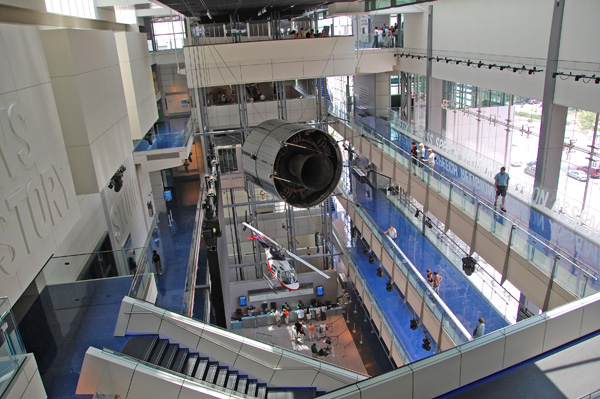
The heart of the Newseum features a replica of a communications satellite.

1newseum_0099
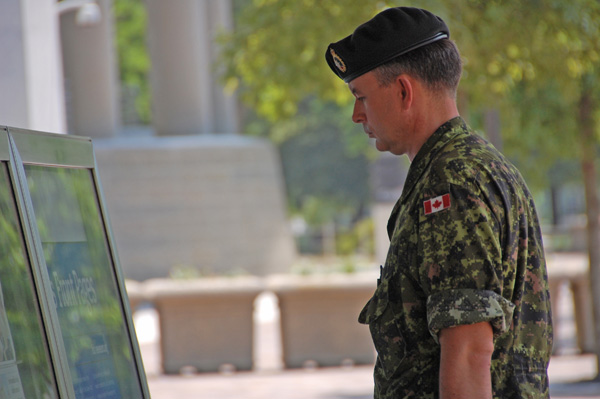
A Canadian soldier looks at the international section of the day's front pages in front of the Newseum. The Canadian Embassy is next door.

sentinel_newseum_0158
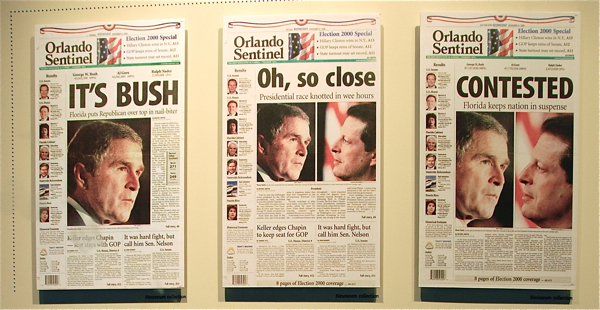
A trilogy of headlines all from the same night in 2000.

1newseum_0109
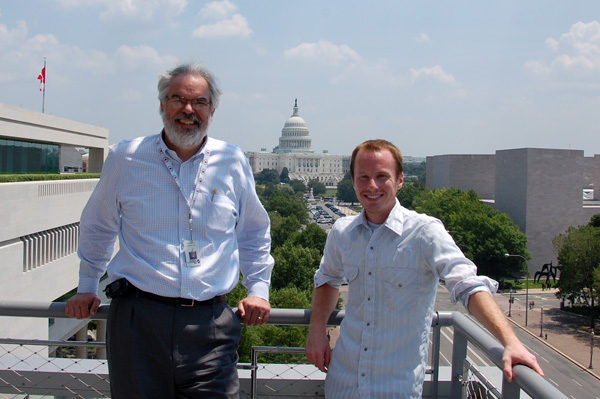
W. Joseph Campbell, a professor of mine, wrote most of the captions for the 383 historic front pages featured at the Newseum.

Saturday, July 5, 2008

Dow Jones copy editing interns blog about residency, new jobs

ConstitutionHall
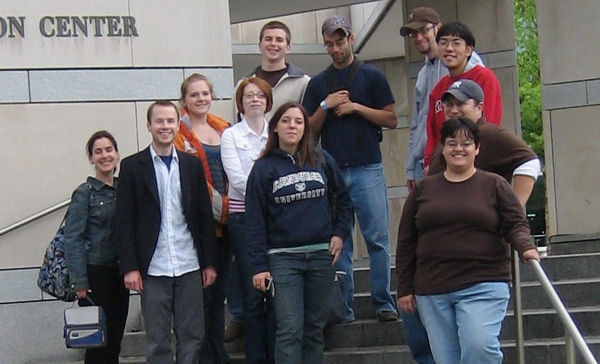
This photo was taken during the 2007 Temple residency participants' half-day in the city of Philadelphia. For most of the two weeks, we were confined to a cold classroom with a tough editing teacher. But we at least enjoyed one afternoon at the National Constitution Center, above. Can't you tell we're tired?

templecrew
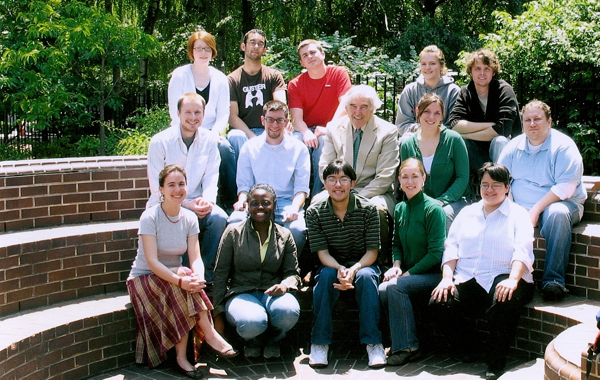
A portrait of all the suspects, including professor Ed Trayes in the center.


Update: Version on the DJNF blog here.


Just more than a year ago, my parents got a telephone call that would change my journalism career.

I was in a master's-level class at American University in Washington, and Mom and Dad were 800 miles away in my hometown of Princeton, Maine.

Mom talked to some man named Ed Trayes, and he wanted my phone number. I had ditched my old Maine number after living in D.C. for a while. Trayes said in a later e-mail, "Apparently you terminated that number and it is now being used by someone else in Maine who is really looking forward to a *big snow* that is supposed to roll in sometime today."

Trayes had something really important to tell me. Reluctantly, Mom gave in.

She did the right thing.

Trayes isn't some creepy guy who likes to call parents and ask them for their child's number. He's the co-founder of the Dow Jones Newspaper Fund, which, through an essay and a test, selects undergraduate and graduate students for copy editing internships at top newspapers nationwide.

Trayes had an offer I would have been foolish to refuse: an internship at Newsday.

Of course, I was overjoyed, but I didn't know what I was getting into.

The editing internship first requires a two-week residency at Temple University in Philadelphia, where Trayes, a professor there, drilled into me and the other interns each entry of the Associated Press Stylebook, along with all of the countries and their capitals, among many, many other bits of knowledge that are essential to copy editing. We learned the difference between "founder" (to sink) and "flounder" (a fish, left, in Philly's Reading Terminal Market.)

It was the most difficult, exhausting and rewarding two-week boot camp I have been subjected to. Most of our time was spent in the classroom, and the rest was spent studying. Three hours of sleep was a good night. We weren't given specific grades for our work and none of us failed out of the course. Nevertheless, all interns tirelessly gave their all as if their lives depended on it. I've never treated a final exam with more importance than I did each stylebook quiz or geography test that Trayes administered.

A blog at http://djnf08.wordpress.com/ has compiled the experiences - including that exhaustion factor - of Trayes' current batch of interns. There's a great variety. Some posts detail what the interns learned at Temple. Others address the interns' impressions of the cities where they are working this summer as copy editors.

As for me, when I left Temple, I was confident and ready for the task at Newsday.

As an intern, I wasn't pigeonholed into menial tasks. I was given important stories with many stones. Under each stone, there was something lurking that shouldn't have been there. I left none unturned.

It was at Newsday that I learned the need to relentlessly question reporters' writing and other editors' editing. Even if I wasn't sure of a question, I asked it. There truly is no such thing as a stupid question in copy editing because you never know the answer. Chances are good that the answer will be even more ridiculous than the question itself.

The most challenging story I have ever edited was one written by Pulitzer Prize-winning columnist Jimmy Breslin. One of a copy editor's best qualities is to challenge authority. I questioned nearly every sentence - and its punctuation marks - in Breslin's column. The metro editor responded: "Breslin has been a journalist for decades. He has a voice. We cannot take that from him." But at least I was able to sleep that night because I did my job: I asked the questions.

My favorite "catch" - as copy editors call the zapping of errors - came minutes before deadline when I simply opened my eyes. An Associated Press caption said military members in a photo were Marines. But I looked at the patches on their uniforms, and they said "U.S. Army." The next day, the error didn't show up in Newsday - but it did appear on the front page of The New York Times (accompanying image is of the correction).

It's unfortunate that I was likely the last Dow Jones intern Newsday will ever have. The paper eliminated its internship program and its two Dow Jones positions after I left. I heard that the Dow Jones spots were transferred to The Wall Street Journal; at least they weren't lost this year.

Now, as a copy editor at FLORIDA TODAY, I owe a great deal of the success of my early career and the way it took shape to the Dow Jones program and to Trayes' teaching - and of course, to my mother. I'm not sure whom to thank more: Trayes for offering me an internship or Mom for picking up the phone.


NewsdayInterns
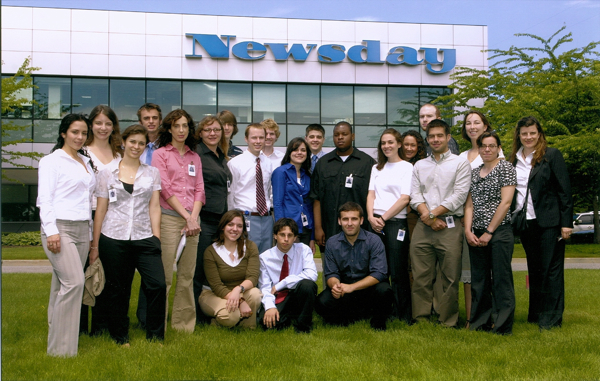
At the beginning of their stints, the Newsday interns of summer 2007 pose for a photo in front of the newspaper's Melville, N.Y., headquarters. I'm standing just left of center in the red tie, white shirt and blue pants. The young lady kneeling is Allison Morrow, the other copy editing intern who also attended the Dow Jones residency at Temple University. The guy kneeling next to her is Sam Rubenfeld of Hofstra University, who is a Dow Jones intern this summer at Dow Jones Newswires. Great back-to-back summers for him. And directly beneath the intersection of the W and S in the Newsday sign is Tim Robertson, with whom I interned at the Bangor Daily News in Maine.

Sunday, April 27, 2008

Smokin' ACES: Premier editing professor Ed Trayes gets it

TrayesACES
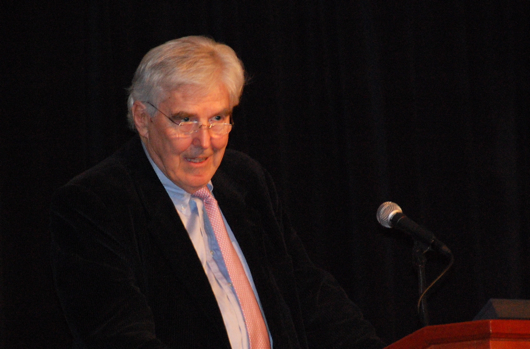
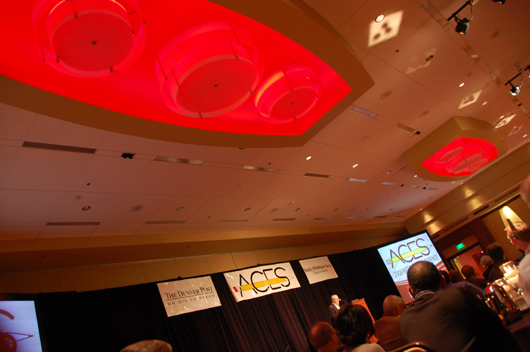
Temple University professor and Offlede mentor Ed Trayes delivers the keynote address at the 2008 American Copy Editors Society national convention in Denver.


If it weren't for a single person, I wouldn't be where I am today. I might be reporting at some tiny community newspaper in North Dakota.

But because of Temple University professor Ed Trayes, I'm a copy editor. And I'm proud of it.

I had the privilege of being taught by Trayes for two weeks as part of my training for The Dow Jones Newspaper Fund editing program. As a fund co-founder, he has led more than 50 such residencies.

After that boot camp last spring, I spent the summer at Newsday as probably its last Dow Jones intern.

It's because of Trayes that I value my role as a copy editor more than I would as a reporter. Copy editors are the quality controllers. We know a lot so that nothing will slip by us, whether it's about Brad Pitt or George Bush.

It was appropriate that Trayes was the keynote speaker for my first American Copy Editors Society national convention. And for a guy who has spent decades training young journalists, he knows that it is our flexibility in adapting to new media that will determine our future.

"No journalist's job has changed more than the copy editor's," he said. "And no group has handled change better, been more nimble, ever going forward, ever adapting, succeeding."

Trayes said that some publications have shot themselves in the foot by trying to attract all audiences through the "slicing and dicing" of content. A focus on a broader readership results in a poorer diet of news.

"So often the competition is we - ourselves," he said.

Today's world is one of shorter attention spans. Instead of actively seeking it, readers want the news to come to them. Commuters at metropolitan train stations will check a box of free newspapers, find it empty, then walk away disappointed - all as a box of 50-cent papers sits full, forlorn, almost untouched.

Trayes said publishers should give away newspapers. Maybe then, we could make those commuters happy.

But the greatest challenge to newspapers, to journalism, is not price; it is time. Technology has trimmed the news cycle from 24 hours to 24 minutes, "probably less," he said. But copy editors will not, must not, get lost in this frenzy.

"Technology ... will not kill us," Trayes said. "As long as there are words to be written, there will be copy editors with whatever at the time is the technological equivalent of a sharp pencil. ... With this in mind, technology and the lifestyles of today - how people choose to get news and information, how they choose to spend their time - will change us."

Technology certainly has changed me.

In the past several months, I have gone from a copy editor of words to a copy editor of media. The new tools that make the news richer - tools such as video, photos, blogs and the general wide world of the Web - must be viewed with the unique and critical eye of a copy editor. We know the genuine from the contrived, the worthy from the weak. When I trained in video editing, I said it is a job that is natural for a copy editor because video is also about details.

After Newsday, I took a job at a company with forethought, with a vision for the future's journalism that is dominated by new media. Copy editors' jobs have changed from the strict editing of words to pagination and design. Now, we must adapt to the online world. And we can't sit back. We must speak up to ensure quality.

"It is up to each of you to meet the challenges as they come while taking an active role in determining what copy editors can and must do in the years ahead," Trayes said.

Some people have criticized my views that traditional copy editors have fallen behind because they have not met the challenges of today's technology. They do not understand how to use it. They do not even understand its uses.

"For at least some of you, if not most of you, the next great battle is online editing," Trayes said. "Editing for Web sites and other venues must have the same standards as print. There is no doubt about copy editing being under attack in this area."

Trayes arrived the morning of his keynote address at the convention's host, the Marriott in Denver. He attended the panel discussion about online editing at which I spoke. I thought his presence would make me nervous, but it put me at ease: I knew he would support, if not agree with, what I said.

In my closing words, I said, "Because of the scrutiny that our Web sites are subjected to, it’s absolute that the next generation of online news producers should be us – traditional, well-grounded, smart and unreasonably critical copy editors. Our reputations are at stake."

In his closing words, Trayes said, "Readers, online and otherwise, count on, depend on, what copy editors pass along as true, accurate and fair."

We may be ignored, but we are not insignificant. We are not powerless.

We are copy editors. We balance the scales of journalism justice. That will never change.

billconnoly0032
Bill Connolly, formerly of The New York Times, spoke after Trayes.

trayesknapp0037
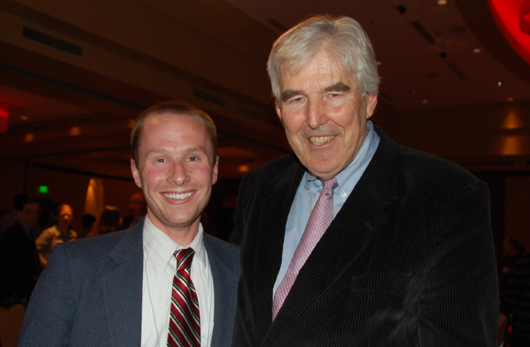
Trayes and I after his keynote.