Monday, April 21, 2008

Earnings are up at Offlede (again), down at Gannett (again)

forsalesigns
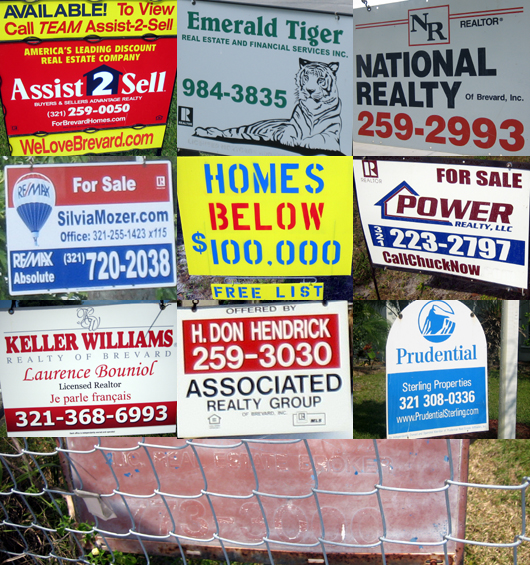
I took my camera on a jog through the neighborhood, and it didn't take me long to shoot enough for sale signs for a Photoshop collage. The bottom sign has been out in a yard so long that it's rusted and faded to the point of near illegibility. If real estate brokers can't make money on real estate, it's no wonder that newspaper also can't.


As ad revenue at The Offlede continues to soar (another Lincoln collected this week, up from 22 cents to 23 cents total), it continues to fall at Gannett, the parent company of FLORIDA TODAY.

Gannett earnings dropped 9 percent in the first three months of the year. You could say the earnings were "nearly decimated." (Click that link, please. You might learn something.) The weak economy likely attributed to fewer ads being sold. According to The Associated Press:
Gannett chairman and chief executive Craig Dubow (who made $7.5 million last year) said the difficulties are particularly acute at Gannett's 11 newspapers in Arizona, California, Florida and Nevada, where the real estate downturn has been sharper. Full story.
Heck, it's so bad here in Florida that my roommate, who owns the house I live in, left his place off the market after his Realtor said she didn't want it anymore. It isn't worth the hassle of listing it because it's not going to sell anytime soon.

The economic doldrum really hit home a few months ago when FLORIDA TODAY "awarded" buyouts to six newsroom employees. The announcement by our executive editor wasn't a shock to me. At the moment the staff meeting was announced via e-mail, I knew it would be about layoffs.

Real estate in Florida is continuing to founder. This state lives for homes. It's a retirement community, after all. And the declining revenues for newspapers exacerbate the economic climate for journalism.

This is the first time I've been at a publication as it laid off people.

Not long after I left the Bangor Daily News in Maine, 11 employees and the internship program were dropped.

The Pew Research Center, where I worked as a reporter, has been cost-cutting, though not necessarily laying off people.

My intrepid and beloved former co-workers at Newsday told me that the internship program had been cut in addition to the 40 buyouts that were distributed throughout the more-than-decimated newsroom.

But I can't do much more right now than just complain and continue to do my job. Copy editors are good at both of those things. Especially the former.

Smokin' ACES: Copy editors are stuck in middle of new media

stuckinmiddle
There's our dull pencil, somewhere near the middle of all the confusion.


Doug Fisher, a journalism professor at the University of South Carolina and blogger at Common Sense Journalism, blogged a few of my posts about the American Copy Editors Society conference in Denver.

It's interesting to see how someone from an older generation with knowledge of the new tools of the trade reacts to the sometimes naive thoughts of yours truly, a self-proclaimed "next-gen" journalist. I like to be snarky and blunt, a tactic that runs the risk of seeming less intellectual at times, especially when I use words such as "stupid" and "dumb."

But it's difficult to avoid those terms when today's journalism, Dumb, still learns from yesterday's journalism, Dumber. Times are changing, and words and attitudes are changing with them.

So that's why I found it a bit humorous how some people reacted to the tools and concepts Fisher presented at ACES. If you look at his handout, which I posted earlier, there are many of them - too many to divulge to any great extent in the 90 minutes he had.

By listening to the questions asked of Fisher, I thought there were some misperceptions among the audience members about why copy editors need to know about Web 2.0. They also had a very basic knowledge of social media and its positive and negative influences on journalism. That's why I said copy editors' collective pencil is a bit dull when it comes to new media.

The overarching of these misunderstandings is that copy editors think they are going to edit Twitter entries, "citizen" blogs and online reader comments as though they are newspaper articles. After all, that's what copy editors do: They edit. Unfortunately, I don't think people were thinking about my "masters of all" theory of copy editing, which states that we must know it "all," whether it's by reading books or by monitoring Joe Schmoe's Twitter page.

Despite the urge to edit Schmoe's ungrammatical and libelous Tweets, as Fisher mentioned during another session ("Moderating Online Communities: A Potential New Job for the Desk"), it's better to take a hands-off approach. I've even heard FLORIDA TODAY's lawyer say it: If you touch something a reader writes, it's yours, and you're liable for it. But if you leave it alone, you're simply an innocent host.

On Floridatoday.com, people who register with the site can published their own blogs through the Pluck platform. It's in its infancy here in Brevard County, but the service should stimulate a robust community conversation. It already has shown promise toward this end in the humorous, critical and sometimes good blogs started by FLORIDA TODAY readers.

Copy editors - no matter how strong their editing urge is - won't be able to touch this conversation unless it's to contribute, as I have done, or to wholly prevent comments on a news story.

Fisher mentioned the comments last year of The Ithaca Journal publisher: Once I give you a voice, I have to accept that voice. Journalists are no longer the only people with a voice. We must get that into our heads.

But he said online communities create so many legal conundrums that cannot easily be answered outside court. "Someone's going to get sued and lose," he said. "I just hope it's not me."

I hope he's wrong (about the first part).


No, seriously, 'What's RSS?'

Misperception No. 2 (though it's more of a misconception) in the first Fisher session was more technical than theoretical. It's about how RSS works, hence the "What's RSS?" question I portrayed copy editors as posing (my headline for that session post was "Know-it-all copy editors ask, 'What's RSS?'").

It seemed that many editors in attendance thought that an online story must be perfectly edited with a perfect headline before it goes live because, as it's posted, an RSS headline goes out, and it cannot be changed later. False. If you rewrite the headline and recache the story, the new headline will overwrite the old.

I know this is the case with The Offlede headlines, but I wanted to see if it were true for a real news site, too. So I experimented with Floridatoday.com. Here are the results:

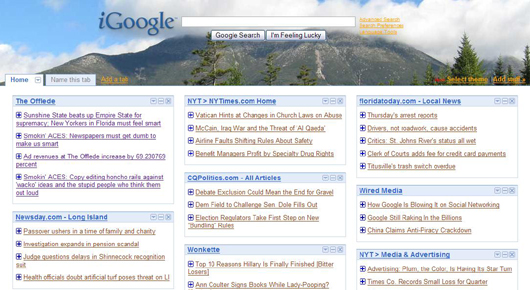
Headline No. 2 in this list - which is a screenshot of my RSS reader, iGoogle - "Students scurry to shine for their last dance" was too long. "Dance" bumped over to the second line. So I decided to take out "their" to shorten it. I went into our online content manager and took it out. Then I waited.

Sure enough, about 30 minutes later, a new headline showed up on my iGoogle desktop via RSS. It was "Students scurry to shine for last dance." So don't worry, newbie online editors, you can change a headline, and RSS readers everywhere will know about it.

Of course, if you have subscribers who get automatically generated e-mails containing RSS headlines (through a service such as Feedblitz), you'll want to make sure the headlines are all right before that e-mail goes out. But really, how many people do this; how many people want more e-mail in their inbox?

It's difficult to say what role copy editors will play in this new-mingled-media landscape. Will we be editing more? Will we be sitting on the sidelines waiting for something big to happen before we step in? Or will we take our usual, humble position as we have in the newsroom for years: Will we be stuck, somewhere in the middle?


Some terms for online conversation communities:
  • Flamer: person who posts just to make people mad
  • Sock puppet: person who creates multiple identities or monikers and starts conversations with themselves
  • Troll: someone who posts off-topic or off-the-wall remarks to make others become emotionally charged or to kill the forum discussion
  • Troll whisperer: moderator, not editor, who deals with difficult posters without depressing the conversation
Session information
  • Title: "Moderating Online Communities: A Potential New Job for the Desk"
  • Time: 2:15 to 3:45 p.m. Friday
  • Panelists: Doug Fisher, University of South Carolina; Travis Henry, Examiner.com
  • Description: "Social networks and comments on stories are all the rage - and rage sometimes is the operative word as conversations get out of hand. As news organizations open their sites to comments, blogs and other community-generated content, this might be a new opportunity for savvy copy editors, or just something else the desk will have to handle. So you want to be a troll whisperer? Find out what has been learned from sites like YourHub and Hartsville Today."
Smokin' ACES home

Sunday, April 20, 2008

Smokin' ACES: Life after journalism would be the death of me

danrather
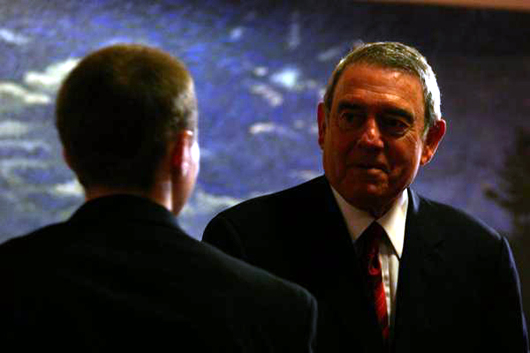
Being a low-level celebrity and meeting high-level celebrities such as Dan Rather (too bad he's a shabby reporter) is a cool part about being a journalist. These moments make journalism a difficult career to abandon. (Photo by Stacy Alexander)


On Feb. 23, editors at a Pulitzer Prize-winning newspaper in Albuquerque, N.M., put the paper to bed for the last time. After 86 years of great, hearty journalism, The Albuquerque Tribune was dead.

"That's when my life after journalism began," former Tribune writer and editor J.A. Montalbano said during a panel discussion last week at the American Copy Editors Society convention in Denver.

Montalbano and a few other former editors at the defunct paper talked about ways in which journalists should prepare themselves for making a living outside of journalism. Montalbano now teaches at the University of New Mexico and at Central New Mexico Community College.

The state of newspapers has forced me into thinking about the territory outside the Fourth Estate. But it's not the first time. There have been several junctures when I questioned the direction in which my career was heading.

In high school, I was all about math and science. I thought engineering would surely be my fate because the University of Maine, the school I was bound for, was known for it; it wasn't where all the wannabe journalists were going. And when I graduated as the valedictorian, I got science awards, not writing accolades.

But it was my interest in and my flair for writing about sports that got me into journalism. I decided on a whim to declare it as my major. And I tell people that I never changed it because I was just too lazy.

I strayed from sports and started to write exclusively about hard news. Then, when I graduated with a journalism degree, I wanted to further my education, either by going to law school or to graduate j-school. I had even started to study for the LSAT when I decided I couldn't stand being away from journalism. So I went to American University to study it yet again.

And then, when it came time to get a real job, I looked into government editing, public relations work and even military service. I started to apply for a few of them when - just as it did during my LSAT studies - that feeling of withdrawal came over me: I could not live without the news and without being a part of the news. (By the way, the federal job application is enough to change your mind about working for the government.)

But while I was in Denver, my vigor was tested again. I was courted to become under the employ of a non-newspaper employer. It would've been an editorial job, but not one that I would consider journalism, or at least, the type of journalism that I would appreciate.

Though the salary would've been more than twice what I get now, I'm not about to abandon the six years that I invested in journalism education for a non-journalism job - especially after I've been a full-time journalist for only seven months. This industry still offers too much for me to ignore.

Besides, I wouldn't enjoy my job as much. I'm sure of that. I thrive under the gun of deadline. I live for breaking news. I love shaping the information readers get.

Some fellow editors at the conference said they revel in the sort of low-level celebrity they enjoy by working at a newspaper. That's manifest in the supermarket-type conversations when someone notices your newspaper ID badge:

Cashier (at World Market): "Oh, you work at FLORIDA TODAY. That's cool."

Me: "Yeah, it's OK."

Me: "You're cute. You wanna go on a date?"

Cashier: "Tee hee. Sure."

Well, the last two lines of that exchange are contrived. But that's beside the point.

The former journalists who talked about life after journalism at the ACES conference said it is important to diversify your job skills.

For one, copy editors - many of whom work nights - are able to devote daylight hours to teaching at a local college or university. Once I get more professional experience, I plan to do that. I already have some teaching experience.

They said the skills of reporters and editors are especially conducive to careers in law, academia and public policy, all of which happen to be areas of interest to me.

"I thought journalism was all I ever wanted to do," said Kelly Brewer, a former executive editor at The Albuquerque Tribune who now blogs and consults from Redding, Calif. "But I discovered there's more out there."

That may be true. And there's nothing stopping me from sampling the outside world. I write. I blog. I take photos. I talk Democrats, Republicans and health care. I do research. I could brief a legal case in five minutes. I even argue like a lawyer.

But it's not my time. Not yet. I'm not ready.

Session information
  • Title: "Is There Life After Newspapers?"
  • Time: 10:45 a.m. to 12:15 p.m. Saturday
  • Panelists: J.A. Montalbano, Kelly Brewer, Zachary Shank
  • Description: Refugees from the Albuquerque Tribune talk about options beyond the newsroom, including law, academia and public policy.
Smokin' ACES home

Saturday, April 19, 2008

Smokin' ACES: Know-it-all copy editors ask, 'What's RSS?'

igoogle2
Many copy editors at a session I attended were clueless as to how programs such as iGoogle gather headlines through RSS, or really simple syndication.


Copy editors are supposed to know a lot. We are the masters of all. We know politics, news, sports, business, literature. You name it.

But with the Web, we're not exactly the sharpest pencils in the basket. That's cause for concern.

One of the sessions I attended at the American Copy Editors Society conference was called "Web 2.0." I was expecting presenter Doug Fisher of the University of South Carolina to go deep into the world of social media.

Fisher certainly has the capacity to do that, but he was held back by many of the old people in the audience who couldn't grasp concepts such as Twitter, RSS feeds and the YouTube.

These are some of the points I gathered from what Fisher said:
  • Two-thirds of all traffic to Web sites doesn't originate at the home page. Instead, the Web hits are through sharing services such as Digg, Facebook and del.i.cious. "Share," Fisher said, "is not a four-letter word." (It's nice to know copy editors still know math.)
  • Each news story should come with a 150-word summary attached. This gives Web surfers a teaser that could persuade them to read the story. At FLORIDA TODAY, this summary is called a "digest." Editors who know what it does actually care about what it says. For those who don't, they wonder why it's there.
  • “If the news is that important, it will find me," Fisher said, quoting a New York Times article. RSS syndicates news from multiple sources by bringing headlines onto a single Web page. When a common reader logs onto his RSS aggregating program - such as Bloglines, Netvibes or Google Reader - he is getting news on a single page instead of visiting external news sites.
  • By the questions copy editors were asking, most traditional journalists don't know what RSS is. More on that in another post.
"Why do we need to know about all this?" was the question asked over and over. Besides that "masters of all" thing I mentioned above, Web 2.0 is pretty important for the delivery and receipt of news and information in today's new media world. Not knowing it is dulling our pencils even further.

Fisher mentioned how reporters and editors can monitor residents' pages on Twitter, a microblogging service, to find out what's happening in the community. He did not mentionstress, however, how Twitter - which permits blog posts up to 140 characters - is being used as a news delivery medium by reporters such as John Dickerson, chief political correspondent for Slate.

And hey! I use Twitter and RSS together on Offlede.com. On the right sidebar, under "Offlede Tweets," you'll see my latest Twitter postings brought to the Offlede home page via RSS. How about that?

But because Web 2.0 doesn't have anything to do with that pile of inky newsprint that shows up on their doorsteps each morning, most attendees just didn't get it. Allison, a friend of mine from my Newsday days, and I jokingly toyed with asking questions such as "What is the blog? What is the Google? What is the YouTube?"

We probably would have been taken seriously, so we settled with simply laughing at everyone else. But ignorance, in this case, isn't really funny: It's a nefarious mark on journalism.

Here is the PDF handout that Fisher distributed during the session.

Session information
  • Title: "Web 2.0"
  • Time: 2:15 to 3:45 p.m. Thursday
  • Panelists: Doug Fisher, University of South Carolina; Chuck Moozakis, Newspapers & Technology
  • Description: How do you navigate the brave new(-media) world? And when it comes to technology, where are newsrooms now and what's ahead? Get a rundown of some of the top Web 2.0 tools that can make your life easier and help you navigate social media. Blogs, wikis, RSS, tags, Technorati, Furl, Newsvibes and more. Bring some of your favorite sites, too, to share.
Smokin' ACES home

Friday, April 18, 2008

Sunshine State beats up Empire State for supremacy; New Yorkers in Florida must feel smart

brooklyn0163
Brooklyn, part of the (former?) Empire, offers culture, crime and Jay-Z.

sunshinepalm
Florida offers sunshine, palmettos and wannabe gangsters.


The Politico
seems to think Florida is overtaking New York as the most dominant state in our blessed Union. Go here for the article.

That milestone is most easily quantified by the leveling political forces of the Empire State and the Sunshine State. After the 2010 census, both will have 27 representatives in the House. The Politico fails to mention behemoths Texas (32) and California (53).

The story points to growth along the Interstate 4 corridor and to the sprawl of large, aesthetically sterile houses near Orlando. The Politico again fails to mention our inflated housing market because of those homes and the sketchy future of the space industry, which once made Brevard the nation's fastest-growing county.

But we shouldn't complain. New Yorkers have it real bad. Apparently, Upstate New York is a scourge of economic declination. Sadly, Kodak in Rochester is among its pot marks.

I've had the pleasure of living in both states. I'm not sure which I like the best. They have their similarities as far as development is concerned.

Three of the five sources quoted in this story are journalists. I'm skeptical of other media figures in stories such as this because they simply don't know as much as academics and other analysts in the particular states.

The story is shoddy but interesting. It's good news for the Grand Old Party. But as Florida continues to grow, it's difficult to envision the Republicans maintaining their grasp on state politics. Further development will make this place liberal.