Wednesday, April 23, 2008

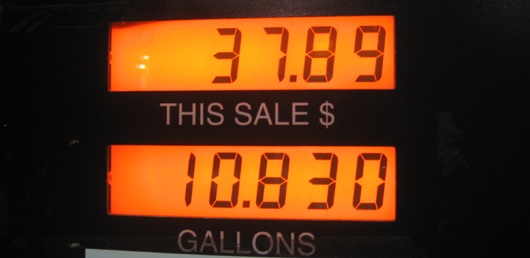
Breaking news: Gas prices are high (it's official)

gasprice2102
I've never paid this much to fill my tiny 11-gallon tank.


That's right! You heard it first on The Offlede: Gas prices are ridiculous.

I equate "breaking news" in the above headline with "it's official."

It's a statement of the obvious. It's almost like the headline "It's raining outside" that I wrote about an obvious weather story.

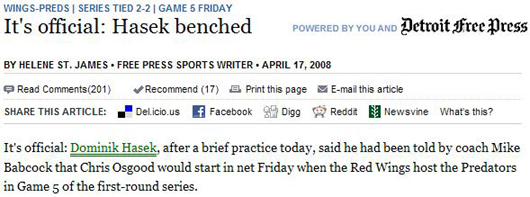
It's official: No. 1 sign you should rewrite that headline

itsofficialfreep
The Detroit Free Press is guilty of using the pointless "it's official." And this headline was taken directly from the lede. Can it get any worse?


This post comes directly from the Rip Your Hair Out Department at The Offlede. "It's official" has to be one of the most grossly overused, unnecessary phrases in newspaper and online headlines. Why?
  • It rarely adds anything.
  • You can always drop it from a headline without losing any vital information.
  • You could probably add it to most any headline without making it incorrect.
So, when you can add Something or take Something away from a headline without destroying its meaning, that's a big sign that Something is pointless (and not capitalized).

To illustrate how perpetual it is, I did a quick survey. "It's official" appeared in 212 article headlines on Google News over the last two weeks. The unpunctuated "Its official" (the "its" still meaning "it is") even appeared six times.

Here are some of the star examples:

It's official: Jake Long is a Miami Dolphin (The Palm Beach Post)
  • Can't you just say that he's a Dolphin?
It's Official: Brauchli Out At WSJ (The Washington Post)
  • No. It's not that it's official now: It's that it actually happened. Everything else before the actual happening was just speculation through "sources with knowledge of the situation but without the authority to speak with the press."
It's official: Hasek benched (Detroit Free Press)
  • When he was unofficially benched, where was he exactly? On the bench? The Freep was an especially egregious violator of the no-it's official rule. This particular one was taken from the story's lede. That's horrible and horribly uncreative headline writing.
It's official: Olive Garden is coming (Bismarck Tribune, N.D.)
  • Oh, thank goodness! There was that unofficial limbo period, and I was so worried it wouldn't really happen. Soup, salad and bread sticks for everyone!
It's Official: User-Generated Content is By and For Corny, Backward Philistines (Wired magazine)
  • A good, vindicating, strangely biblical one for some of you traditional journalists.
It's official: Sex therapists suck in bed (San Francisco Chronicle)
  • Because everyone knew that before anyway. And finally, it has been written down.
Yup, it's official: Flint has shrinkage (The Flint Journal, Mich.)
  • Everyone knows it's cold up there.
It's official -- The Masters will forever be ESPNized (Orlando Sentinel)
  • Before it became official, the tournament was covertly ESPNized. Isn't that better than CBSized anyway?
It's official -- no state-sponsored cocktail (The McDowell News, N.C.)
It's official -- no clothesline ban (Oakville Beaver, Ontario)
  • Wait. Things can officially NOT happen?!
It's Official: Jenna Bush To Wed At Ranch (The ShowBuzz)
  • This must have been the lede: Despite his earlier threats of a veto, President Bush today signed a bill compelling his daughter to marry at his crib in Crawford, Texas.
It's Official: Mount Snow's Closing Date is Unofficial (AlpineZone News, Conn.)
  • There's nothing like unofficial officialism.
It's official, Alabama is the Soviet Union (The Huffington Post)
  • That's expected from Arianna.
It's official: Mountain named in honor of combat fatality (Winston-Salem Journal, N.C.)
It's official: Piestewa Peak name OK'd (East Valley Tribune, Ariz.)
It's Official: Piestewa Peak (Reznet News, Mont.)
Squaw Peak officially Piestewa Peak (The Arizona Republic)
  • Same story. Different newspapers. Same official headline. This was the fault of none other than The Associated Press. Other newspapers thought it necessary to keep the AP editor's "official" in their versions of the headline.
It's official: FairPoint closes Verizon deal (Mainebiz Daily)
  • When did they unofficially close it?
It's official: Rangers vs. Devils in playoffs (Newsday)
  • Like, so, yeah, it became official when the teams advanced to the next round, right? Or what?

Smokin' ACES: Ex-Freep editor is fond of the weird and short

freepmast
"On guard for 176 years," and Alex Cruden was there for almost 40 years of it.


Alex Cruden, longtime editor at another Gannett publication, the Detroit Free Press, reflected on his 40 years in daily journalism. He just took a buyout in March.

This was actually the last session I attended at ACES, but it was one of the best. Oddly enough, however, I didn't take many notes. I must have been too engrossed in his wisdom. (Cruden is at left. Photo by Daniel Hunt, Flickr.)

This is the one thing I wrote down, and it's a quote from Cruden: "Be willing to not only tolerate the unusual; try to enhance it." He was talking about the editing process and how it's paramount to accentuate what makes news, news.

Cruden distributed a handout about how to edit on a tight deadline. He offers a 14-step process. For the Word version of the guide, go here. For the PDF version, go here. Click it. Print it. Learn from it.

The closing two sentences of his biography in the ACES conference program were: "As an editor, he has a fondness for short sentences. And irony."

I know a few flowery-writing reporters who could benefit from his insight.

Session information
  • Title: "40 Years in 90 Minutes"
  • Time: 2:15 to 3:45 p.m. Saturday
  • Presenter: Alex Cruden, Detroit Free Press (retired)
  • Description: "Cruden will offer a one-page handout and lead a discussion based on distillation of four decades of daily journalism. What’s most valuable amid the tread of deadlines and the blare of online? What skills should an editor cherish, and expect to be rewarded for?"
Smokin' ACES home

Tuesday, April 22, 2008

Stuff you find on Florida roads: plastic and glass near work

ftjunk2100

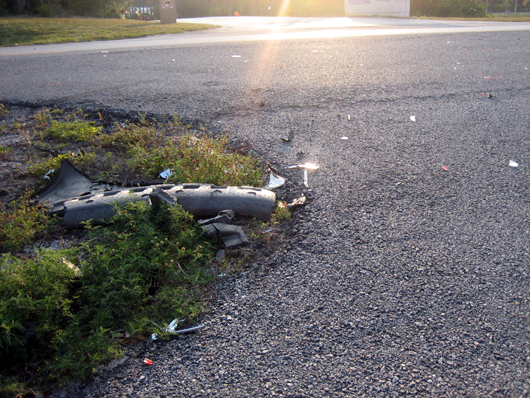
This is the second installment of "Stuff you find on Florida roads." And I almost became a victim of road rage to bring it to you.

It seems that another minor accident happened, and crews did a shoddy job of picking up.

This time, it was in front of the FLORIDA TODAY building on U.S. 1 in Melbourne/Rockledge/Suntree/Brevard (its location is debatable). Of course, my car tires had to roll over the glass and tail-light plastic when I entered the driveway to my workplace.

I snapped this photo from my driver's seat after stopping in the turning lane with a car behind me. Its driver honked and was likely wondering what the heck I was doing. Luckily, that person didn't turn into FLORIDA TODAY. I thought it was a co-worker. That would have been awkward.

Maybe that traitorous interrobang should just be shot

freepfrontinterro

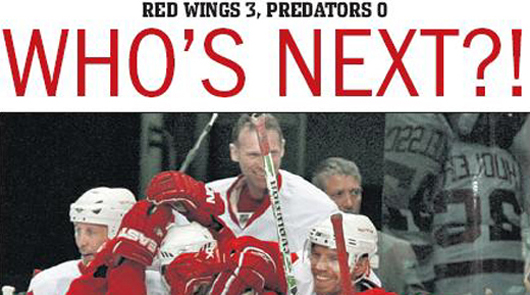
Browsing through the Newseum's front pages yesterday, I noticed the either deft or dimwitted use of the interrobang on the front page of the Detroit Free Press.

Ideally, the interrobang is formed by visually blending a question mark with an exclamation point, as you see to the left. Few pagination and word processing programs allow such blasphemy, so we must settle with side-by-side marks of punctuation whose usages are merged. I'll call it a "severed interrobang." OK?!

There are three common uses for an interrobang:
  • To excitedly pose a question
  • To convey excitement or disbelief through a question
  • To ask a rhetorical question.
And, of course, the word "interrobang" itself is derived from interrogation (asking a question) and "bang!," which is slang for an exclamation point. So, to use an interrobang is to ask a question with a bang.

Its origin has been traced to media advertiser Martin Speckter, who supposedly invented it as a convenient way to express incredulity.

I suspect its frequent usage today in our sacred English language is another casualty from the slaughter that electronic communication has committed. How many times have you seen your instant messaging buddy respond to you like this:

WHAT?!?!?!

My problem always is deciding which order the question mark and the exclamation point should be arranged in. The question is: Which is the most important mark of punctuation? The first? Or the last?

I'm guessing it's the last because that's the one that makes the lasting impression, the punctuating cherry on the top. In the case of this headline, it's an exclamatory cherry.

The question mark says, "Seriously, who's next? I wanna know so we can start watching film."

The exclamation point says, "Grrr, who's next? Who wants a piece of me? Bring it on!"

Of course, the severed interrobang flies in the face of the old rule that a sentence should end in a single piece of punctuation. Sentences that end, say, with a interrogatory title cannot escape that rule's jurisdiction. Example:
  • I used to watch "Where in the World is Carmen Sandiego?"
It's not:
  • I used to watch "Where in the World is Carmen Sandiego?".
The latter would be silly.

But what would happen if the headline had just one of those punctuation marks?

WHO'S NEXT?
  • Borrrrrrring.
WHO'S NEXT!
  • Wrong.
So in the old world, the severed interrobang would be sacrilege. But in the new world, it might work.

After all, the use of punctuation, as opposed to grammar, always has been somewhat interpretative. Even The Associated Press admits this. Its stylebook says: "The punctuation entries in this book refer to guidelines rather than rules. Guidelines should not be treated casually, however."

But let's remember that the person who invented the interrobang worked in advertising. So putting it in a front-page headline is not just melding two marks of punctuation; it's also combining news and advertising.

A simple punctuation mark, the interrobang, could be responsible for the fall of the wall between church (advertising) and state (news).