Saturday, April 26, 2008

Offlede finally finds answer to newspapers' problems

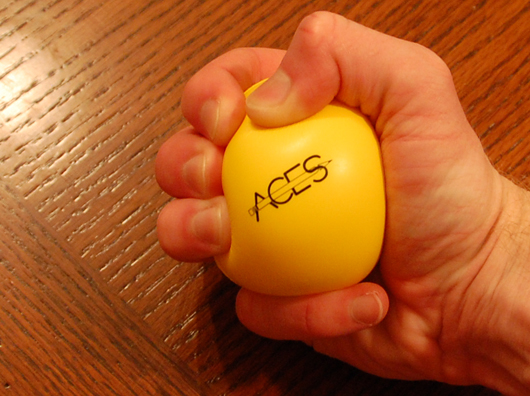
stressball


Buyouts. Folding newspapers. The Internet.

Woe is we.

The secret to calming our fears? A stress ball. I bought mine for $1 at ACES in Denver.

They sold out.

Friday, April 25, 2008

Offlede finds more downs than ups of Mac conversion

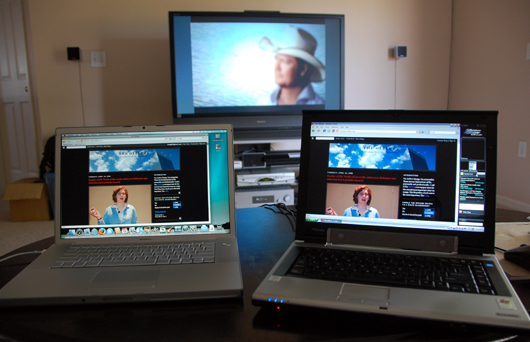
newcomputer
The new MacBook Pro is on the left, and the old Toshiba Satellite is on the right. It's actually not a total conversion because I'm keeping the Toshiba.


My new friend came all the way from Shanghai in just a few days. And now that the Apple MacBook Pro is here, I'm adjusting to several things.

I decided to buy the MacBook when the old Toshiba Satellite was slowing during Web browsing. I wouldn't want Offlede readers to suffer because of inferior equipment.

Another reason for becoming a Mac convert is the Final Cut Express video editing software I had installed. The slimmed-down version of the software has all the tools needed for news-like videos. Journalists don't use special effects, so I won't miss them. Besides, it's light years beyond Microsoft Movie Maker, which was imprecise and not even close to sophisticated.

The following are a few differences and potential downsides I've noticed on the new Mac. I haven't looked into solving them yet, so don't judge me for judging the Mac too quickly. These are only superficial observations (and ones I was aware of before the purchase):
  • There's no forward delete key. There's only a backspace key labeled "delete" that, of course, deletes backward. I'm used to deleting forward on a PC. Am I missing something?
  • My Web site looks funny. Certain letters are cut off on the right sidebar, such as in the "Journalism Job Links" section. The hook of the J in "Job" is not visible. My Georgia font looks different in Mac's version of Firefox, I guess.
  • The keyboard is slightly offset compared with my Toshiba. This is noticeable when I hit the "caps lock" key instead of the "A" key.
  • There's no right click on the trackpad. This is especially bothersome in Firefox, in which I often highlight a word on a Web page, then right click and hit "Search Google for 'keyword.'" On the Mac, I have to open a new window and search for it. Some fixes would be Google Desktop with a Web search window or an external mouse with a right button.
  • Surprisingly, I miss the tabs on the Windows toolbar.
  • Are there "page up" and "page down" keys on this thing? The arrows are too slow. On a PC, I hit those keys instead of using the vertical scrollbar.
I found fewer positives. They are great, though. They are:
  • The 15-inch widescreen is not glossy. That's the main reason for converting: Most PC laptops have a glossy screen that looks like a mirror in harsh light. The matte Mac is easy to see and easy on the eyes.
  • It's thin and purrrrty.
  • The keys are pleasantly soft. Typing is an enjoyable experience - if I could just stop hitting the "caps lock" key.
  • It's fast. I was beginning to wonder if it was the network that slowed my Toshiba. But the Mac is fast on my home's wireless, so I guess not.
I'm not discouraged; it will just take an adjustment. If you have any suggestions to deal with the drawbacks, let me know.

Smokin' ACES: Florida Today, small papers stand among giants of online editing

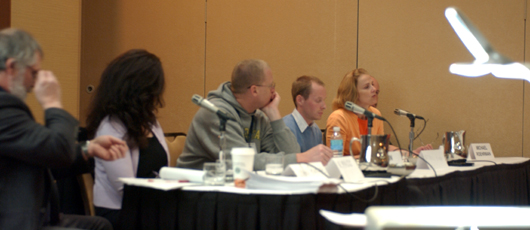
wholepanel
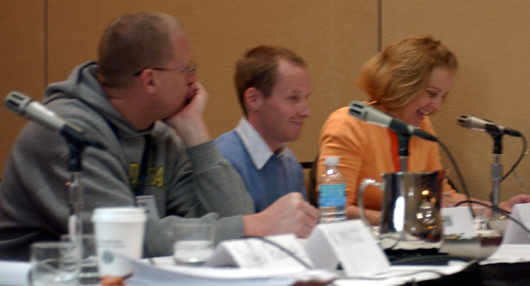
From left to right: John Russial, University of Oregon; Valerie Mass, The Denver Post; John Boogert, Rocky Mountain News; Andrew Knapp, The Offlede (and FLORIDA TODAY); and Amy Hubbard, the Los Angeles Times. Michael Roehrman of The Wichita Eagle is hiding behind Hubbard. Boogert gave Mass a difficult time throughout the session because they're cutthroat, but friendly competitors.

threeofus
Photos by Daniel Hunt, Flickr


Several weeks ago, after being in my first full-time job for six months, I was preparing for the American Copy Editors Society national conference. It would be my first.

So when University of Oregon professor John Russial asked me to participate in a panel about online editing, I was hesitant to accept. I told him that I was inexperienced and relatively immature, but he still thought I would be "a good addition." So I accepted. And I'm glad.

I presented my opening statement alongside Amy Hubbard, the copy desk chief for Travel, Real Estate and Books at the Los Angeles Times, and John Boogert, Internet news editor at the Rocky Mountain News. Even Hubbard was nervous when she gave her speech, so that put me at ease.

Russial first presented his study about the editing of online products at newspapers. He surveyed 210 publications and divided them into three size categories. I don't have many details, but these are a few things I jotted down.

Twenty percent of the largest newspapers said they don't edit online stories.

Of all papers that do edit online, there's a 2-1 ratio of editors who have editing experience to those who don't. But copy editors would say "editing" experience doesn't mean "copy editing" experience.

Of the newspapers that don't edit online stories, 59 percent said they don't because it delays posting, and 42 percent said they don't have enough employees.

But the most striking result in Russial's study is that smaller newspapers are, for the most part, doing just as well as the larger ones when it comes to online editing.

For example, Michael Roehrman of The Wichita Eagle, which is about the size of FLORIDA TODAY, said that all stories are given to the day or night copy desk to be edited, then sent to the Web site. The Eagle was surveyed in Russial's study. FLORIDA TODAY was, too, and that's why Russial asked me to join the panel.


Represent!

At FLORIDA TODAY, online producers are responsible for editing and for the technical maintenance of the site's function and aesthetics.

My opening statement about how editing is done in Brevard County was well-received. People came up to me several times for the rest of the conference to talk about FLORIDA TODAY. I was a proud ambassador.

To look at my speech, click on either the Word version or the PDF version.


Editing blogs

In Russial's sample, one of three newspapers did not edit blogs. Of the sites that didn't edit blogs, 70 percent said blogs were solely the writer's responsibility.

Hubbard said the Times assigns blogs to copy editors to edit whenever they have time. It's not a regular part of their duties. This seems like a good way to handle blog editing.

Some people argue against blog editors because they risk taking away the writer's voice. But what about accuracy? What about embarrassing errors? Andy Bechtel of the University of North Carolina talks more about blog editing here.

Copy editors don't edit FLORIDA TODAY blogs. Instead, an assigning editor oversees them, so there is some quality control.

It isn't always practical to have a copy editor for a blog, such as in the case of FLORIDA TODAY's space team. Some blogs are 24-hour features that are updated from home or from the field. For example, our NASA reporters blog from Mission Control in Houston at 3 a.m. when no one is on duty in Florida.

The only thing that I ask, however, is that bloggers learn to write headlines.

Session information
  • Title: "Online Copy Editing: What’s Being Done, What Could Be Done"
  • Time: 10:45 a.m. to 12:15 p.m. Friday
  • Panelists: John Russial, University of Oregon; John Boogert, Rocky Mountain News; Amy Hubbard, Los Angeles Times; Michael Roehrman, Wichita Eagle; Valerie Mass, Denver Post; Andrew Knapp, Florida Today
  • Description: "A look at who’s editing what online, and how little copy actually is being edited before being posted. The problem runs from small to large publications. But some newsrooms have created online copy editing positions, and others are experimenting with schedules, desk structures and other things as a way to get online copy read."
Smokin' ACES home
Smokin' ACES: Trimming fat is a big part of copy desk's job

trimmingfat


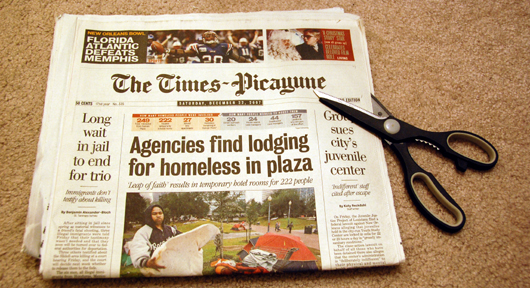
This post is pretty straightforward. Copy editors often are charged with trimming large stories into smaller ones, sometimes considerably smaller ones. It's increasingly becoming a reality as our readers' attention spans shorten. I'll just present my notes in bullet points for any editor who wants to pick up a few tips.


Types of trims

  • An inch or two
  • Slash and burn: cutting a story by several inches
  • From a story to a brief
  • From a story to a sentence or two (FLORIDA TODAY has a page of summaries for the big articles of the day. It's called the 5-Minute Read. Each item is a sentence or two.)

Obstacles
  • Deadlines, especially online
  • Shrinking news hole and staff size
  • Pressure for shorter stories and fewer jumps
  • Alternate story forms (design-heavy stories)

Options
  • Make use of cutlines: Don't repeat the same information from the story.
  • Let graphics and text boxes share the load: Again, this text shouldn't regurgitate the story.
  • Use the Web.
  • Cut carefully with the reader in mind.

An inch or two
  • When a story is close to fitting, edit it thoroughly before trimming: Find words and phrases to cut.
  • Trim excess details and quotes.
  • Summarize and condense.
  • Pull back lines if your publishing system allows it: Watch out for widows.

Slash and burn
  • When you have a lot to trim, remember the inverted pyramid.
  • Read, but don't edit, the entire story.
  • Pick an ending point. Deal no more with what's below that point. (Turn a major trim into a minor trim.)
  • Look for optional trims in wire copy.
  • Keep the "new news."
  • Keep the explainer (why you should care about the story).
  • Keep the "talker" (something you would tell a co-worker tomorrow at the water cooler).
  • Keep the methods and disclaimers on scientific and poll stories.
  • Keep the he said/she said (both sides of the story).
  • Cut the excess, and summarize the essential.

Caution
  • Make sure you keep the first reference of names.
  • Don't end on a transition.
  • Make sure the story ends somehow, not necessarily with a quote.

Briefs
  • Use just the facts: Leave out quotes.
  • Craft a focused lede.
  • Use quotes only if they're effective at getting the story across.

Web streamlining tasks
  • Breaking news
  • News updates
  • Night-before stories (big teasers to print edition)
  • Summaries for multimedia projects
  • All of these elements require a short style, which often is achieved through trimming.

Breaking news
  • When a car accident happens around 4:30 p.m., put the traffic information at top. Do this especially if people are injured. Later on, the lede might change to stress injuries or fatalities.

Session information
  • Title: "Tighten Up! Trimming the Fat, Trimming to Fit"
  • Time: 9 a.m. to 10:30 a.m. Saturday
  • Panelists: Andy Bechtel, University of North Carolina; Lisa McLendon, Wichita Eagle
  • Description: One of the underrates skills that a copy editor must have is the ability to trim: Cutting huge swaths, excising an unnecessary paragraph of two, posting parts of stories online first, even if the whole story is in. But trimming isn't just about fitting the story to the page. Just because there's unlimited space on the Web doesn't mean readers wants 1,600 words. This session will cover trimming for both situations: fitting stories into a print publication and streamlining for the Web.
Smokin' ACES home

Thursday, April 24, 2008

Smokin' ACES: Words will be words, unless your dictionary says otherwise (but it probably doesn't)

erinmckean0013
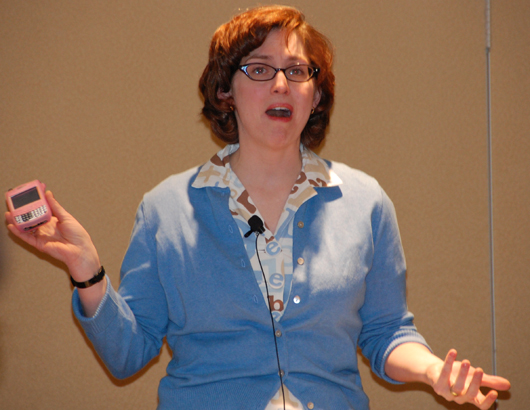
I can't remember, but I think Erin McKean was looking up a word on a BlackBerry as I snapped this. ... Sorry, Erin. But look! She's got letters, which make words, on her dress.


Words are surprisingly entertaining. So that means a book of words, also known as a dictionary, could be a good piece of literature to curl up to on a cold January afternoon.

Not necessarily. As I will explain later, there's danger of death when you do that.

But dictionaries do offer some fuel for debate and are often the main weapons of copy editors when attempting to shoot holes in a reporter's deranged word usage.

But copy editors should remember: Just because a word is in the dictionary, we don't necessarily have the right to use it.

Erin McKean, the dictionary evangelist and chief consulting editor at Oxford University Press, asked copy editors at their 2008 geek fest in Denver what they want in a dictionary.

For me, all I ask for is a sound compilation of words with definitions that are easy enough for a reporter to understand.

But copy editors often use the dictionary as ammunition against readers, too.

My boss has mentioned on a few occasions that readers have complained about using the word "tank" to describe a team or business that founders.

Yes, dear reader, the noun "tank" is a sort of military vehicle, but it also is a verb meaning to decline, to sink or to otherwise fail miserably. It's in the dictionary. Look it up.

But the dictionary doesn't have your back 100 percent of the time. You can't always interpret it literally. McKean's example was "hackles," which a dictionary might say are the hair on a dog's neck. But the entry might not say that it means temper or anger that becomes visible when you see the neck hair stand up. The sentence "The boy pets the dog's hackles" would just be wrong.

Even though the definition of a word is technically correct, it's use as such in a sentence just may not fit. But the dictionary doesn't tell us that. In this case, a copy editor can't point to a dictionary when saying, "I told you so," to a reporter who insists on using "hackles" in that manner.


A case for online dictionaries

So, copy editors need something to explain why a sentence is "just wrong."

That's where extensive etymologies and usage dictionaries could come in handy. But the space needed to print them would be mind-boggling.

"The paper book is just too limiting," McKean said. "They can't show the supporting evidence."

Newspapers have found the print product limiting, and dictionaries should follow their lead by migrating online. Cyberspace offers forums for comments on words and their various usages, sometimes depending on regional dialect. They also offer efficient searchability, a time saver that would help the copy desk.

Probably the best online dictionary is Merriam-Webster. Some of my fellow copy editors are known to look up more words on m-w.com than in the proper, Associated Press-sanctioned Webster's New World College Dictionary, Fourth Edition.

This is too bad, of course. Though Merriam-Webster bills itself as the direct descendant of legendary lexicographer Noah Webster, many circles see it only as the "slut" dictionary: It allows almost everything between its binders.

Ironically, Merriam-Webster seems rather bitter on its Web site. Under the frequently asked question "Are all Webster's dictionaries alike?" (which is answered "no"), it says: "In the late 1800s and early 1900s, legal difficulties concerning the copyright and trademark of the name Webster arose, and eventually many different publishers — some rather unscrupulous — began putting dictionaries on the market under the Webster's name."

I don't care. You're still a slut.


Words are fun when they're hopped up on caffeine

Where McKean really shined was in her humor and insight. Dictionaries can be fun.

She mentioned two words that irk her: "slacks" and "moist." I don't see their irksome nature. Of course, in Florida, if you dress up in a suit during the humid summer months, what do you get? Yup, moist slacks, and I guess they are a bit irksome.

McKean exposed a little-known fact about lexicographers. Because they guard their work closely, they make up words to see if other
lexicographers will steal them. A good example is "esquivalience." Go to this New Yorker article for more.

Also, the Dictionary of American Regional English, or DARE, contains definitions from all the great sections of the United States. McKean mentioned the long-debated words for a soft drink.

These are my theories behind the soft drink variations:
  • pop (Upper Midwest)
  • coke (Lower Midwest and South, specificallyespecially Atlanta)
  • soda (Northeast)
  • tonic (Canadian border regions, such as my hometown)

Safe and deadly ways of improving vocabulary

This was the only session I attended with co-worker Beth. As we listened to McKean, I asked Beth, "What do you think she scored on her SAT?"

So, to get smart like her, McKean suggested two methods. One is safe. The other is fast and dangerous, possibly deadly.
  • Safe: Up your reading. Buy a bunch of magazines you wouldn't normally buy, ones that are out of your comfort zone. If you're the Vanity Fair type, buy Forbes. If you're the Forbes type, buy Vanity Fair.
  • Fast and dangerous: Buy a word-a-day calendar (or look at The Offlede's "Word of the Day" feed on the right sidebar). The danger is that you won't have the context to the use the word in a proper sentence. McKean said a child once told his librarian, "My family erodes a lot," because he learned that the definition of "erode" is "to eat away" or "to eat out." The boy meant to say, "My family eats out a lot." Also, high-security inmates with access only to dictionaries, not real books, are guilty of memorizing words without context. "You don't want to sound like someone writing from death row," McKean said.
Session information
  • Title: "Tell Me What You Really Want From Your Dictionary"
  • Time: 4 p.m. to 5:30 p.m. Friday
  • Presenter: Erin McKean
  • Description: Once you really get some traction as a copy editor or journalist, you start to see the holes that all dictionaries—even great dictionaries—have. Words you can’t find. Unclear usage information. Ambiguity abounds, and trying to get a definitive (no pun intended) answer can be tricky, especially on deadline. But dictionaries can’t fix what they don’t know is broken. Come to this session and vent to a real-live lexicographer ... and learn about some new and exciting (and more importantly, more helpful) dictionary features that are just around the corner!
Smokin' ACES home