Showing posts with label astronomy. Show all posts

Tuesday, January 25, 2011

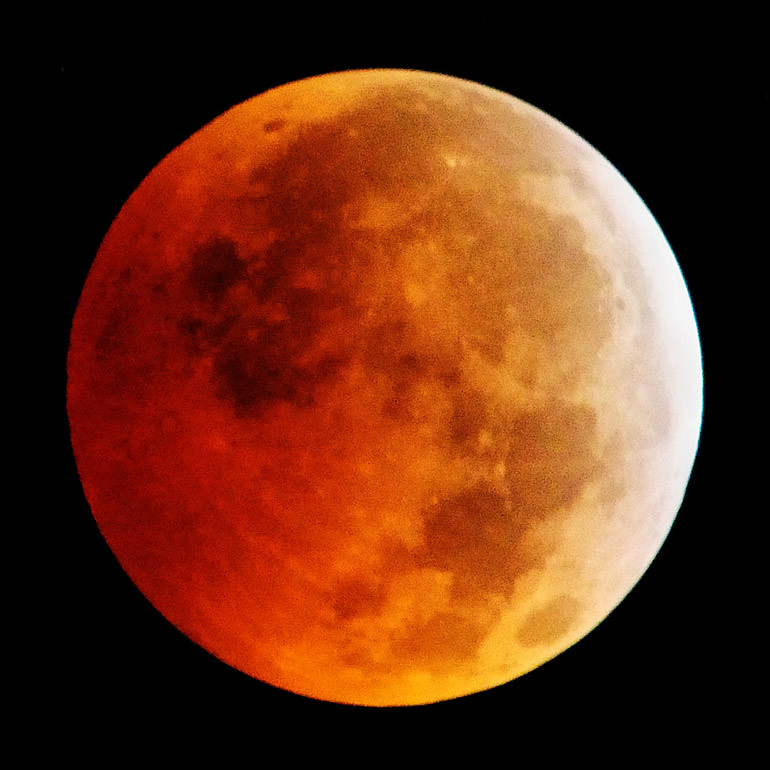
Total eclipse of the moon

web_eclipse_0015
The lunar eclipse in its fullness, as seen at 500 mm.

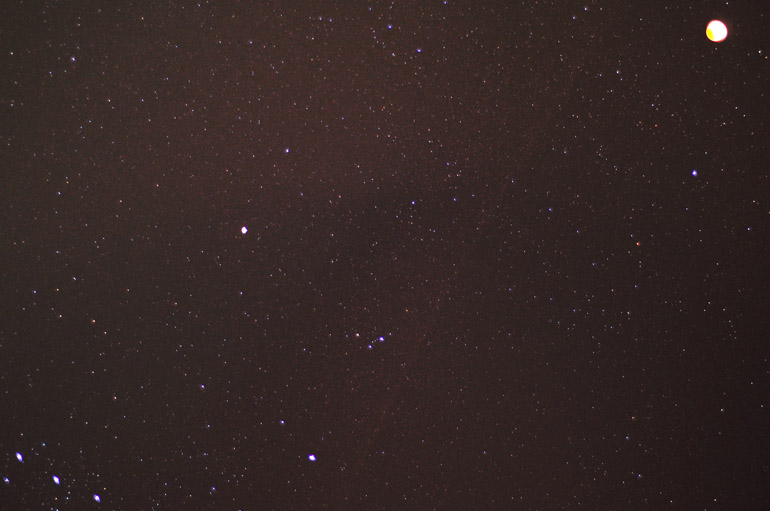
web_lunareclipse_wide_0030
In this shot with a 50-mm lens, the moon is eclipsed in the top right corner, and Orion's belt hangs out in the bottom left.


I have once again fallen behind in the posting of photos, even in the taking of photos. It must be my advancing age -- 27 next month! -- that is eating away at my desire to stay up overnight and gaze at the dark sky, trying to find an object in it to photograph.

On Dec. 21, something happened that I had been waiting all year for. I even posted on Facebook in January 2010 that a year of celestial events -- including a comet passage that, if I had gotten up early in the morning for, I would've seen -- would be culminated with a lunar eclipse.

But when it came the morning of Dec. 21, I was sick and tired and not feeling capable of keeping my eyes open for all the various phases of the moon as it was shadowed by Earth. The plan was to capture each stage, then construct a panorama out of all the images. And in addition to my exhaustion, it was freezing out.

Instead, I set my alarm clock and went to sleep. I awoke to step onto my porch and take a few telephoto shots of the orange moon and a wide-angle view. And then it was bedtime again.

Tuesday, August 10, 2010

The Milky Way in Florida? No way!

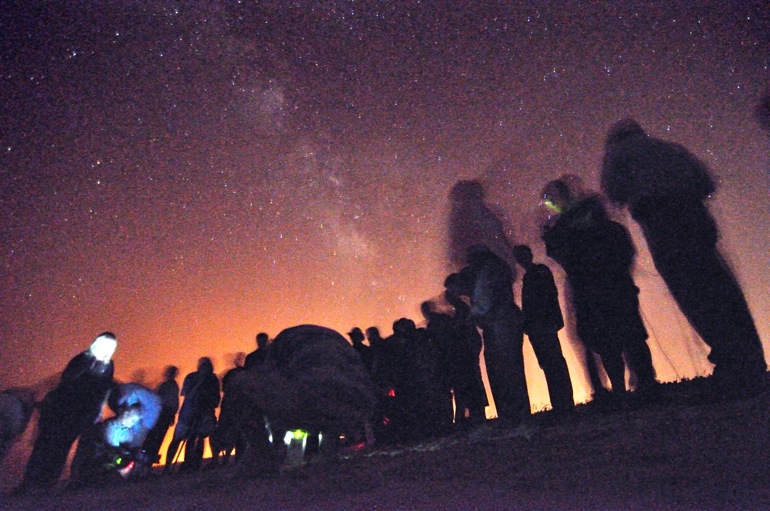
best_0080 copy2
Despite considerable ambient light on the horizon, the Milky Way Galaxy (see it better here) is visible behind the wildlife officials and journalists participating in the release of some of the turtles rescued from the Deepwater Horizon oil spill. It was the first time I had seen our little band of stars from a location in Brevard County.


One of the biggest shortcomings of the Space Coast -- aside from its lack of lightning bugs, fall foliage, rugged terrain -- is the ambient light that blocks a view of the heavens.

During my childhood in Maine -- especially if I'd had a rough day -- I would walk outside my house and onto the dock over the lake and lie with my back on the sun-bleached 2-by-4s that seethed with water spiders. And I would stare at the stars.

The billions of stars.

And not a light in sight. No revving car engines, only hollering loons. Fish jumped and splashed down under the veil of darkness. I'd fight off mosquitoes and black flies, but it was worth it: just to look up and wonder, and to gasp in awe of a meteor. I couldn't blink. I couldn't miss anything.

Here, the stars seem countable. The city lights are just too much.

That's why last Monday's work shift was the best I've yet had here in Florida. Not because the story itself was amazing or exciting or especially ruthless and bloody, but because the setting reminded me of a better place. Despite the day's lousy ending and the ensuing lousy week, it made things bearable.

The assignment entailed a late-night excursion onto Canaveral National Seashore, a federal park that's closed to the public after 8 p.m. in the summer. The road to it is gated, and the beach itself is fenced off near Kennedy Space Center. But journalists were invited at 10 p.m. Monday to witness the release of hundreds of baby sea turtles relocated (via FedEx) from the Gulf of Mexico, where they would have been threatened by the oil spill.

From the outset, the assignment was pretty cool. (There's not a more apt descriptor than "cool," is there?) A park ranger blinked a flashlight at my car as it approached the gate. He checked my press badge and let me through. The next few miles of road meandered through the brackish marshes of northern Merritt Island.

I passed Kennedy Space Center's two shuttle launch pads and the Vehicle Assembly Building, its NASA "meatball" logo and its giant American flag bathed in white light.

Eyes glimmered in my headlights. In Maine, that means there's a deer, a moose or a bear up ahead. Here, it means there's an alligator up ahead. It crawled off the pavement.

Bugs -- basketball-size mosquitoes and behemoth moths -- collided with my windshield. My car got low on washer fluid.

As a regular thing, when I step out of my car at night, I first crane my neck backward and look at the sky. But when I parked at the seashore's Playalinda Beach -- notable among locals as a nudist attraction -- I saw something I had never seen here. At first, I thought it was a ribbon of thin clouds that stretched from the southwest horizon to the northeast horizon. But it wasn't moving.

It wasn't cloud cover. It seemed foreign.

It was foreign. It was downright extraterrestrial.

It was the Milky Way.

The stream of stars making up our spiral galaxy flowed from the mainland and emptied into the Atlantic Ocean. Only when I drove through the Keys last year had I seen this in Florida. Spotting it requires a dark sky.

On the beach, reporters and photographers from TV stations and newspapers -- including The Times of London -- watched turtles scamper to the ocean. They listened to biologists talk about the chances that this would work out for the baby critters. But I stood away from the crowd. I crouched, planted two knees into the sand and looked at the stars above the hubbub.

Then, a shooting star. And I made a wish: I wanted a tripod. I wanted to shoot the biologists and journalists focusing on the ground -- with the real star of the photo being the Milky Way in the sky behind them.

But as a rule, my wishes just don't come true, so I improvised. I planted my notebook into the sand, then set my camera on top. That stabilized my Nikon, then I boosted the ISO setting to make the shutter speed as quick as possible: four seconds. The resulting shots weren't technically awesome, but I didn't much mind. It's one of those sights that can't be shown through a lens anyway. I conveyed my enthusiasm and my observations in the article:

Our Milky Way Galaxy formed a spine of stars stretching across a clear sky -- a rare site for amateur astronomers here. A half moon had not yet risen. Twenty miles to the north, New Smyrna Beach glowed orange. To the south, the lights of Launch Complex 41, where Atlas V rockets lift off, were dim. Lightning intermittently flashed on the western horizon.

"This is one of the darker beaches on the East Coast," Jane Provancha, the NASA-contracted biologist supervising the effort, said as bats and mosquitoes battled over her head. "You can see with the night sky how really wonderful it is." (Full story)

I could have taken more time to gawk at the heavens, but I had to leave and pick up a cell phone signal somewhere back in civilization so I could file a story. When I was typing on my laptop while parked at a 7-Eleven back on the mainland, a minivan hit and crumpled my car's rear fender. $1,000 in damage. It was my first accident, though it was a lame one.

But it didn't bother me. I saw the sky and remembered what I had seen. I'm simple enough a person to know that no matter where I am on Earth, I can look up, forget and be happy.

Tuesday, May 18, 2010

At dusk, a distant conjunction of Venus and the moon

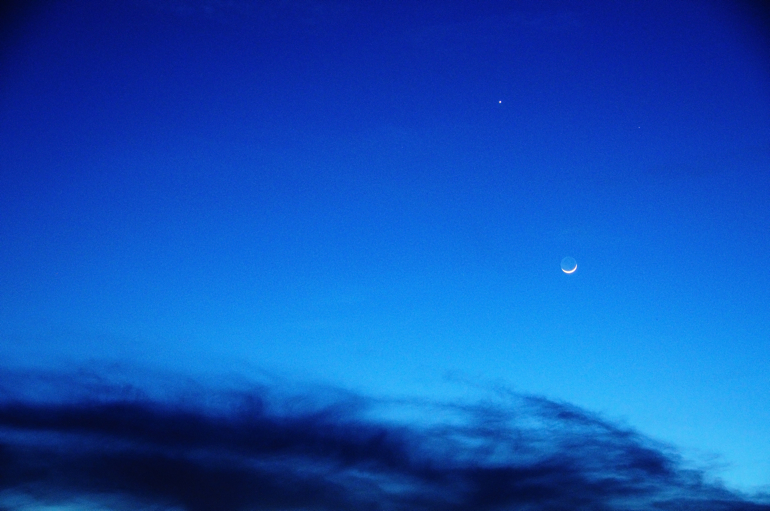
web_conjunctionsvenusmoon_clouds_0006_2695
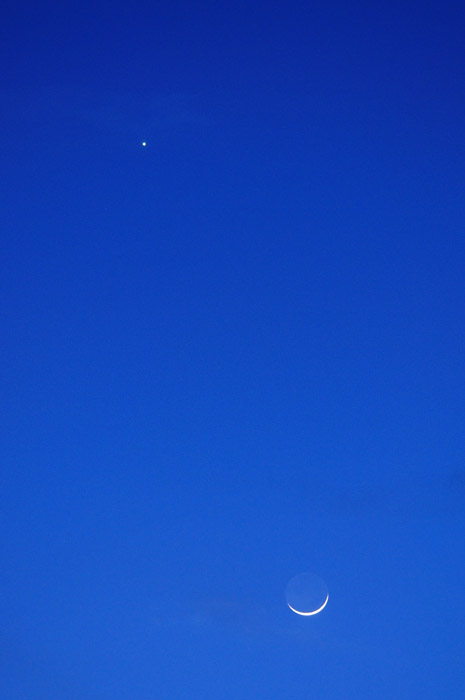
There are closer conjunctions of Venus and the moon yet to come this year (see below), but I never miss a chance to photograph these two heavenly objects during a rendezvous. This time, it was just after sunset, with a deep-blue sky.

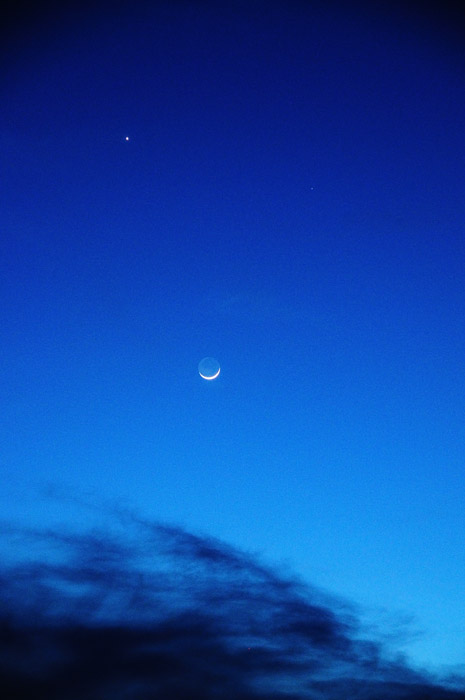
web_conjunctionvenusmoon_vertical_0008_2696
This distant conjunction came the night after a new moon, so the waxing crescent was at its skinniest (Venus, coincidentally, also was a crescent, if only I zoomed in closer). Additionally, sunlight bouncing off Earth and hitting the moon's surface faintly lit the other 97 percent of the disk that wasn't illuminated directly. The strength of this phenomenon -- called "planetshine" or "Earthshine," in our particular case -- is determined by which part of Earth is seeing daylight at the time (land reflects more than oceans) and by the amount of cloud cover in that area (clouds reflect half the light hitting them).

web_conjunction_moonvenus_0005_2694
Of course, the best conjunction in a while happened early one morning in April 2009. See that post here. A better conjunction-viewing opportunity is coming after sunset on Aug. 13, when Mars joins the party with Venus and the moon.

Friday, January 1, 2010

The moon is made of green cheese - or is it blue?

web_bluemoon_halo_0050_2407
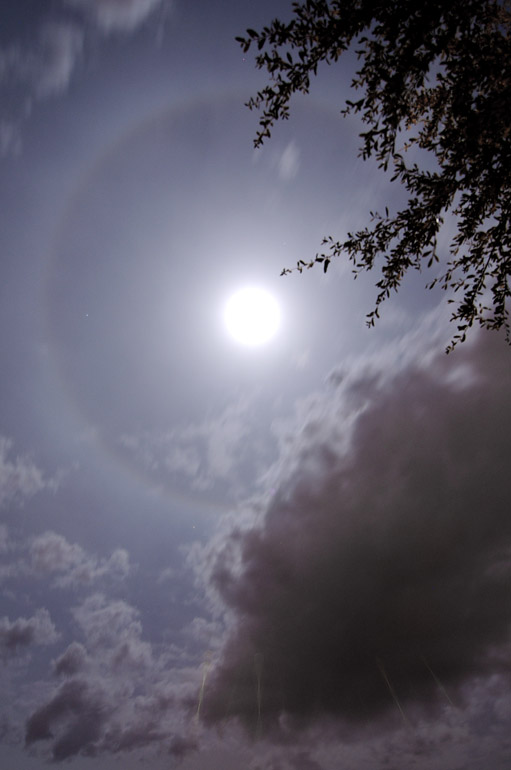
Reflected sunlight and high clouds create a halo effect around the moon early on New Year's Day. Darker rain clouds move in at the lower levels of the atmosphere.


The year 2009 ended and the year 2010 began with a full moon, the second in the month of December. Such an occurrence has become popularly known as a blue moon, which more likely got its name from the idiom, not the other way around.

The term's apocryphal beginnings can be attributed to a 1946 Sky & Telescope article that misinterpreted the Farmers' Almanac, which is published in Lewiston, Maine (best state in the Union). The agricultural bible assigned the name "blue moon" to the third full moon in a season with four of them. (Seasons typically have three full moons.) It didn't necessarily mean there were two in one month.

Before that, "blue moon" referred to either somberness or rarity, as "once in a blue moon" now conveys.

And to get even more technical, the moon wasn't ever full following its rise just after sunset Thursday in the United States. That opportunity would have come in the afternoon, before it was visible.

That's all according to my exhaustive Google searching. Astronomy can be confusing, and there's nothing like the Internet to confound people further. There's lots of mythology related to Earth's natural satellite, including one belief that its pull can determine when a pregnant mother gives birth. A story to that effect was published in my newspaper today. Good grief.

Though what I write here, as best as I can tell, is true, it doesn't matter much. What matters is that the moon was rather rad in appearance early Friday morning. High, wispy clouds caused the sunlight reflected off the lunar surface to create a halo. After the night grew old, lower storm clouds moved in, at which time I made the above exposure.

The rain wasn't far behind.

Friday, November 6, 2009

Maine's autumn, Day 6 | Windmills, turkeys and the Milky Way

lake_0018
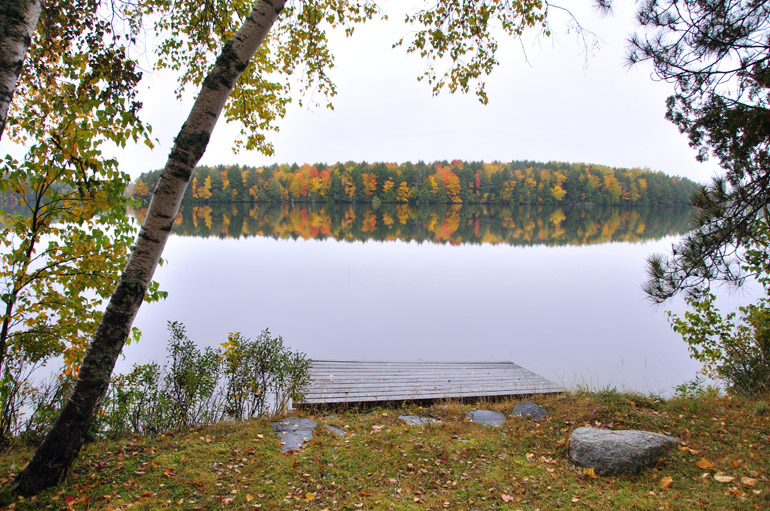
The excursion started at home, of course, where I took a photo of the view I woke up to every day for 18 years. It was before the wind picked up, so the surface of Grand Falls Flowage, part of a chain of lakes along Maine's eastern border with Canada, was like glass. The sky, however, was still overcast.


Day 6, the Saturday during my Maine vacation, included a family trip across Route 6 in Washington County, a major east-west route. And when I say "major," I mean it's a hilly, pothole-pocked roadway through the middle of nowhere.

We then took a smaller road north to the Danforth area of northern Washington County.


windmills_0104
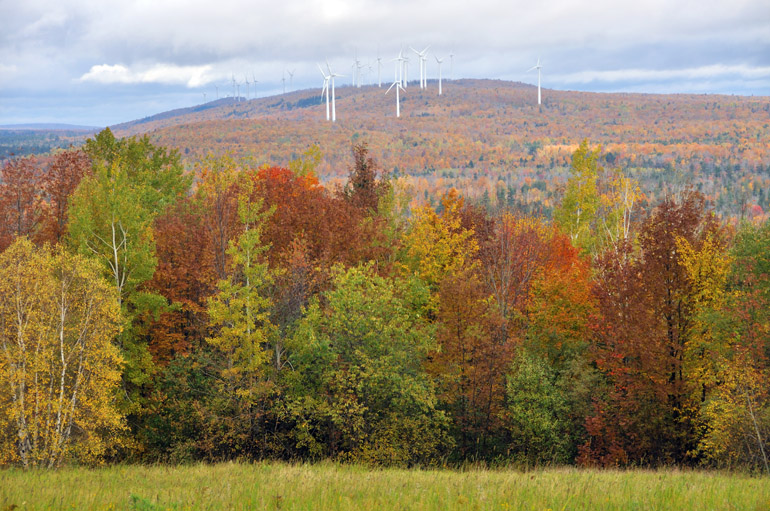
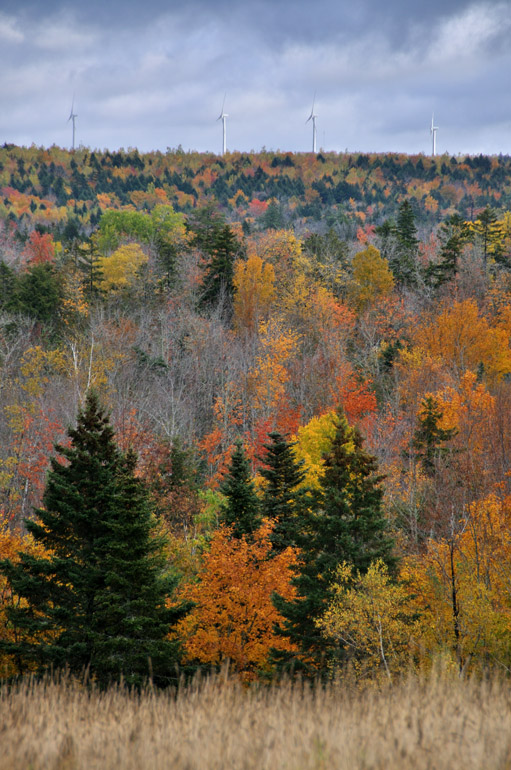
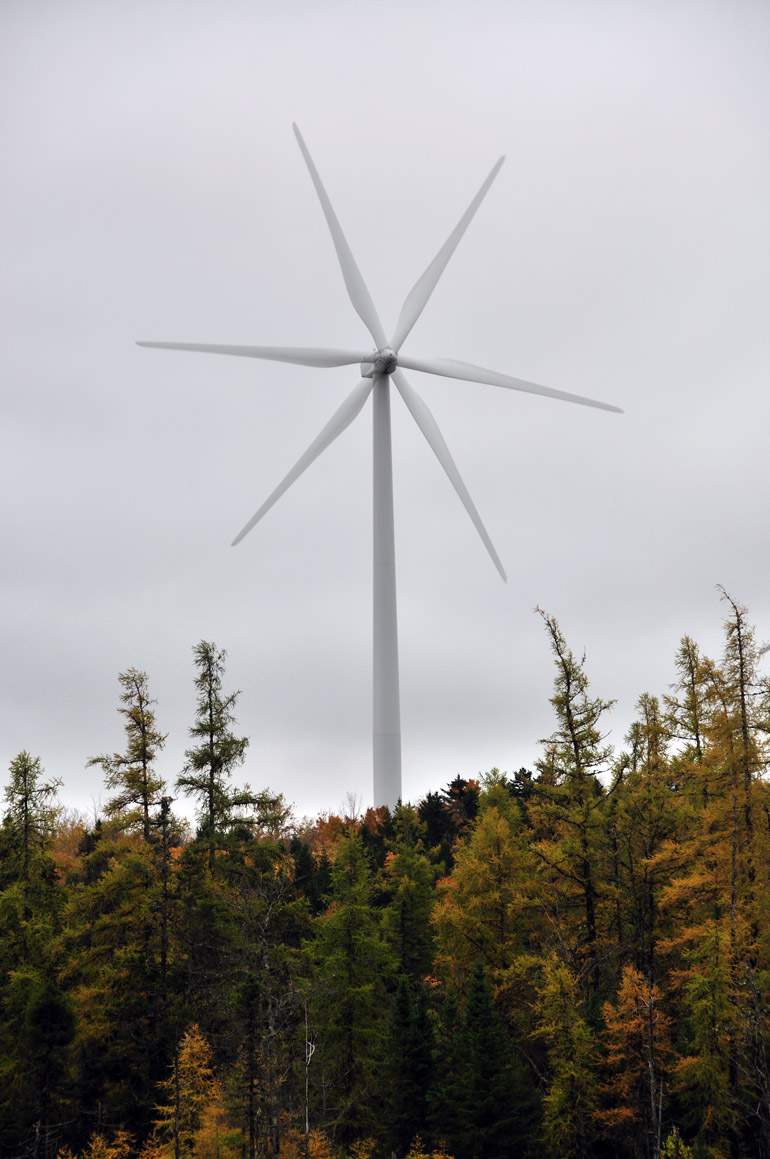
Along Route 6, near the border of Washington and Penobscot counties, is one of the first instances of a new trend in Maine: wind power. These windmills were constructed along a high ridge, called Stetson Mountain. Maine has harnessed wind power for years with the use of sailboats. But this new mode of energy generation has been met with some resistance, especially from hikers and environmentalists along the Appalachian Trail, who thought the windmills would mar the area's natural beauty. Personally, I think the windmills themselves are kind of attractive.

windmills_dark_0108
The wind had picked up considerably after we embarked on our journey, so these pinwheels were moving swiftly.

WindmillLapsed
This is the closest we got to the windmills. This shot is a composite of two separate images, showing the three blades in different positions. The photos were layered in Photoshop.

hill_road_0113
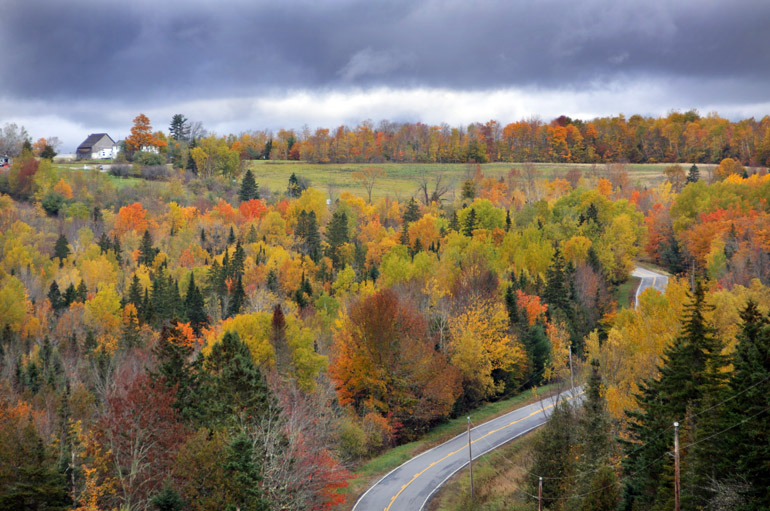
On a backwoods road off Route 6, a house on a distant hill caught my eye.

sign_0205
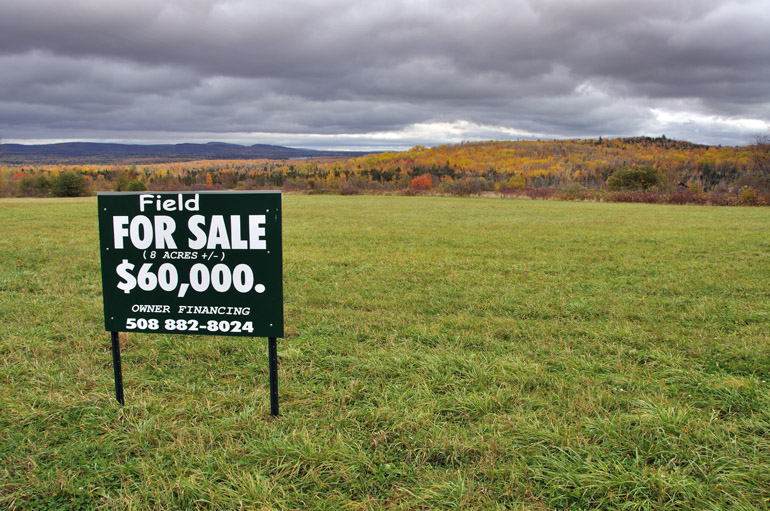
Even with real estate as defunct as it is in Florida, you still can't get a deal like this - or a view like this one.

yellow_field_0207
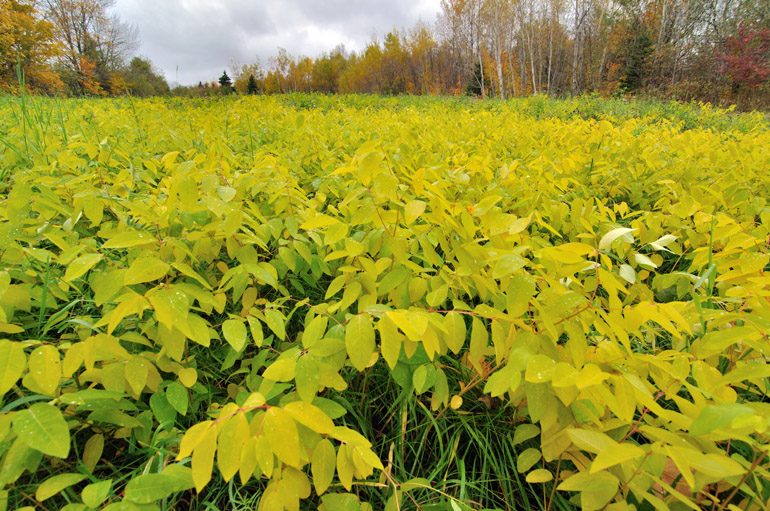
A field was covered in leafy bushes that were turning yellow.

parts_0212
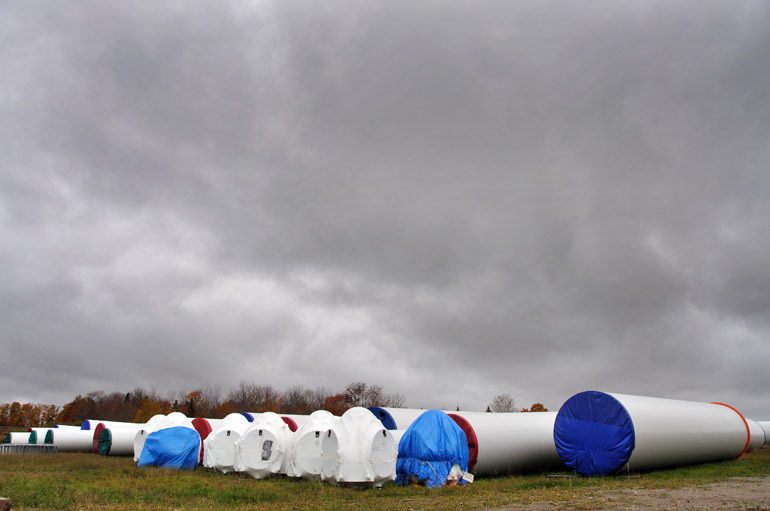
Along a road off Route 6, we ran into a storage field for windmill parts. The area was marked with "no trespassing" signs. I told my parents that I often trespass on private property to get photos. But they were having none of that, so I settled for a shot from the side of the road.

milliondollar_0150
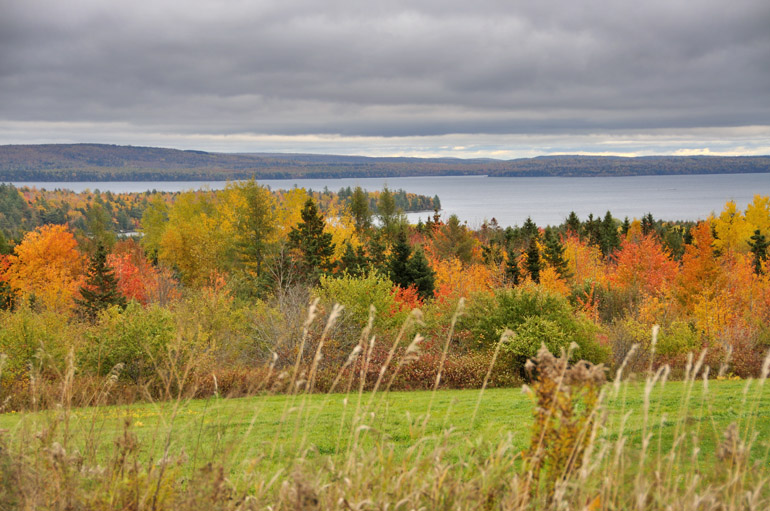
This was taken along the Million Dollar View Scenic Byway, an eight-mile stretch of U.S. 1 that looks eastward to New Brunswick, Canada. The lake is West Grand in northern Washington County, nicknamed the Sunshine County because it's the first in the United States to be graced by the sun's rays each day.

turkeys_0268
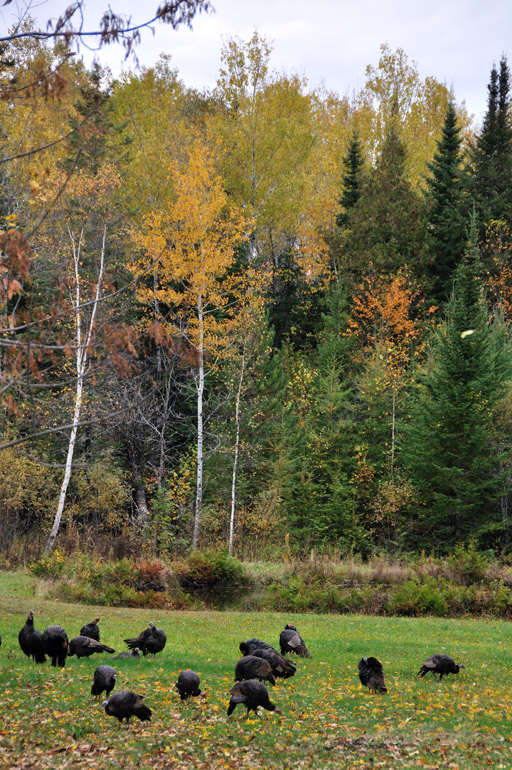
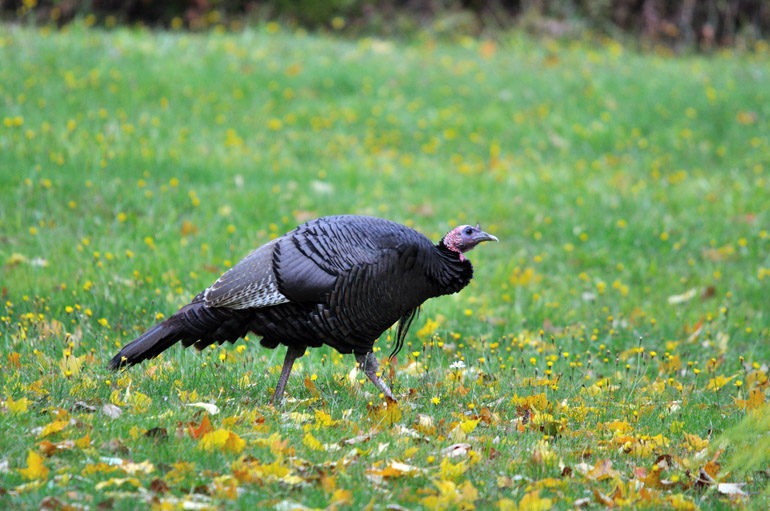
Wild turkeys are making a resurgence in eastern Maine. While he was driving, my father spotted these dozens grazing in someone's backyard (this photo doesn't show the whole group).

turkey_0283
My photography eventually made the turkeys rather anxious, and they scurried off.

milky_way_0329
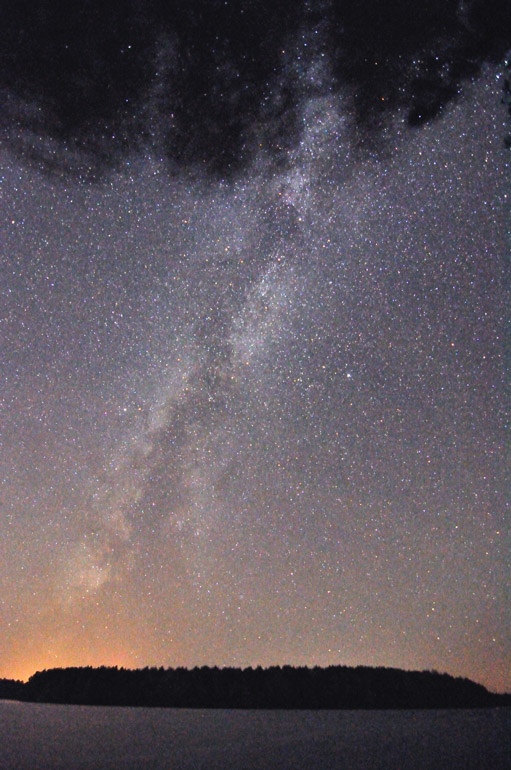
Back at home, after sunset, the sky cleared, and I took some exposures of the Milky Way Galaxy, something astronomers can't easily make out in most parts of Florida.

stars_above_0334
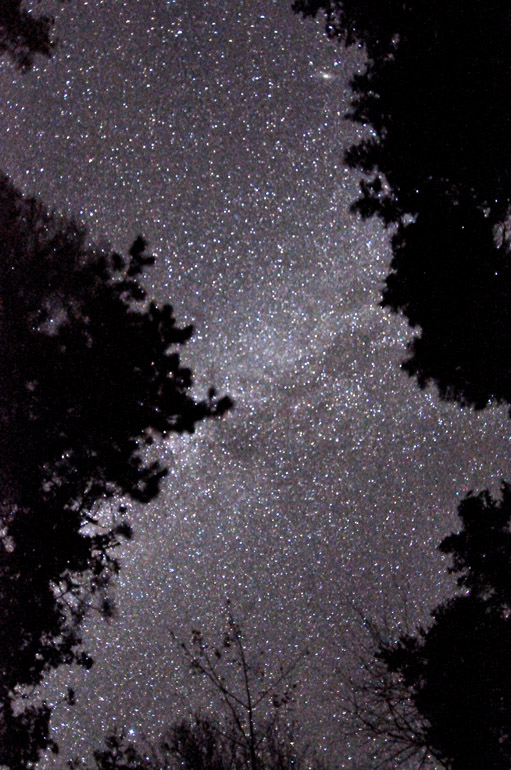
For this shot, the camera was pointed at a 90-degree angle upward, showing the stars and the treetops.

trails_above_0335
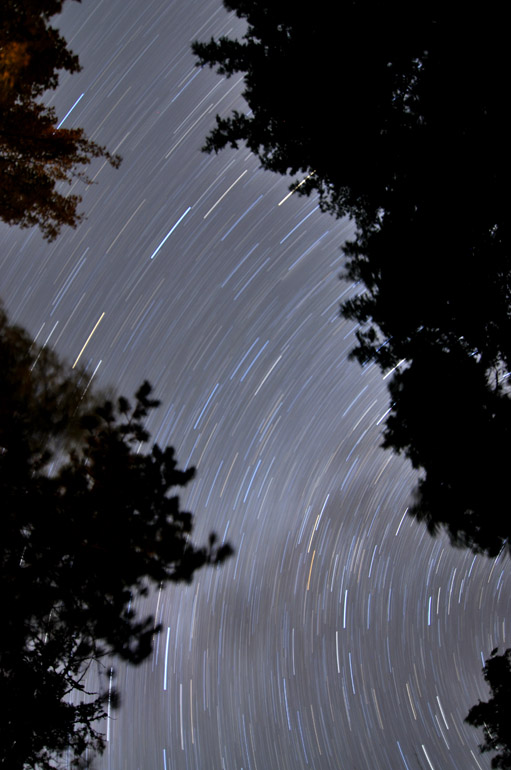
Here, the camera's shutter was open for its longest possible exposure: 30 minutes. It shows the circular trails of the stars as Earth spins on its axis.

Friday, August 21, 2009

Jupiter and none of its moons - and all that noise

jupiter_noise_0009
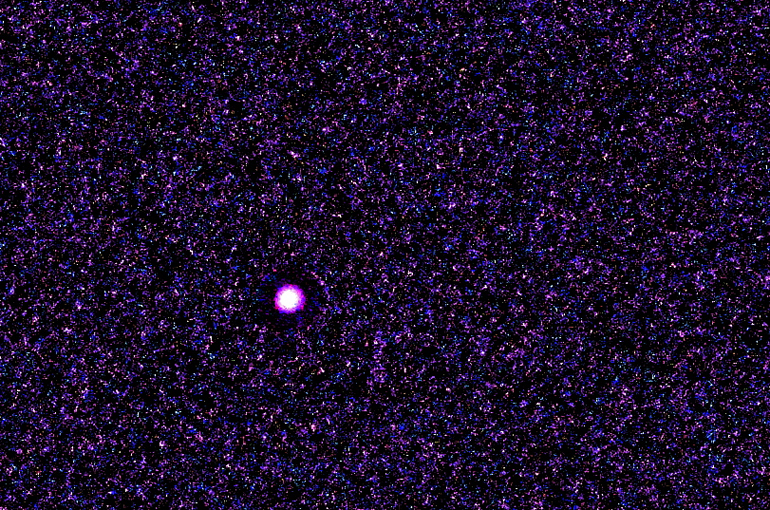
Jupiter and lots of purplish-pinkish light noise.


As I've mentioned before, astronomy and astrophotography aren't easy hobbies to execute when contending with the lights of Central Florida. Nevertheless, I try my best to glance at the heavens now and then, and to take photos of planets, satellites and shooting stars at times.

Last week, Jupiter was at its closest approach to Earth of the year, a great time for viewing the gas giant and four of its biggest moons: Io, Europa, Ganymede and Callisto. In addition, 2009 is a year of spectacular phenomena when it comes to Jupiter's 63 natural satellites. Tonight, for example, two of its moons will be seen from Earth in a 100 percent occultation, or when one passes directly in front of the other. Two others will rendezvous for a total lunar eclipse, or when one casts a shadow on another. More on that, including cool images, here.

(To find Jupiter, look slightly west of south most anytime of the night. It's the big bright thing in the sky. You can't miss it. For a sky chart and easy navigation instructions, visit and register for Sky & Telescope's interactive version here.)

Last night, the planet looked brilliant as I stepped out of my car after getting home from work. I quickly set up my tripod and made several exposures of Jupiter. But in none, however, were the four largest moons visible, a sight that should be achieved through even my 500mm lens. The light interference again got the best of me. I was disappointed.

Frustrated, I messed up one of the images in editing by boosting the exposure and saturation. That ended up highlighting the extreme noise in the photo that is achieved through the camera's high ISO, which was set at 2000. I ended up with one of those psychedelic posters that were so popular a decade ago.

I have asked myself for a telescope for Christmas, but I'm not getting my hopes up.

Friday, August 14, 2009

Oh, to catch a falling star: Light's a pain when shooting Perseids meteors

perseids_0349
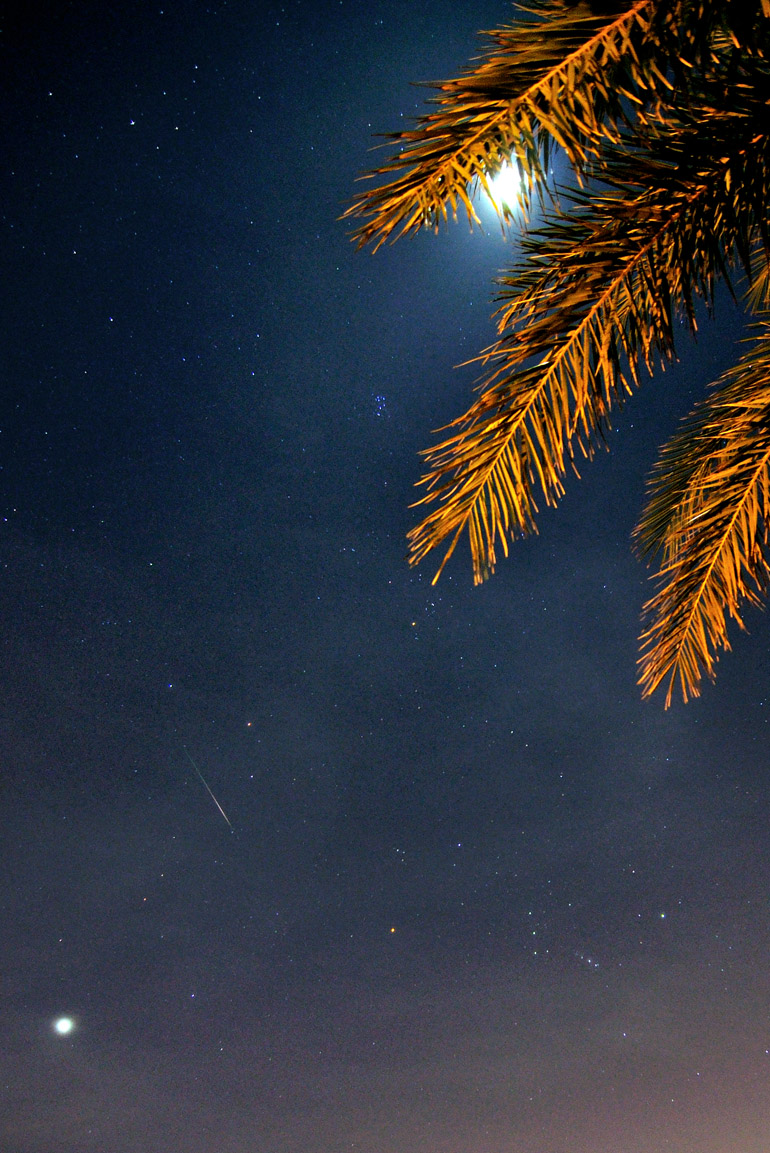
The moon's bright light was creating nasty lens flare, so I finally got the idea to use this palm tree as shade. That did the trick, effectively eliminating the artifacts my camera was picking up. Shot vertically, this photograph captures the moon at top and Venus in the lower left. The meteor, of course, is just to the right and slightly above the planet. I cropped out the horizon because of too much nasty, yellow artificial light from a senior center at Wickham Park in Melbourne. In general, the quality of this image is crap because of the light - and all the noise it adds.


Light at night is difficult to escape here on the Space Coast. The regional infrastructure is oriented from north to south, with few major roadways leading westward, into the more rural inland parts. For stargazers, artificial light obstructs the view of the heavens, and any venture to get away from it is time-consuming and, of course, gas-guzzling.

The peak period for viewing meteors in the Perseids shower came in the early half of this week. And the lights of Melbourne were my bane. With little spare time for seeing shooting stars this week, I settled for stepping outside my apartment when I had the chance. The brightest meteors, I knew, would be visible despite the glare.

I had been unsuccessful in my viewing attempts until early Wednesday morning, around 3, when a glance at the southeastern sky picked up a giant fireball streaking downward. It was the most brilliant one I had ever seen.

Knowing the shower was technically scheduled to peak before dawn Wednesday (despite the moon's light creating even more of a viewing problem after midnight), I thought that meteor was just the tip of the iceberg. So I grabbed my camera to try shooting a shooting star for the first time.

But meteors are the most difficult celestial phenomenon I have attempted to photograph. With such bright lights from the city, the exposure can't be long, and with relatively dim light from the meteors, the camera's aperture must be open wide in order to capture any of their light. In an area far from cities, the task would be considerably easier.

But in my case, I stood under the stars - the humidity wrapping itself around me and the mosquitoes sucking my blood as usual - and I snapped 421 shots, filling a 4-gigabyte memory card. For each image, the shutter was open for eight seconds. Any more, and they would have been overexposed.

All told, I managed four or five exposures with some sort of streak from a meteor. The above - taken at 5:46, more than an hour before sunrise - is probably the best. It's one of the few I shot vertically to capture both the moon and Venus, too.

None of them, however, live up to the hype created when I saw the giant fireball hours earlier. That's just how things work, though.

Friday, July 17, 2009

From the Archives | Comet Hale-Bopp and a lost ambition

Hale-Bopp 2
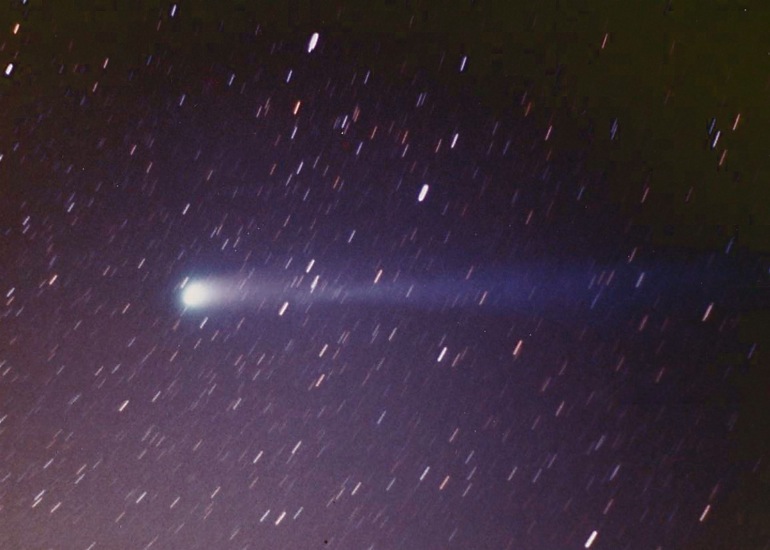
Comet Hale-Bopp, as seen in 1996 through the 50mm lens of my Pentax K1000 film camera.


ArchivesMonday's 40th anniversary of the Apollo 11 moon landing has prompted me to look back into the archives at a later celestial event, a naturally occurring one.

Remember this?

Comet Hale-Bopp was visible for much of 1996 and 1997 without any visual aid - except your eyes, of course. It passed about 122 million miles from Earth, close enough for a wide-angle lens, such as the one on my Pentax K1000, to pick it up. At the ripe age of 12, I took this long exposure featuring the dirty snowball rolling through space.

I was very interested in space and astronomy as a youngster. Living far from city lights in rural Maine made it easy to appreciate the vastness and beauty of what's beyond Earth's atmosphere.

To get even closer to what I saw in the night sky, my career ambition became an astronaut. The blue NASA flight suit that I wore during the early days of elementary school displayed that interest. Oddly enough, I don't remember getting teased for that. I should have, though.

Why I eventually chose journalism over science is beyond me.