
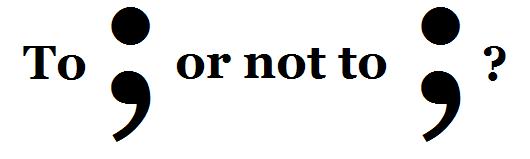
I read this article in The New York Times, and I can't decide which is better: the actual story or the correction appended. Take a look:
In a story about the inclusion of a certain punctuation between independent clauses, The Times commits a serious flub and omits a certain punctuation from the title of a certain book about proper punctuation. By leaving out the comma in "Eats, Shoots & Leaves," The Times subverts and simultaneously proves the modern-day conundrum of poor English at the center of the book's title. (The presence or absence of a comma distinguishes a cuddly panda that walks into a cafe and eats shoots and leaves, from a crazed panda that walks into a cafe and eats, shoots and leaves.)Semicolon sightings in the city are unusual but Neil Neches, a writer in the transit agency’s marketing and service information department, inserted one on a placard anyway.
As for the article's subject matter, I'm a semicolon detractor - only because most people can't use it properly, especially newspaper reporters. I fully support its informed use, but there are too many times it's used incorrectly when a more neglected punctuation - the period - would suffice. The run-on sentence is my pet peeve.
Where the heck did this statement come from anyway?
"In literature and journalism, not to mention in advertising, the semicolon has been largely jettisoned as a pretentious anachronism."
 Are you serious New York "Our Reporters Can Write Anything They Want Without Attribution" Times? I see proper and improper use of the "winking" piece of punctuation (as in the emoticon, left) each time I read the paper.
And though it's technically not wrong, I don't really agree with the semicolon's use in this particular example: "Please put it in a trash can; that's good news for everyone." The first sentence leads to the second, but they're not really related.
I also fault the grammar. The sentence conveys the action of moving something into something else; therefore, the preposition "into" instead of "in" should be used (semicolon is used correctly in previous sentence).
"Please put it into a trash can: That’s good news for everyone" is more like it.
I side with this guy:
"Allan M. Siegal, a longtime arbiter of New York Times style before retiring, opined, 'The semicolon is correct, though I’d have used a colon, which I think would be a bit more sophisticated in that sentence.'"I'm sure the co-arbiter of Times style, Bill Connolly (whom I met and received an autographed stylebook from while I was at Temple University), also would concur.
Frankly, I don't even like the "trash can" marketing line. It's not cute. It's not motivating. And it's somewhat degrading to newspapermen. Instead of saying "throw good journalism into the trash," I say, "Help a journalist and educate others: Leave your newspaper for the next commuter to read."
And by saying "educate others," I'm taking for granted that the newspaper has been properly copy edited.
Nice job.
ReplyDeleteThe only real problem I had with the subway sign is that it promotes throwing away the paper, rather than recycling it.
ReplyDelete~WN
That's exactly what I'm advocating. Well, somewhat. I'm more of a supporter of reusing the paper by leaving it for the next person to read.
ReplyDelete